Showing posts with label Canada West. Show all posts

Monday, March 16, 2015

The Sheep Advocate

"Sheep Farming in Canada
Taken from the Colonial Advocate, Thursday, June 3, 1824. Published by W. L. Mackenzie, Bookseller, Queenston, Upper Canada.

We were called on some business conected with our private affairs, to York, in the early part of May last, and wishing to take the head of lake Ontario in our way, on our journey home, we returned in that direction, and meeting with indifferent weather on Flamboro' mountain, we sent the innkeeper's boy back with the horses, and made up our mind to rest for the night, and enjoy the pleasure of a chat about local improvements, with our esteemed acquaintance, Mr Alexander Brown, of East Flamboro'. Disappointment is the lot of man, and so it fared with us, for Mr. Brown whose plain, sound, Scotch judgement, (as Mr. Wilberforce would call it) is held in much respect by his neighbours, was absent acting as umpire upon some dispute which had occured between two of them in regard to a property. Mrs. B. however, prepared a comfortable cup of tea, and when her husband resturned, we informed him that, next day we would desire his opinion on a subject, o which he was well qualified to give correct information, viz. The rearing of sheep. Accordingly, next morning we proposed our queries, nearly in the order in which they are now arranged. Mr. Brown's answers we give entire adding nothing, and we conceive their publication in every paper in the Colonies, would be a benefit conferred on the country. We will in future numbers, consider the Canada woolen manufacture; it is a most important branch of our domestic industry, even now; and, be it remembered, it is also the principal, and favourite manufacture of old England.
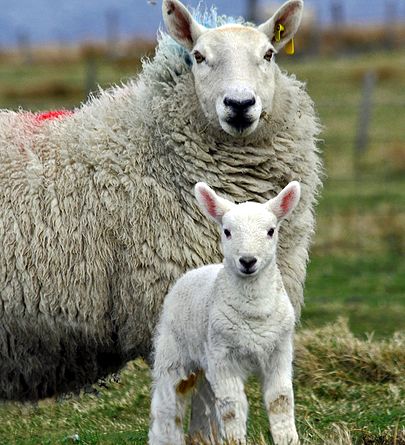
Cheviot ewe with lamb

Question 1. Do you improve your land by keeping sheep, or is it rendered poorer?

Answer. Sheep do not hurt a farm, the pasture need not be long if it is clear; sheep do well enough in summer, though kept on very indifferent pasture. I do not conceive from my experience that sheep improve a farm.

Question 2. What breed of sheep thrive best in Upper Canada?

Answer. I believe the common sheep of the country, the Cheviot breed do, but I would prefer the Liecestershire breed, if they could be easily kept, as being a much heavier sheep, and affording a much greater quantity of wool, and either I consider more advantageous than the full blooded merino. I have the full blooded merino, its wool is too fine, and does not suit the machinery in use in the country, neither will this sheep stand the winter like the Cheviot breed of sheep.

The merino breed crossed with the Cheviot, if kept carefully during the winter, are better adapted for this climate, and their wool being of an intermediate quality, between the former and the latter, is far better suited to our domestic manufacture.

Question 3. When should the rams be allowed to go to the ewes?

Answer. From my experience, not before the 15th or 24th of November, because the ewes if not very full in condition, will not nurse or attend their lambs. In this case, the lambing time will be from the 5th to the 24th of April, (a sheep going 5 months) and at this period, the season is becoming daily milder, so as not to chill the lambs, and there is generally grass enough come up to form a great proportion of sheeps' food. If the sheep lamb in February or March, we have little chance of succeding in saving the lambs, ten or eleven out of twelve die, the grass not being grown, and the weather being too cold.

Question 4. In your knowledge, and with good management, your ewes being sixty, and taking one year with another, how many lambs wil you have each season?

Answer. I should expect sixty lambs; some of the ewes will be barren, others will have two lambs, and perhaps a few lambs may die.

Question 5. What is your general method of managing flocks of sheep during the winter?

Answer. During the winter season, I keep my ewes of two years old and upwards, with my wethers, in a body apart by themselves, and give them plenty of good hay, but not red clover hay, which is not good for them. I have sheds for them at night; when the weather is stormy, and the snow deep, they are kept in these sheds in the day time; but only in such cases, as it is of the utmost importance to sheep to have freedom, when the weather renders it at all possible.

The sping lambs, and the wether sheep, I keep apart by themselves in a comfortable place, giving them, besides good hay, occasionally a little grain, oats, pease or maize are good, I do not think much of buck-wheat, but though I have not had much experience of oil-cake, I know that its mixture with wheat, or bran, will answer well. I give all my sheep salt, once a week, two quarts serve 100 sheep.

Question 6. Do you think it advantages to let the spring lambs breed the first year?

Answer. I do not. In small flocks it cannot be prevented, but I would advise, where large flocks are kept, that the lambs be weaned about the lasy of July, or beginning of August, and then kept seperated from the rest of the flock, until the following spring, and that in no case the rams be let amongst them. Sheep which are then prevented from bearing lambs the first year, become much better and stronger, they greatly improve the stock, &c by weaning the lambs as above. They are no worse, and it gives the ewe time to get in better order to stand our long winters.

Question 7. How ought sheep to be kept in the summer?

Answer. I should say, in the open field, or in a large space; sheep kept very close together at night, become unhealthy.

Question 8. Are sheep liable to many disorders in this country?

Answer. The worst disorder to which sheep are here liable, is cold; most commonly caused by over early shearing and washing. I disapprove of washing before shearing, in general, as it is made a frolic of; sheep are handled too roughly and are apt to get hurt. The best time for shearing, if the weather is not too cold, is early in June. I entirely disapprove of shearing at an earlier period. By this time the new wool is some grown, the sheep therefore can be easier shorn, and it will thereafter feel comfortable. An objection has been raised by many, that the new wool is shorn and intermixed with the old, and that my that means, the wool is injured in the carding machine. From my experience in this country, I can say that I have always shorn my sheep late, and that the carders have assured me that no better wool to work than mine has ever passed through their hands. I have had 15 years experience in Britain before  came to this country; and in the last five years before I emigrated, I aided and assisted in shearing 25,000 sheep, yet I never heard a complaint of this nature made. I know of no other disorder generally affecting sheep in Canada, unless sometimes blindness - The cure in this case is to let blood in a small vein in the hollow below the eye, and let the blood run into the eye.

Question 9. Do you think the risk in keeping sheep is so great here as in Britain?

Answer. I should say, no. As regards disorders, there are much fewer natural deaths; the risk in winter is less. But wolves, though unknown in Britain, are very destructive to flocks in most places in this province, I conceive the bounty offered for their destruction to be a measure of general utility. There is little risk of losing sheep in winter, if they are duly attended to.

Question 10. Have you any other remark of importance to make concerning the improvement of sheep?

Answer. To improve the stock, I would draw off some of my oldest ewes and weakest lambs and dispose of them to some one having a smaller stock who could tend them better. The old ewes may be known by looking in their mouths to see if all their teeth are in good order. If any of the teeth are lost, or become very long and sharp, I would put them away, unless in a rare instance of a very good ewe. In all stocks, change the rams occasionally.

Question 11. You have, doubtless, from your long experience, a correct idea of the profits to be derived from the keeping of sheep flocks; state your opinion on the subject?

Answer. I average about 3 lbs of wool yearly from each sheep. The expense of keeping sheep, taking one with another throughout the year, I calculate at about a dollar a head. Ewes will do to keep 9 or 10 years, or till their mouths get very bad, so as that they cannot eat; but wethers, if they are fat, should be killed at 4 or 5 years, as they never will be so good food after that age. Even at the price which wool now fetches in the best settled part of the province, I should say that it would pay the expenses and risk of keeping the sheep. By keeping on the stock of wether lambs, and selling the old wethers fat in the spring or early in the summer at 4 or 5 years, there is a profit; 5 or 6 dollars has in many cases been paid, (the fleece being on;) the average price is about a guinea.

In a flock of 100 sheep, and allowing for all accidents, I should suppose 40 lambs to be the increase yearly; Iike enough a half would prove to be rams - Twenty wethers could thus be sold every year, and the stock would still be on the increase. This gives a profit of twenty guineas, besides an increase of twenty ewe lambs in one year, after paying all expenses and trouble. The profit is indeed much greater than this, but I have conceived it best to be under, rather than over the truth. I think that sheep are the most profitable stock a farmer can keep in this country, for such as have farms that will permit the keeping of them."

We informed Mr. Brown that we would publish his observations in an early paper, to which he agreed; indeed, we have made it a rule that what we obtain of information, in private, we never shall make public, using our informant's name, without his consent. We now took our leave of this worthy and opulent farmer and his family, and descended the mountain, fully enjoying the beautiful, interesting, and varied scenery, which the grand amphitheatre around Burlington Bay presents, thinking, all the while, upon the bonny highland hills, sheep cots, and green knowes of our native Scotland, and lifting merrily one of those songs of the inimitable Ramsay, which we had first heard sung amidst the echoes of our native glens and heather mountains, (and which our readers, if in cheerful mood, may find the pretty pastoral, "the Gentle Shepherd.") We soon reached the valley by the narrow craggy road least travelled, and in rather better than an hour found ourselves in the busy little village of Coote's Paradise, better know by its other name, Dundas."

Thursday, March 12, 2015

Wool in the 19th Century - Part Two

Dyeing wool is a step that can take place either before or after the actual spinning process.  Early settlers in Ontario were dyeing their wool predominately to hide the dirt and filth on their clothes from their intense agricultural work.  They may not necessarily have an abundance of clothing, so to dye their one or two dresses brown would make going to church on Sundays less embarrassing because any dirt would be less noticeable.

Skeins of black walnut dyed wool
One of the most popular local dyes used in Ontario is mad from the shell of a black walnut.  Black walnut trees are native to Ontario.  In fact, many of the Pennsylvania-Dutch settlers that arrived in Ontario c.1790s-1830s believed black walnut trees to be a sign of fertility of the land, and would make their settlements near any growth.  This theory is explained in The Trail of the Black Walnut by G. Elmore Reaman, where the migration of the Pennsylvanian-Dutch from American to early Canada can be traced by the growth of black walnut trees throughout southern Ontario.  The black walnut itself can make a fantastic, and very intense, brown.  Perfect for masking any dirt!  After boiling the shells in hot water, you strain the water, and place the wool in the dye bath.  After sitting for just a few hours, you can get a fantastic brown dyed fabric!

This three-part series "Wool in the 19th Century" was written by Caroline Bendiner, Culture Coordinator for the Township of King.  She has a BA in history from Queen's University and a post graduate certificate in Cultural Site Management from Centennial College. Caroline has a strong passion for history and sharing history with the public.

Thursday, February 26, 2015

Special Announcement!

http://www.scottish-blackface.co.uk/
Scottish Blackface Sheep
Each post during the month of March will be dedicated to sheep in Upper Canada/Canada West - who kept them, how many, which breeds were preferred, and of course their many uses.

Why sheep? Why not?

As a special bonus this month I've teamed up with fellow colleague and wool aficionado Caroline Bendiner. She's prepared guest blog posts on early 19th century methods of turning fleece into wool, as well as where you can see these methods being used today.

For March there will also be a number of extra posts related to sheep facts. Never again will you come face to face with an Ovis aries and not know that while it may have four stomachs, it has no top front teeth.

Don't forget to check back often, and of course feel free to comment - let's show our guest blogger some love!

Thursday, December 18, 2014

Curling

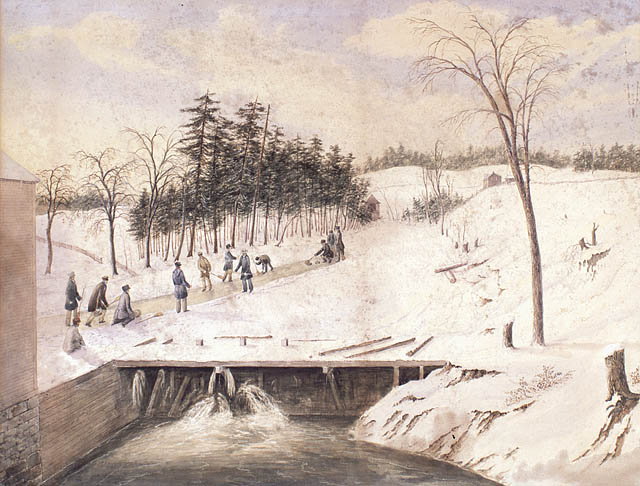
Curling was a popular winter sport brought over to Canada by early Scottish settlers. Many settlements in Upper Canada had their own curling clubs, some of which exist to this day. Below is a wonderfully bucolic scene of a curling match in Toronto, circa 1836.

http://www.collectionscanada.gc.ca/pam_archives/public_mikan/index.php?fuseaction=genitem.displayItem&lang=eng&rec_nbr=2837821
Curling on the Don River, Toronto, Watercolour c. 1836, Artist Unknown
Library and Archives Canada
Sources
Library and Archives Canada 2014, "Curling into Canada"
Galt Curling Club 2014, "History of the Galt Curling Club, 175 years and going strong"
Nancy B. Bouchier's 2003 For the Love of the Game

Further Reading
Canadian Curling Association 2014, "History or Curling"

Thursday, November 20, 2014

Lands in Upper Canada

Clicking on the image below with enable you to zoom in on this advertisement for settlement, printed in 1835 in London, England.
http://static.torontopubliclibrary.ca/da/pdfs/ohq-ephe-c-w-89.pdf

Some excerpts from the advertisement include:

"The ordinary baggage of Emigrants consists of their wearing apparel, with such bedding, and utensils for cooking, as may be required on the voyage, and any articles of clothing, not intended to be used at sea, ought to be packed in water-tight cases or trunks, not exceeding eighty or ninety pounds in weight."

"The class of persons chiefly required in Upper Canada, and who, of course, will find it best suited to their purposes, are small Capitalists, Farmers, Mechanics, and Labourers."

Sources
Toronto Public Library Digital Archive 2014, "Lands in Upper Canada"

Thursday, October 23, 2014

The Credit, Barter, and Three-Way Systems of Payment

Let's pretend you're living with your family in Upper Canada in the first half of the nineteenth century. You own a productive farm, and keep sheep and chickens in addition to various crops such as apples, wheat, and barley. Life is good - you have everything you need. One day while in the village, you pass by the General Store and lo and behold there's a window full of things you want: Fabrics for making new clothes for the family, spices to make just about everything taste better, and tools that will make farm work easier. Remember, life is good, and you decide to head in to the store. After a few of your items have been wrapped in paper, the shopkeeper gives you the total. How are you going to pay for these luxuries? 

Responding to the needs of their customers, and accepting of the fact that currency was scarce in most rural communities, shopkeepers offered many of their goods on credit. (Fraser, 86) The prices of purchased goods were noted in an account book (ledger) or on a bill.  From time to time, most customers paid all or part of that bill by service, cash or trade.  In order for the credit-based system to work, not only did the customers have to be honest, trustworthy and able to pay off their debts in a timely fashion, but the shop owner had to be equally as honest, trustworthy, and able to bear the various debts of often an entire village.  In many cases, the shop owner was a man in good circumstances and was able to wait until sales of crops or livestock enabled farmers to pay for items purchased throughout the year.


Crysler's Store, Upper Canada Village
Morriston Ontario
A shop could quite easily fail due to bad debts, or the inability of the store owner to collect in a timely manner.  Collection of debts could be tricky for the shop owner.  If he came on too strong, he would lose the customer (and the money). If he was too lenient, he might end up out of business, unable to pay his own debts. Opening a store where family and neighbourly ties are stronger was an effective way to stay in business.  By knowing his customers on a more intimate level, the credit system had a better chance of succeeding. (Fleming, 141) The shop owner could appeal to his friends (who presumably wished him to succeed) to pay off their debts, and could visit them with a kindly reminder when they did not.  Knowing your customers had another advantage, for it allowed the shop owner to “avoid sales to those who would not pay, and to increase sales, especially of goods that carried the highest mark-up, to those most likely to pay”. (McCalla, 401)


There were a number of ways in which a family or individual could repay the store owner for items purchased on credit.  The three most popular methods include payment through service or labour; delayed payment using cash, or payment through trade.  Payment through service or labour included for example, splitting and piling wood for the shop owner, lending the shop owner a horse or ox for a project, or lending skills such as blacksmithing, etc. (Fleming, 127-129) Payment using cash occurred whenever the family or individual had some to spare – usually in the fall of each year, after the “threshing” or the “killing”. (Sherck) It was also not uncommon for the shop owner to institute a monthly collection whereby accounts were required to be settled by the end of each calendar month.

Some debts could be repaid by trading in chickens, eggs, or butter.  In October 1861, James Watson, a shop owner in Lindsay advertised through the local newspaper that he would accept “all kinds of country produce” as payment. (Fleming, 26) A Manilla shop owner, Adam Gordon, also advertised that he would purchase “Wheat, Pork, and other farm produce, at the Highest Market Prices”. (Fleming, 26) Payment through trade was extremely common, but must not be confused with pure bartering.  Each object (usually by weight) had a dollar amount attached to it, and customers did not, for example, simply trade eggs for tea.  Every transaction was entered into the ledgers, and one dollar’s worth of tea must be offset by at least one dollar’s worth of eggs.

There were also many instances where arrangements were made between businesses which allowed for labourers to be paid in credit to the local general store or to a trade, eliminating the need for workers to handle cash:  “Every builder or contractor made an arrangement with the various trades and stores for a line of credit, by which they could pay their workman as much of their wages as possible with the smallest amount of cash.” (Guillet, 240) Worker’s wives would then go and pick up items from the store as needed without the requirement for currency to exchange hands.  The items purchased would simply be deducted from the credit provided by the employer. Likewise, the Three-Way System involved little to no exchange of money.  For example “In Glencarin, Ontario (west of Barrie), millworkers paid for their laundry indirectly. Storekeeper and mill owner M.N. Stephens would deduct a dollar or two from wages and enter that amount as a credit on the laundry woman’s account”. (Fleming, 138)

General Store Interior, Black Creek Pioneer Village
Toronto, Ontario
As communities grew, and the connections between shop owner and neighbour became more distant, the need for payment upfront and in cash increased.  Additionally, the amount of individuals travelling through the province and purchasing goods was also rising.  Itinerant purchasers could little be expected to be tracked down if they did not live in the area, and so they too were expected to pay in cash.  As the cost of some goods also increased, so too did the debts of the shop owners. (Fraser, 90) Eventually, the general store moved away from the credit, trade, and Three-Way systems and adopted the more streamlined cash system.


Sources
W. Hamish Fraser's 1981 The Coming of the Mass Market,1850-1914
Michael Gonder Scherck's 1905 Early Pioneer Life in Upper Canada. 
Edwin C. Guillet's 1934 Toronto, from Trading Post to Great City. 
McCalla, Douglas. “Retailing in the Countryside: Upper Canadian General Stores in the Mid-Nineteenth Century”. In Business and Economic History, Winter 1997; 26, 2. Pages 393-403.

Thursday, June 19, 2014

What's in a Name? History

Many are familiar with the place names listed below, but are unaware that each denotes a very specific period in the history of the province of Ontario.

Pays d'en Haut (1500s-1763) From initial discovery to France's loss to the English in the Seven Years' War, Ontario was a wilderness region of New France referred to as "the upper country".

Quebec (1763-1791) After the Treaty of Paris in 1763, the British crown took over New France, named it Quebec, and included the large colony into it's already substantial North American holdings.

Upper Canada (1791-1841) The American Revolution, ending in 1883, encouraged thousands of loyalists to move north to Quebec (which remained a part of the Crown). With this new influx of settlers came a demand for English laws and government - as opposed to the French civil system still in operation in the colony. The Constitution Act of 1791 divided Quebec into Upper and Lower Canada, and provided Upper Canadians with their own Lieutenant Governor and legal system.

Canada West (1841-1867) Upper and Lower Canada were rejoined in 1841 as the Province of Canada in a political and cultural attempt to overpower the then dominant French population (as well as any potential rebels on both sides). Although the province was now unified, each region remained distinct as Canada West, and Canada East.

Ontario (1867- ) With Confederation came yet another separation as the Province of Canada was divided into roughly the Ontario and Quebec we know today. Ontario's borders were finally established to the north and west by 1912.
Maps depicting borders in 1774 and 1791
Maps depicting borders in 1867 and 1912
Name changes also apply to the smaller scale of villages and cities:

Shade's Mills (1816-1827) Named after Absalom Shade who was hired by founder William Dickson to manage and superintend the new settlement in Dumfries. Shade quickly established a saw and grist mill as well as a shop and home for himself and his family.

Galt (1827-1973) For many settlements, the establishment of a post office is a big deal. It's an opportunity to put your name on the map (and subsequently make it easier for everyone to find you and do business with you). Many settlements stick with the name they've started with, while others take this opportunity to change theirs to something else.* William Dickson decided to change the name of Shade's Mills to Galt after Scottish poet and friend, John Galt.

Cambridge (1973- ) In 1973 the city of Galt, the towns of Preston and Hespeler, and the hamlet of Blair amalgamated to become Cambridge.

*Some communities didn't have a choice in the matter once they realized that they share the same name as another settlement that already received a post office. You can't have two Burwick, Canada Wests: So the community just north of what is now Toronto changed their name to Woodbridge in 1855.

Sources
Dictionary of Canadian Biography, 2014 "Absalom Shade"
Archives of Ontario, 2011 "The Changing Shape of Ontario" (Economic Atlas of Ontario / Atlas Économique de l'OntarioW. G. Dean, Editor/ Directeur; G. J. Mathews, Cartographer/ CartographePrinted 1969 by University of Toronto Press for the Government of Ontario)
City of Vaughan, "A Brief History of Woodbridge"

Further Reading
Canadian Encyclopedia, "Seven Years' War"
Canadian Encyclopedia, "Durham Report"
Canadian Museum of History, 2014 "Virtual Museum of New France"