Showing posts with label Cambridge. Show all posts

Thursday, April 30, 2015

Mr. Dickson's House

View of Galt, Ontario, including Scotch church and Mr. Dixon's House
Drawing by Alice E. Brown in 1857, Currently a part of the Archives of Ontario collection
Sources
Archives of Ontario, 2014 "View of Galt..."
James Young's 1880, Reminiscences of the early history of Galt
First United Church, Cambridge "About Us"

Further Reading
Lucille H. Campey's 2005, The Scottish Pioneers of Upper Canada, 1784-1855: Glengarry and Beyond

Thursday, April 16, 2015

Pipes, Guitar, and Flute, Oh My!

With the warmer weather upon us (finally!), it's time to venture out and experience another season of festivals, events, and games in Ontario. Many of these gatherings are a great opportunity to experience and learn more about the Scottish traditions which remain vital to many communities. What can be more Scottish than bagpipes?

Thursday, April 23, 2015 starting at 7:00pm
McDougall Cottage, Cambridge
Tel: 519-624-8250
89 Grande Ave S.
N1S 2L7

New performer. Join multi-talented musician Mark Fletcher for a fabulous evening of traditional Scottish fiddle music and song. Mark performs small pipes, mandola, guitar, flute, whistles and Highland pipes. He is joined by fellow performer Drew Skuce (bodhran) for a fantastic evening of Scottish tunes. Music spanning 4 centuries, from both the Scottish Borders and the Highlands will be featured; some linked to history and historical figures and some just for the fun of the music. www.markfletcher.ca.

Admission by cash donation.

Thursday, April 9, 2015

All Aboard!

This image has nothing overtly to do with early settlement and Scottish culture, but it caught my attention enough that I thought it worth sharing. I love coming across images of home from different periods and perspectives. Galt at the start of the 20th century was absolutely bursting with potential and promise - all aboard!

Galt, Preston and Hespeler Street Railway, 1903
Sources
Waterloo Public Library, "Galt, Preston and Hespeler Street Railway"

Further Reading
Kitchener-Waterloo Street Railway 2007, "A History..."
TheRecord.com March 27, 2015 "Century-old streetcar line found under LRT construction"
The Globe and Mail 2010, "No desire for this Waterloo streetcar"
CBC February 25, 2015 "LRT construction set to close King Street in Kitchener in March"

Monday, March 16, 2015

The Sheep Advocate

"Sheep Farming in Canada
Taken from the Colonial Advocate, Thursday, June 3, 1824. Published by W. L. Mackenzie, Bookseller, Queenston, Upper Canada.

We were called on some business conected with our private affairs, to York, in the early part of May last, and wishing to take the head of lake Ontario in our way, on our journey home, we returned in that direction, and meeting with indifferent weather on Flamboro' mountain, we sent the innkeeper's boy back with the horses, and made up our mind to rest for the night, and enjoy the pleasure of a chat about local improvements, with our esteemed acquaintance, Mr Alexander Brown, of East Flamboro'. Disappointment is the lot of man, and so it fared with us, for Mr. Brown whose plain, sound, Scotch judgement, (as Mr. Wilberforce would call it) is held in much respect by his neighbours, was absent acting as umpire upon some dispute which had occured between two of them in regard to a property. Mrs. B. however, prepared a comfortable cup of tea, and when her husband resturned, we informed him that, next day we would desire his opinion on a subject, o which he was well qualified to give correct information, viz. The rearing of sheep. Accordingly, next morning we proposed our queries, nearly in the order in which they are now arranged. Mr. Brown's answers we give entire adding nothing, and we conceive their publication in every paper in the Colonies, would be a benefit conferred on the country. We will in future numbers, consider the Canada woolen manufacture; it is a most important branch of our domestic industry, even now; and, be it remembered, it is also the principal, and favourite manufacture of old England.
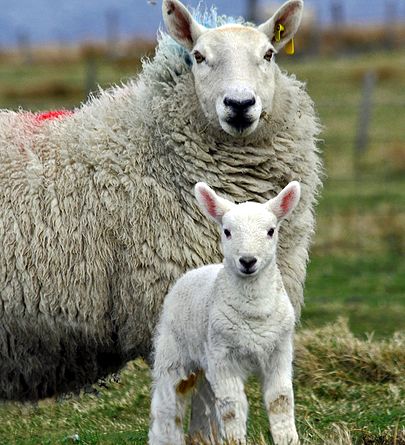
Cheviot ewe with lamb

Question 1. Do you improve your land by keeping sheep, or is it rendered poorer?

Answer. Sheep do not hurt a farm, the pasture need not be long if it is clear; sheep do well enough in summer, though kept on very indifferent pasture. I do not conceive from my experience that sheep improve a farm.

Question 2. What breed of sheep thrive best in Upper Canada?

Answer. I believe the common sheep of the country, the Cheviot breed do, but I would prefer the Liecestershire breed, if they could be easily kept, as being a much heavier sheep, and affording a much greater quantity of wool, and either I consider more advantageous than the full blooded merino. I have the full blooded merino, its wool is too fine, and does not suit the machinery in use in the country, neither will this sheep stand the winter like the Cheviot breed of sheep.

The merino breed crossed with the Cheviot, if kept carefully during the winter, are better adapted for this climate, and their wool being of an intermediate quality, between the former and the latter, is far better suited to our domestic manufacture.

Question 3. When should the rams be allowed to go to the ewes?

Answer. From my experience, not before the 15th or 24th of November, because the ewes if not very full in condition, will not nurse or attend their lambs. In this case, the lambing time will be from the 5th to the 24th of April, (a sheep going 5 months) and at this period, the season is becoming daily milder, so as not to chill the lambs, and there is generally grass enough come up to form a great proportion of sheeps' food. If the sheep lamb in February or March, we have little chance of succeding in saving the lambs, ten or eleven out of twelve die, the grass not being grown, and the weather being too cold.

Question 4. In your knowledge, and with good management, your ewes being sixty, and taking one year with another, how many lambs wil you have each season?

Answer. I should expect sixty lambs; some of the ewes will be barren, others will have two lambs, and perhaps a few lambs may die.

Question 5. What is your general method of managing flocks of sheep during the winter?

Answer. During the winter season, I keep my ewes of two years old and upwards, with my wethers, in a body apart by themselves, and give them plenty of good hay, but not red clover hay, which is not good for them. I have sheds for them at night; when the weather is stormy, and the snow deep, they are kept in these sheds in the day time; but only in such cases, as it is of the utmost importance to sheep to have freedom, when the weather renders it at all possible.

The sping lambs, and the wether sheep, I keep apart by themselves in a comfortable place, giving them, besides good hay, occasionally a little grain, oats, pease or maize are good, I do not think much of buck-wheat, but though I have not had much experience of oil-cake, I know that its mixture with wheat, or bran, will answer well. I give all my sheep salt, once a week, two quarts serve 100 sheep.

Question 6. Do you think it advantages to let the spring lambs breed the first year?

Answer. I do not. In small flocks it cannot be prevented, but I would advise, where large flocks are kept, that the lambs be weaned about the lasy of July, or beginning of August, and then kept seperated from the rest of the flock, until the following spring, and that in no case the rams be let amongst them. Sheep which are then prevented from bearing lambs the first year, become much better and stronger, they greatly improve the stock, &c by weaning the lambs as above. They are no worse, and it gives the ewe time to get in better order to stand our long winters.

Question 7. How ought sheep to be kept in the summer?

Answer. I should say, in the open field, or in a large space; sheep kept very close together at night, become unhealthy.

Question 8. Are sheep liable to many disorders in this country?

Answer. The worst disorder to which sheep are here liable, is cold; most commonly caused by over early shearing and washing. I disapprove of washing before shearing, in general, as it is made a frolic of; sheep are handled too roughly and are apt to get hurt. The best time for shearing, if the weather is not too cold, is early in June. I entirely disapprove of shearing at an earlier period. By this time the new wool is some grown, the sheep therefore can be easier shorn, and it will thereafter feel comfortable. An objection has been raised by many, that the new wool is shorn and intermixed with the old, and that my that means, the wool is injured in the carding machine. From my experience in this country, I can say that I have always shorn my sheep late, and that the carders have assured me that no better wool to work than mine has ever passed through their hands. I have had 15 years experience in Britain before  came to this country; and in the last five years before I emigrated, I aided and assisted in shearing 25,000 sheep, yet I never heard a complaint of this nature made. I know of no other disorder generally affecting sheep in Canada, unless sometimes blindness - The cure in this case is to let blood in a small vein in the hollow below the eye, and let the blood run into the eye.

Question 9. Do you think the risk in keeping sheep is so great here as in Britain?

Answer. I should say, no. As regards disorders, there are much fewer natural deaths; the risk in winter is less. But wolves, though unknown in Britain, are very destructive to flocks in most places in this province, I conceive the bounty offered for their destruction to be a measure of general utility. There is little risk of losing sheep in winter, if they are duly attended to.

Question 10. Have you any other remark of importance to make concerning the improvement of sheep?

Answer. To improve the stock, I would draw off some of my oldest ewes and weakest lambs and dispose of them to some one having a smaller stock who could tend them better. The old ewes may be known by looking in their mouths to see if all their teeth are in good order. If any of the teeth are lost, or become very long and sharp, I would put them away, unless in a rare instance of a very good ewe. In all stocks, change the rams occasionally.

Question 11. You have, doubtless, from your long experience, a correct idea of the profits to be derived from the keeping of sheep flocks; state your opinion on the subject?

Answer. I average about 3 lbs of wool yearly from each sheep. The expense of keeping sheep, taking one with another throughout the year, I calculate at about a dollar a head. Ewes will do to keep 9 or 10 years, or till their mouths get very bad, so as that they cannot eat; but wethers, if they are fat, should be killed at 4 or 5 years, as they never will be so good food after that age. Even at the price which wool now fetches in the best settled part of the province, I should say that it would pay the expenses and risk of keeping the sheep. By keeping on the stock of wether lambs, and selling the old wethers fat in the spring or early in the summer at 4 or 5 years, there is a profit; 5 or 6 dollars has in many cases been paid, (the fleece being on;) the average price is about a guinea.

In a flock of 100 sheep, and allowing for all accidents, I should suppose 40 lambs to be the increase yearly; Iike enough a half would prove to be rams - Twenty wethers could thus be sold every year, and the stock would still be on the increase. This gives a profit of twenty guineas, besides an increase of twenty ewe lambs in one year, after paying all expenses and trouble. The profit is indeed much greater than this, but I have conceived it best to be under, rather than over the truth. I think that sheep are the most profitable stock a farmer can keep in this country, for such as have farms that will permit the keeping of them."

We informed Mr. Brown that we would publish his observations in an early paper, to which he agreed; indeed, we have made it a rule that what we obtain of information, in private, we never shall make public, using our informant's name, without his consent. We now took our leave of this worthy and opulent farmer and his family, and descended the mountain, fully enjoying the beautiful, interesting, and varied scenery, which the grand amphitheatre around Burlington Bay presents, thinking, all the while, upon the bonny highland hills, sheep cots, and green knowes of our native Scotland, and lifting merrily one of those songs of the inimitable Ramsay, which we had first heard sung amidst the echoes of our native glens and heather mountains, (and which our readers, if in cheerful mood, may find the pretty pastoral, "the Gentle Shepherd.") We soon reached the valley by the narrow craggy road least travelled, and in rather better than an hour found ourselves in the busy little village of Coote's Paradise, better know by its other name, Dundas."

Thursday, February 26, 2015

Special Announcement!

http://www.scottish-blackface.co.uk/
Scottish Blackface Sheep
Each post during the month of March will be dedicated to sheep in Upper Canada/Canada West - who kept them, how many, which breeds were preferred, and of course their many uses.

Why sheep? Why not?

As a special bonus this month I've teamed up with fellow colleague and wool aficionado Caroline Bendiner. She's prepared guest blog posts on early 19th century methods of turning fleece into wool, as well as where you can see these methods being used today.

For March there will also be a number of extra posts related to sheep facts. Never again will you come face to face with an Ovis aries and not know that while it may have four stomachs, it has no top front teeth.

Don't forget to check back often, and of course feel free to comment - let's show our guest blogger some love!

Thursday, February 19, 2015

It Takes a Village

A census is a wonderful tool for looking back at a population at a particular point in time. What were their names? Where did they come from? What did they do to get by? While census data is often bare-bones and provides the most basic facts, it can help us to understand a community and create a framework that can later be filled in by other source material.

In 1851 a census was completed for Galt, which included information on its 2,246 residents: Name, Place of birth; Religion; Occupation; Age; Marriage status; etc. If you've ever wondered what you might do for a living in a small Victorian village, take a look at the graph I've compiled below. Not every census taker had an occupation listed, and I have a sneaking suspicion that there were in fact more farmers... but this information, though incomplete, is eye-opening. You can check out the rest of the census in an easy to read PDF document here.


You do what exactly? Well, a Spinster is an unmarried (and not likely to become married) woman. She might be living and looking after the welfare of older relatives, or living with and looking after the education of nieces and nephews. Coopers are makers and repairers of casks and barrels. A Teamster is someone who drives a team of draft animals and a wagon. You can think of them as the equivalent of transport truck drivers today. Sadlers make, sell and.or repair saddlery. A Mill Wright is someone who builds and maintains mills and their internal machinery. Cordwainers are actually shoemakers who work with cordovan leather. Fleshers flesh hides and skins and tan them in the production of leather. They may also sell meat - in other words, a butcher. Pedlers are travelling salesmen, often going from door to door to trade and sell any number of items. Lime Burners process limestone (by means of baking it in large kilns) into a number of agricultural and home products such as quicklime for home construction, whitewash, and for spreading on fields as a fertilizer. A House Joiner is a type of carpenter that cuts and fits wood without the use of nails, screws, or other metal fasteners. Lastly, a Carriage Trimmer is someone who preps and finishes the lace, linings, and other trimmings for carriage makers.

Sources
Waterloo Region 1851 Census, Transcribed by the Ontario Genealogical Society in 2001.

Thursday, December 11, 2014

Shopping in Shade's Mills

For the early settlers arriving and establishing themselves in Shade's Mills/Galt, there were but a few options when it came to purchasing the goods they needed and/or wanted.

Excerpt from James Young's Reminiscences of Galt, Page 54
The first option was to visit the combined home/general store of Absalom Shade and his second wife, Isabella. This two-storey log home was the first to be built in the new settlement (c.1816), and was located near the corner of Main and Water streets. (Young, 31) By the following year a blacksmith's shop had opened, thus providing the necessary materials and equipment for life on a farm. Mr. Shade was able to secure for himself a bit of a monopoly for his general store, and later increased his trade in 1824 with the opening of a second and larger shop, known as the Red store. (Young, 48) With a promise from William Dickson that no land would be sold to anyone else wishing to construct or operate a shop, Shade was able to comfortably grow his personal fortune.

Nearly a decade later, Mr. Shade added the 'White store' to his holdings (c.1832). Different from the Red store which conducted business in credit or barter, the White store worked in cash. (Young, 109) There was also now a hatter in the village, as well as a tavern, and a hotel. As the population of Dumfries township and surrounding areas grew, so to did competition. In neighbouring Preston, and in Waterloo, shops were able to offer goods at lower prices. The construction of roads, relative ease of transport (as compared to the previous decades), growing industry in other larger towns, and increased demand for "luxury" items encouraged businessmen to open up new enterprises.* By 1838 a former pedlar had opened a shop in the heart of Galt, and Shade's monopoly was effectively broken.

Sources
Black Sheet Iron Money Box, c.1830-1850
Dictionary of Canadian Biography 2014, "Shade, Absalom"James Young's 1880, Reminiscences of the early history of Galt
McCalla, Douglas. “Retailing in the Countryside: Upper Canadian General Stores in the Mid-Nineteenth Century”. In Business and Economic History, Winter 1997; 26, 2. Pages 393-403.

Further Reading
For more information on the credit and barter systems, you can check out a previous blog post here.
W. Hamish Fraser's 1981 The Coming of the Mass Market,1850-1914
Michael Gonder Scherck's 1905 Early Pioneer Life in Upper Canada.

* It has been shown that villages/towns with populations over 500 tend to see the growth of specialised shops. For example, rather than visiting a general store for items you might need, you can visit the shoemaker, the harness shop, the carpenter, or the grocer's separately. Ideally, these specialised shops would be able to offer you more selection, and possibly better prices. (McCalla)

Thursday, October 9, 2014

Model Railway and Local History

This past weekend I visited the St. Jacobs and Aberfoyle Model Railway in St. Jacobs, Ontario. The 3,000 square foot display focuses on Southern Ontario in the 1950s, and includes various urban and rural scenes (during the day and night).

The detail in each of the hand-made elements of this model is astounding, and I spent a great deal of time examining each building (in many cases there were little people going about their "lives" inside). The most endearing features of the exhibit, however, are the many nods to local life, geography, and architecture. Ah nostalgia!

A Mennonite barn raising is in progress next to a small farm and sawmill, while a man and a cat watch from the farmhouse porch. At a small campsite a tent has been pitched and a bear spies on a family as they sit around a small campfire. The Niagara Escarpment is an integral feature of the display, and the cliffs and foliage act as the perfect canvas for the scenes below.

In the more urban sections of the model railway, I was drawn immediately to a building that many in Galt (Cambridge) would recognize: The Galt Post Office.


"Built between 1884 and 1887, the Former Galt Post Office served an important function as the home of the post office, customs, and other government services. This post office was one of the many buildings erected during the course of a program of government construction in small communities and towns across Canada under the direction of Thomas Fuller, Chief Architect of the Department of Public Works from 1881 to 1896. The high standard of design imposed by Fuller is evident in the former Galt Post Office. Typical of his designs, the building features an round-arched entrance portico, symmetrical twin façades and a clock tower, in this case uniquely adapted to be visible from both the street and the Grand River. The steeply pitched mansard roof, as well as the use of contrasting colours and textures and the accomplished stonework, come together to create a striking blend of the Gothic, Second Empire and Romanesque styles." (HP)

Of course I could not cap off this trip to the Model Railway without a stop in Galt for dinner right across from the old post office - this time in full scale.

I would absolutely recommend that everyone who has the opportunity to visit the Model Railway should do so. Admission is $8 for adults, and the volunteer staff are amazing. When you're done exploring you can head out and spend the rest of the day in St. Jacobs, making sure of course to stop at A Touch of Scotland for some mushy peas, tartans, and other Scottish treats.

Sources
St. Jacobs and Aberfoyle Model Railway Website, 2014

Further Reading
Canadian Encyclopedia Online, 2013 "Thomas Fuller"
Your Heritage Waterloo Region, 2014 "Old Galt Post Office" Search Results for some great images

Thursday, October 2, 2014

From the Pen of William Dickson

The Honourable William Dickson was educated, eloquent, and greatly opinionated (in addition to his also being the founder of the Township of Dumfries, and of Galt); Three qualities which were often demonstrated in his personal correspondence and at various speaking engagements. His sentiments are so clear that you can almost picture him preaching the benefits of a conservative and obedient life under the Crown (the dour expression in the photo below should assist you should you need inspiration). I always find learning about history through the eyes and pens of its participants particularly appealing. Thus, the following are excerpts from a speech delivered to his fellow Galtonians in 1839 on the occasion of his 70th birthday. His words give us a glimpse into his world, and into his mind, on all things political, social, and emotional.*

On the Difficulties of Settlement
"Embarrassments and difficulties beset me - despondency sometimes showed her unwelcome visage." (JY, 176)

"Many of you have had your days and nights of gloom - you have encountered privations, toil, trouble, and uphill exertions, but many of you have attained the summit of your wishes, and others are in a progressive advance." (JY, 177)

On the creation of Upper Canada in 1791
"I was then at Niagara, when General Simcoe first addressed the assembled Legislature; and well do I remember the joy and enthusiasm which pervaded all classes and ranks, on such a boon being granted." (JY, 177)

On Upper Canadian prosperity
"If the people of Upper Canada are not happy and contented, it must mainly be their own fault." (JY, 181)

On Dumfries / Galt
"... I entertain, and shall always continue to feel, a lively interest in all that relates to Dumfries; and I have especial pleasure in receiving the evidence of the satisfaction and prosperity which seems to prevail among its inhabitants." (JY, 173)

On the French and politics
"The Constitution and form of Government that was at that time conferred on the Canadas has worked well in practice in Upper Canada, and would have worked equally well in Lower Canada, had not the malignant, ambitious, and selfish French demagogues poisoned the minds of an illiterate peasantry - inducing them at length to throw off the mask of moderation, and factiously to resort to insurrection, treason, and rebellion." (JY, 177-178)

On the United States and civil war
"Reflecting on the change in the national character of the descendants of British subjects, I am almost warranted in adopting an opinion that the elective principle, carried on to an extreme stretch, has changed the pulse of men and inoculated the people of the United States with principles destructive of liberty and good government, and that the time may yet arrive, when, on the revolving wheels of their government, the clog of despotism may be found not to be that far distant from that of democracy, and when civil broils and a servile war may madden to a contest, which, for the sake of humanity, may kind Providence in his mercy avert." (JY, 180)

*As these are excerpts, they are taken somewhat out of their original context. To fully understand his words, be sure to check the source material referenced.

Other interesting Dickson facts
- He was challenged to a duel in 1808 by a colleague, Mr. Weeks, who had felt he had been publicly insulted by him. Dickson won, and Mr. Weeks died three hours later. (JY, 16)
- He was captured in Niagara-on-the-Lake (at that time known simply as Niagara) by American forces in June 1813 and jailed in Albany until the following January. When he returned he found his house, and the village had been razed.(JK)
- He was a member of the Family Compact

Sources:
(JK) James E. Kerr's 1916, "Sketch of the Life of the Honourable William Dickson"
(JY) James Young's 1880, "Reminiscences of the Early History of Galt and the Settlement of Dumfries in the Province of Ontario"

Further Reading:
Dictionary of Canadian Biography 2014, "William Dickson"
Cambridge Archives and Records Centre, "Honourable William Dickson"

Thursday, September 11, 2014

Waste Not, Want Not (When Mackenzie Came to Town)

No matter where you're from, being able to make a connection to a (in)famous individual through a specific location can be a source of pride. While I'm not personally for violent rebellion, I was nonetheless a bit starstruck that William Lyon Mackenzie had once visited the fair little village of Galt. His effigy was there too... and as it turns out, neither of them fared too well.

William Lyon Mackenzie
It was 1833 and William Lyon Mackenzie was touring the province; speaking to small crowds of men from all walks of life, attempting to drum up support for political reform. He was a well known critic of the ruling Family Compact and its individual members, and indeed had been expelled numerous times from the Upper Canada Assembly (only to be re-elected back in each time). What he wanted were investigations into past alleged abuses of power on behalf of the government, and better representation for the people of the growing settlements in the province.

While support for Mackenzie continued to exist throughout Upper Canada, it began to wane as his ideas became viewed as too radical, or disloyal to the Crown. Thus, when he decided to speak at the little (and only) tavern in Galt in 1833 there were both fellow reformers and adversarial Tories in attendance. From neighbouring townships there amassed a crowd estimated to be a few hundred strong, but as we all know, it only takes one to ruin a party.

As supporters were eagerly listening to Mackenzie in the afternoon sun, there could be seen an unusual pair of shapes coming toward them from Main Street. Those shapes were in fact, "a person with a blackened face and fantastic dress... carrying a hideous-looking effigy" (Young). Supposedly to continue the theme, the effigy (meant to be Mackenzie) was also fully dressed for the occasion with the addition of a parcel of gunpowder hidden within. A group of Mackenzie and reform detractors were looking to make it quite clear that such men and policies were not welcome in their village.
Men's Leather Shoe, 1799
Bata Shoe Museum Collection

The gun powder lit and the effigy exploded into flames in front of its horrified audience. Mackenzie meanwhile continued his speech completely unfazed - shouting his words with a smile on his face from the tavern window to the crowd below. Among his supporters, and a member of that crowd, was a young farmer by the name of Marshall. By his attendance at Mackenzie's speech that day Marshall demonstrated his desire for political change. Equally, by his exceedingly hasty exit from that speech along with the very boots that adorned the inflamed effigy, he demonstrated his desire for decent footwear.

Why let good things go to waste?

Sources
James Young's 1880, Reminisces of the Early History of Galt and the Settlement of Dumfries in the Province of Ontario.
James Young's 1912, Public Men and Public Life in Canada: The Story of the Canadian Confederacy
Historica Canada, 2013, "Rebellion in Upper Canada"
Dictionary of Canadian Biography, 1976, "William Lyon Mackenzie"

Further Reading
Bata Shoe Museum, 2014


Thursday, September 4, 2014

Mill Creek

The confluence of Mill Creek and the Grand River is where William Dickson and Absalom Shade first decided to begin the settlement that would eventually become Galt, and later Cambridge. For some reason Mill Creek is plainly visible in Google Maps... but disappears once it hits Main Street in the Satellite view. Is it there or isn't it?


It turns out that Mill Creek was in fact there in a very big way, and still is. It has simply been altered over time to suit the needs of those developing the area since the early nineteenth century. Today, the creek has simply been diverted underground to accommodate a more modern way of living - one that's not as dependant on the productivity of mills and water-powered factories, etc. The following two images are part of a series of six completed by PLANT Architect Inc. in Toronto, Ontario. I encourage you to visit their site to see all of the maps in sequence.


In an upcoming blog I'll be detailing the importance and inner working of various mills in the Galt area; so stay tuned! In the meantime, feel free to browse the Further Reading links provided.

Sources
PLANT Architect Inc. 2012, "Mill Creek Galt"
Google Maps, 2014, "Cambridge"

Further Reading
Grand River Conservation Authority, 2014, "Low Water Response: Mill Creek"
April Souwand and Derek Coleman, A Natural History of Cambridge, Ontario
The Township of North Dumfries, 2014, "History"

Thursday, August 21, 2014

Don't Ask, Just Eat It

Baguette topped with sliced apple
and black pudding, with brown
gravy for dipping.
I've recently discovered the most amazing little cafe in Cambridge which caters to the Scots-loving crowd: Rising Dough Scottish Bakery and Coffee Shop. I went on a bit of a spree, buying a haggis, four haggis pies, three packs of black pudding, and two Double Decker bars (all for under $50). I would highly recommend to anyone within driving distance to check them out. Other than my general love of haggis, there was a particular reason for this visit; the TV adaptation of Diana Gabaldon's Outlander had premiered, and what better way to celebrate than to whip up some Scottish goodies with some friends?
 
What is black pudding? "Essentially, black pudding is a mixture of suet, blood, barley and a special blend of spices stuffed in a length of protein casing." (Visit Scotland) In other words, it's a type of blood sausage... but you'll get more people to eat it if you just call it black pudding. It's relatively soft with an oaty texture, but is also very rich in flavour, and very filling. You can purchase it as sausage links, or already sliced into pucks for convenience.

https://archive.org/stream/cookeryreformedo00londiala#page/n5/mode/2up
Recipe for Black Puddings found in Cookery Reformed; or, The
Lady's Assistant, published in London in 1755.
I chose to fry some black pudding pucks in a pan with some butter (about 5 minutes each side), and then set it on top of baguette slices with apple. I made up some brown gravy in case anyone wanted to dip, and voila! All in all it only took a few minutes to prepare, and was absolutely delicious. I'm very selfishly planning to hoard the rest of my black puddings for breakfasts and snacks. 

Now, if you are the sort to want to spend more time (ie. a few days) in the kitchen, you are more than welcome to this recipe, taken from a 1755 publication, Cookery Reformed; or, The Lady's Assistant. The ingredients have not changed all that much over time - why mess with a good thing, right?

Sources
Visit Scotland, 2014, "Traditional Scottish Food"

Further Reading
Showcase, 2014, "Outlander"
The English Breakfast Society, 2014, "Traditional Black Pudding"


Thursday, August 7, 2014

Debating Societies

As a means of self-improvement for gentlemen, and as an “inner and outer polish” for young men preparing for their entrance into respectable society, a number of debating societies were created in Galt in the mid-nineteenth century. (Holman, 123) Such types of intellectual clubs were popular throughout the Victorian period, as it allowed men to practice and hone their speaking skills, as well as network with respected members of their community. 

Above: Homer Watson's Collecting the Hay
Below: Royal Exchange Square, Glasgow
In his Reminiscences, James Young describes one such debating society, established in 1834, which would meet at the home of Mr. John Reid on cold winter evenings to discuss the most relevant topics of the day. (Young, 70) The questions raised and discussed at these meetings covered all manner of subjects from politics to religion, from gender issues to education, and from science to the arts. Many are so timeless (and so philosophical) that they can still be debated at great length today.

Five of the questions regularly put towards the abovementioned group include:
  • Which is the most benefit to mankind, Agriculture or Commerce?
  • Whether is the profane man or the hypocrite most injury to society?
  • Which is the most destructive element, fire or water?
  • Whether does wood or iron most benefit mankind?
  • Would a ship made of iron sink or swim?
Other subjects were a bit more controversial by today's standards: "Whether or Not Woman is Mentally Inferior to Man". To perhaps add to the controversy, the decisions of the various debating clubs were printed in local newspapers. In December 1860, the Reformer published the Galt Literary and Debating Society decision that woman was in fact inferior to man. (Holman, 123)

I encourage you, next time you're with a group of friends or colleagues, to bring up a few of these questions and see what happens. (If you're really keen you can attempt to debate these issues from a Victorian male, or female, point of view.)


Further Reading


Thursday, July 24, 2014

The Canada Company

Canada Company Coat of Arms
The country does not alter the race
The Canada Company, founded in 1825, was established to promote and assist in the colonization of Upper Canada. As a private firm however, its main goal was the sale of land (primarily in south-western Ontario) to new immigrants. The company had purchased about 2.5 million acres from the government in 1826 for this purpose, and in so doing ushered in a new era of development; private firms in charge of land administration rather than the crown.

Many Scottish immigrants took advantage of the new organization and had nothing but praise for the company (and land) after having been settled: "The land here [North Easthope Township, now the Township of Perth East in Perth Countyis good and well-watered, the terms of the Upper Canada Land Company are liberal, requiring the settler only pay a fifth of the purchase money when the land is applied for, and the remainder in five yearly instalments with interest at six per cent. The Company at present [1836] sell their land at 12s. 6d. currency per acre being equal to 10s. 8d. British, and the only stipulation is to clear off each year about three and a half acres for every 100 acres owned by a settler... There are grist mills and saw mills within a few miles of us east and west, also a store where goods of all kinds are sold. This settlement is mostly Scotch, almost wholly so where we are settled, and the utmost goodwill and unanimity prevails. We enjoy, though obtained at present by hard labour and perseverance, all the necessary worldly comforts and with the prospect, if we and our families are spared, of seeing them and us all independent and comfortable farmers, farming our own land." (Campey, 131) 

http://www.canadianmysteries.ca/sites/donnellys/prelude/settlingin/indexen.html
Canada Company Poster
While a great many immigrants benefited from the company as settlers, the company was not without its controversies. One Reverend Patrick Bell, a Presbyterian minister from Angus referred to the men working for the Canada Company as "cruel seducers" who would lead poor Scots out into the wilderness to starve (Campey, 130). Some settlers in later years would complain that the price per acre had become too high. Still others considered the professional relationship between the Canada Company and the Family Compact to be a little too close for comfort. In fact, many considered them to be one and the same; An exclusive club of elites who only work for and with each other. Political animosity towards the ruling Family Compact resulted in open rebellion in 1837 and 1838. After that period and the sharp decline of those ruling elites, the Canada Company streamlined its operations, became far more inclusive, and continued to operate until all of its lands were finally sold off in 1951.

John Galt (the Scottish novelist and founder of Guelph and of Goderich in 1827, and the namesake of the former Shade's Mills) was the first Secretary and Superintendent of the Canada Company. His tenure was cut short however, by company directors who considered him a little too interested in the actual welfare of settlers over profit margins. Galt spent only three years in the province before heading back to Scotland; dying in 1839. A further discussion of Galt and his achievements will be forthcoming in another post. In the meantime, please check out the further reading links below to some of the original documents related to the creation of the Canada Company.

Sources
Wikipedia, 2014 "Canada Company" (not a bad place to start for some good overview and a list of members/positions)
Canadian Encyclopedia, 2013 "Canada Company"
Canada in the Making, "Post-Loyalist Settlement (1814-1830)"
Canadian Dictionary of Biography, 1988, "John Galt"
Lucille H. Campey's 2005, The Scottish Pioneers of Upper Canada, 1784-1855

Further Reading
'A Bill to enable His Majesty to grant to a Company, to be incorporated by charter, to be called "The Canada Company," certain lands in the province of Upper Canada, and to invest the said company with certain powers and privileges relating thereto' (London, House of Commons, 1825).
National Archives of Canada, Map of the Lands of the Huron Tract Belonging to the Canada Company by Samuel Oliver Tazewell.

Thursday, June 26, 2014

You Were Here

It is only natural that when presented with a map - any map - one will always look for a familiar place name or feature. Being able to place oneself somewhere within the map's borders makes it more relevant. It also makes it more exciting. I recently came across this map of Galt, produced in 1861, in which I can clearly see the property lines for my childhood home.
Tremaine's Map of the County of Waterloo, Canada West. Compiled & Drawn from
 Actual & Original Surveys by the Publishers. Geo. R. & G.M. Tremaine, Toronto, 1861.
 (City of Cambridge Archives)
Davidson Street!

Thursday, June 19, 2014

What's in a Name? History

Many are familiar with the place names listed below, but are unaware that each denotes a very specific period in the history of the province of Ontario.

Pays d'en Haut (1500s-1763) From initial discovery to France's loss to the English in the Seven Years' War, Ontario was a wilderness region of New France referred to as "the upper country".

Quebec (1763-1791) After the Treaty of Paris in 1763, the British crown took over New France, named it Quebec, and included the large colony into it's already substantial North American holdings.

Upper Canada (1791-1841) The American Revolution, ending in 1883, encouraged thousands of loyalists to move north to Quebec (which remained a part of the Crown). With this new influx of settlers came a demand for English laws and government - as opposed to the French civil system still in operation in the colony. The Constitution Act of 1791 divided Quebec into Upper and Lower Canada, and provided Upper Canadians with their own Lieutenant Governor and legal system.

Canada West (1841-1867) Upper and Lower Canada were rejoined in 1841 as the Province of Canada in a political and cultural attempt to overpower the then dominant French population (as well as any potential rebels on both sides). Although the province was now unified, each region remained distinct as Canada West, and Canada East.

Ontario (1867- ) With Confederation came yet another separation as the Province of Canada was divided into roughly the Ontario and Quebec we know today. Ontario's borders were finally established to the north and west by 1912.
Maps depicting borders in 1774 and 1791
Maps depicting borders in 1867 and 1912
Name changes also apply to the smaller scale of villages and cities:

Shade's Mills (1816-1827) Named after Absalom Shade who was hired by founder William Dickson to manage and superintend the new settlement in Dumfries. Shade quickly established a saw and grist mill as well as a shop and home for himself and his family.

Galt (1827-1973) For many settlements, the establishment of a post office is a big deal. It's an opportunity to put your name on the map (and subsequently make it easier for everyone to find you and do business with you). Many settlements stick with the name they've started with, while others take this opportunity to change theirs to something else.* William Dickson decided to change the name of Shade's Mills to Galt after Scottish poet and friend, John Galt.

Cambridge (1973- ) In 1973 the city of Galt, the towns of Preston and Hespeler, and the hamlet of Blair amalgamated to become Cambridge.

*Some communities didn't have a choice in the matter once they realized that they share the same name as another settlement that already received a post office. You can't have two Burwick, Canada Wests: So the community just north of what is now Toronto changed their name to Woodbridge in 1855.

Sources
Dictionary of Canadian Biography, 2014 "Absalom Shade"
Archives of Ontario, 2011 "The Changing Shape of Ontario" (Economic Atlas of Ontario / Atlas Économique de l'OntarioW. G. Dean, Editor/ Directeur; G. J. Mathews, Cartographer/ CartographePrinted 1969 by University of Toronto Press for the Government of Ontario)
City of Vaughan, "A Brief History of Woodbridge"

Further Reading
Canadian Encyclopedia, "Seven Years' War"
Canadian Encyclopedia, "Durham Report"
Canadian Museum of History, 2014 "Virtual Museum of New France"

Thursday, June 12, 2014

McDougall Cottage

Last month I had the opportunity to visit McDougall Cottage - a small but lovely historic home located along the shore of the Grand River at Grand Avenue South and Cedar Street.

"McDougall Cottage, ca.1858 granite and limestone labourer's dwelling, is located in downtown Cambridge in the historic factory district. Home for more than a century to two families of hardworking Scots, the McDougalls and the Bairds, this charming traditional cottage with its equally charming pocket-sized gardens, boasts the most spectacular hand-painted friezes (patterns along the top of walls or buildings) and trompe l'oeil ceilings (three dimensional illusions) that Ontario has to offer.
The Cottage serves as an interpretation centre, showcasing its unique interior landscape and presenting mini-exhibits on monthly themes." (Region of Waterloo)

During my visit I was able to see a temporary exhibit on quilting with a Scottish theme, as well as the beautiful friezes described in the quote above. There's a massive kitchen with a conservatory overlooking the gardens to the back of the house. There are apparently monthly teas held in this space which I'd love to attend. The staff are incredibly friendly and easy to talk to - a highly recommended little stop in Cambridge (right across from the Southworks Antique Market!). For more information on the cottage, its hours and calendar of events, see the links below.


Sources
Region of Waterloo, 2010 "McDougall Cottage"
Region of Waterloo, 2014 "Happenings at McDougall Cottage"
McDougall Cottage's Facebook Page
Cambridge Now, 2014 "McDougall Cottage"

Thursday, May 8, 2014

Pioneer Pergola, Galt (Cambridge)

I recently visited the Pioneer Pergola in Cambridge last week. I have visited the site more times than I can count, but it's only as an adult that I can truly appreciate the lives of the people represented by these tombstones, and really visualise the world in which they lived.


The pergola is located in a small and peaceful park on St. Andrews Street in Cambridge Ontario, right across from Dickson Public School. During my elementary years at Dickson (built in 1876 and also attended by my grandmother in the 1940s), my class would often visit the park to practise snowshoeing, or to learn about the natural environment. The tombstones were something to be respected - or marginally feared if you happened to find your first or last name on one of them.

Today, they are a slowly vanishing reminder of the people who created a thriving village out of a forest. Many of the tombstones date from the 1840s-50s, and indicate the individual's place of birth. Inverness-shire, Perthshire, Roxburghshire, and Aberdeenshire were all major counties in Scotland which contributed eager settlers to the Township of North Dumfries.


Further Reading:
Canada's Historic Places, "Pioneer Pergola"
Plaque Text can be found, unofficially, here.
Canada's Historic Places, "Dickson Public School"

Photos were taken by myself, May 2014.