Showing posts with label Upper Canada. Show all posts

Thursday, April 30, 2015

Mr. Dickson's House

View of Galt, Ontario, including Scotch church and Mr. Dixon's House
Drawing by Alice E. Brown in 1857, Currently a part of the Archives of Ontario collection
Sources
Archives of Ontario, 2014 "View of Galt..."
James Young's 1880, Reminiscences of the early history of Galt
First United Church, Cambridge "About Us"

Further Reading
Lucille H. Campey's 2005, The Scottish Pioneers of Upper Canada, 1784-1855: Glengarry and Beyond

Monday, March 23, 2015

Start to Finish

http://www.thecanadianencyclopedia.ca/en/article/sheep-farming/
Detail from Lewis Parker's Upper Canada
Detail of Lewis Parker's Upper Canada, showing sheep being washed, sheared and released to frolic while the fleece is washed, dried, carded, and spun. Visit the Canadian Encyclopedia, "Sheep Farming".

Thursday, March 19, 2015

Wool in the 19th Century - Part Three

Ontario’s early history of sheep and wool is less about any financial benefits and more about basic survival in harsh, isolated, and extreme environments.  Many newly arrived settlers in the 18th and early 19th centuries were unaware of the extremes in climate in this area. Autumns could bring unexpected frost during the night, freezing many livestock to death.  Settlers had to fear other predators attacking their sheep and livestock: foxes, minx, weasels, and wolves would find their way into animal barns and make a meal of the farmers’ livestock.  Winter brought even colder temperatures, and hungrier predators.

From the 18th century to the first few decades of the 19th century, many early settlers were working with wool solely to clothe themselves rather than for business purposes.  The entire wool production process was very time consuming, and a couple would be lucky to make enough socks to keep their feet warm during their first winter on their land, let alone make sweaters and cloaks.

As early settlers arrived on their properties, the task of creating a farm and home for their family took precedence over spinning an entire wardrobe’s worth of wool.  Time may not allow for much at all to be spun.  About 5 hours of spinning can produce enough yarn to make a pair of socks.  This does not include the shearing, cleaning, carding, and eventual knitting to make the socks.  After the first few years on their farm, a family would probably have produced enough wool to live on, and would be at a point where they can sell or trade any surplus of woollen goods with other neighbours in need.

By the 1830s, the image of the early settler woman sitting in her cabin and spinning wool on the spinning wheel becomes increasingly obsolete.  Early settlers moved up from their tiny cabins to established farm houses, and availability of goods made spinning their own wool less of a necessity for survival.  At this point, it becomes more of a hobby for those that could afford the leisure time.  Spinning thus becomes a nostalgic image of early settlers and their struggle to clothe themselves warmly for the harsh winters.  To this day, nothing can beat a nice home spun woollen toque, mitts, or scarf.

This three-part series "Wool in the 19th Century" was written by Caroline Bendiner, Culture Coordinator for the Township of King.  She has a BA in history from Queen's University and a post graduate certificate in Cultural Site Management from Centennial College. Caroline has a strong passion for history and sharing history with the public.

Thursday, March 5, 2015

Wool in the 19th Century - Part One

Spinning Wool at Black Creek Pioneer Village
in Toronto, Ontario
One of the most iconic images of the early settler period of Ontario is that of a pioneer woman sitting in her tiny log cabin spinning wool.

The process of turning fleece into wool is simple, yet takes a lot of practice to truly perfect.  The first step is to shear the sheep; normally done once, sometimes twice, a year in the early spring.  This allows the sheep to be comfortable during the summer weather, while growing back their wool to maintain warmth through cooler seasons.

The next step is to clean the fleece.  To make the cleaning process more efficient, some would pick it apart first, removing any overly matted bits or large clumps of dirt or excrement.  How do you clean fleece?  You can literally place it in a tub of cold water with minimal soap.  Hot water can threaten the fibres and too much soap can remove some of the natural oils (lanolin) that even to this day we can separate and harness for other purposes (hand lotions, soaps).  Having some of the natural oils on the wool also makes it easier to spin.  Some settlers may change the water once or twice to remove as much of the dirt as possible.  

Traditional Sheep Shears
Once the fleece is clean, and before spinning it, it is integral to card the wool.  This involves using two brushes (carders) and brushing the wool in opposite directions.  The fibres that create the wool become straight after they’re carded, and the wool becomes easier to control when spinning.

Spinning wool is essentially the twisting of the fibres at a rapid pace to connect them and link them into one whole string.  The thickness and consistency of that string is all dependent on the spinner.  An early settler spinning wool to make socks for their children may not care so much for the consistently and quality of the string as someone spinning for a business.  It is completely possible to spin several strings together to create a thicker yarn.

This three-part series "Wool in the 19th Century" was written by Caroline Bendiner, Culture Coordinator for the Township of King. She has a BA in history from Queen's University and a post graduate certificate in Cultural Site Management from Centennial College. Caroline has a strong passion for history and sharing history with the public.

Thursday, January 29, 2015

From Adze to Zouave Jackets

A brief A-Z glossary of words one might encounter when studying life in Upper Canada.  For more detail on each of the words, phrases, names, and titles, simply follow the source links provided.

A - Adze
Used with the hewing axe to make the log faces as smooth as possible. Any divots, chunks, or "juggle marks" in the logs made by the hewing axe allow water to penetrate the wood, creating rot. In winter, this moisture will form ice build-up, stress the wood and cause the building to shift. (The Dalziel Barn) See image 1.
1. An Adze at work
2. Neeps along with haggis and potatoes
3. Toulouse Geese (with a gentleman
for scale)
4. Example of a Zouave Jacket and dress
from 1862.
B - Bairn
Noun, Scot. and North England for a child; son or daughter. (Dictionary.com)
C - Ceilidh
A Scottish and Irish term for a party with music, dancing, and often storytelling. (Wikipedia
D - Dovetail Joint (Dovetailing)
A joint formed by one or more dovetails fitting tightly within corresponding mortises. (Visual Dictionary of Architecture)
E - Emigration
Emigration is the act of leaving one's native country with the intent to settle permanently or temporarily elsewhere. Conversely, immigration describes the movement of persons into one country from another. (Dictionary.com) Remember that one always emigrates from and immigrates to a place.
F - Fermentation
Fermentation is a metabolic process that converts sugar to acids, gases, and/or alcohol. Important particularly when discussing beer and its importance in pioneer life in Upper Canada. It was often safer to drink than water, had a number of medicinal uses, and contained a number of vitamins and minerals needed by hardworking homesteaders. By the 1860s there were 300 breweries across Upper Canada, not to mention the fact that beer was also brewed at home in the kitchen. (Virtual Museum of Canada)
G - Gaelic
Noun; any of the closely related languages of the Celts in Ireland, Scotland, or (formerly) the Isle of Man. Adjective; of, denoting, or relating to the Celtic people of Ireland, Scotland, or the Isle of Man or their language or customs.(Dictionary.com)
H - Hogmanay
It is believed that many of the traditional Hogmanay celebrations were originally brought to Scotland by the invading Vikings in the early 8th and 9th centuries. There are several traditions and superstitions that should be taken care of before midnight on the 31st December: these include cleaning the house and taking out the ashes from the fire, there is also the requirement to clear all your debts before "the bells" sound midnight, the underlying message being to clear out the remains of the old year, have a clean break and welcome in a young, New Year on a happy note. (Historic UK)
I - Indian
Indian people are one of three cultural groups, along with Inuit and Métis, recognized as Aboriginal people under section 35 of the Constitution Act. There are legal reasons for the continued use of the term "Indian." Such terminology is recognized in the Indian Act, and is used by the Government of Canada when making reference to this particular group of Aboriginal people. (Aboriginal Affairs)
J - James Young
The Honourable James Young was born in Galt on 24 May 1835. Raised in Galt, he worked as a journalist before spending 25 years in politics (12 years of which in the federal parliament). It was at this time that Mr Young wrote his history of early Galt, titled "Reminiscences of the Early History of Galt and the Settlement of Dumfries" and published in 1880. The book remains one of the major sources of information about the early development of our community. (City of Cambridge)
K - Kirk
Kirk is a Scottish word meaning a church, or more specifically, the Church of Scotland. (The Church of Scotland)
L - Land-Jobber
A man who makes a business of buying land on speculation, or of buying and selling for the profit of bargains, or who buys and sells for others.
M - Mortise and Tenon
A joint made between two pieces of wood where the projecting part of one piece fits into a corresponding cu-tout on another. (Architectural Terms)
N - Neeps
A popular (and delicious) side to a haggis dinner; made primarily of boiled and mashed turnips. See image 2.
O - Orkneymen
Immigrants from the Orkney Islands, off the north coast of Scotland, Orkneymen played a major and largely unrecognized part in the exploration and settlement of Canada's North-West in the 18th and 19th centuries. At the peak of their involvement with the HBC in 1800, Orkneymen comprised 80% of a labour force of almost 500. (Canadian Encyclopedia)
P - Parritch
Although it is by no means a dish confined to Scotland, parritch (an altered pronunciation of the earlier form “potage”) was until quite recently such a staple of the Scots diet that it became the foundation, not only for a day’s work, but also for wisdom. Parritch figures strongly in a number of Scottish proverbs. Today the term "porridge" has become more popular. (Scots Language Centre)
Q - Quoin
A quoin is an angle at the outside corner of a building. You can call the corner itself a quoin, or use the word for the special stones or bricks that reinforce corners of brick or stone buildings. Some quoins are decorative features, providing variety and pattern to the corner where two exterior walls meet. (Vocabulary.com)
R - Rebellion
The 1837 rebellion in Upper Canada [Ontario] was a less violent, more limited affair than the insurrection that same year in neighbouring Lower Canada [Quebec], although its leaders, including William Lyon Mackenzie, were no less serious in their demands for democratic reform, and an end to the rule of a privileged oligarchy. The rebellion itself failed, yet its very failure helped pave the way for more moderate and careful political change in British North America, including the union of Upper and Lower Canada, and the eventual arrival of responsible government. (Canadian Encyclopedia)
S - Saltire (St. Andrew's Cross)
The Saltire is the national flag of Scotland and, with a white diagonal cross on a blue background, it represents the crucifixion of the apostle St. Andrew Scotland’s patron saint. Believed to be the oldest flag in Europe, the origin of the flag comes from an old legend. Tradition has it that the flag originated in a battle fought near the East Lothian village of Athelstaneford in AD 832. (Visit Scotland)
T - Toulouse Goose
The name Toulouse is used for several types of gray geese descended from the European Greylag. People have selected Toulouse as general purpose farm birds, as producers of fois gras, and as show-birds. In the past, goose fat was a primary source for cooking fats and lubricants. Historically farmers often raised Dewlap Toulouse geese in cages to limit their movement, valuing their ability to put on large quantities of fat when fed plenty of food with no room to exercise. (The Livestock Conservancy) See image 3.
U - United Empire Loyalists
The United Empire Loyalists were generally those who had been settled in the thirteen colonies at the outbreak of the American Revolution, who remained loyal to and took up the Royal Standard, and who settled in what is now Canada at the end of the war. (United Empire Loyalists Association of Canada)
V - Venison
Noun, the flesh of a deer or similar animal as used for food. (Dictionary.com)
W - Wattle and Daub
Wattle and daub is a composite building material used for making walls, in which a woven lattice of wooden strips [or branches, etc.] called wattle is daubed with a sticky material usually made of some combination of wet soil, clay, sand, animal dung and straw. (Wikipedia)
Y - Yoke
Wooden shoulder yokes [for people] were used to carry two buckets of milk from the cow to the dairy in the days when cows were milked in the fields. They were also heavily used to collect water for household use.  The yoke was made from a beam of wood, usually willow for lightness, but ash and sycamore were also used. It is concave at the centre to fit comfortably around the shoulders, with a recess to fit around the neck of the wearer. The ends of the yoke tapered to terminate just beyond the wearer's shoulders. Chains were then hung from the ends with hooks to fix onto the buckets. (Object Lessons)
Z - Zouave Jacket
A woman’s short embroidered jacket or bodice, with or without sleeves, resembling the jacket of the Zouave uniform. (Oxford English Dictionary) See image 4.

Thursday, January 15, 2015

To Scotchmen in the Colonies...

Click to view a larger version of this image
Printing in Victorian Canada was often a very time consuming process. Just one paragraph from the paper shown here would take about 90 minutes to set up - letter by letter, space by space on a setting stick. The entire sheet adds up to almost 21 hours of work, done by the Printer, or divided amongst any apprentices. Add to that the effort of printing each sheet individually (a speedy professional could press 40-50 sheets an hour), and the drying time for the ink as well as the time needed to bring all the printed sheets together into what we would recognize as a "newspaper", and, well... let's just say you've got a lot of work cut out for you.

All of that work would of course be completed after the author had written their piece, and had paid the Printer for the space in their publication. As the many supplies required for a printing press (including paper) began to be manufactured in Canada in the 1830s, prices dropped, and the entire process became more accessible. More printers, a greater number of publications, and increased readership led to staggering amounts of personal opinions becoming public. During times of political and cultural tension these opinions tended towards the lengthy, but were anything but prosaic. Grandiose Victorian language simply meant more work for the apprentice, and more money for the Printer.

Sources
Toronto Reference Library 2015, "To Scotchmen in the Colonies and at Home"
The Canadian Encyclopedia 2013, "Print Industry"
YouTube, "BCPrinter" A brief video showing a visit to the Print Shop at Black Creek Pioneer Village, Toronto.

Thursday, January 1, 2015

Hogmanay - A Scottish New Year Celebration

http://blog.britishnewspaperarchive.co.uk/2012/12/31/the-origins-history-and-traditions-of-hogmanay/
Hull Daily Mail – Tuesday 30 December 1930
Hogmanay is more than just a wildly fun all-night New Years' Eve street party in Edinburgh; it's a long-standing (and apparently somewhat mysterious) tradition that goes back centuries.

Celebrations today may include fire-dancers, fireworks, the consumption of copious amounts of alcohol, live music in the streets, dancing, parades and more. Edinburgh's Hogmanay celebration is the largest in Scotland, and attracts visitors from around the world.

First Footing is a New Years tradition that begins at midnight and continues into the early morning. This custom involves being (or welcoming) the first person through the threshold of your home for the New Year. This 'first footer' would bring any number of symbolic gifts to the homeowner, each of which would bring a different sort of luck for the year ahead: Salt (for flavour), coal (for warmth), shortbread (for food), or whisky (good cheer). If you are short, blonde, and a female, it is recommended that you not attempt to beat anyone through a Scot's doorway at midnight - you're bad luck. A tall, dark, and handsome man is who's really desired, as it would indicate that that family inside would have a financially prosperous year. The Greeks have a similar tradition.

The Illustrated London News
December 30, 1882
"The First Foot: A Scottish Custom on New Years' Eve"
In preparation for Hogmanay in Upper Canada, Scottish settlers would thoroughly clean their homes, finish any mending that needed to be done, change bedding, do any polishing, pay off any debts and return any items that had been borrowed over the past year - in other words, they would put their lives, homes, and businesses in order for the New Year.

Sources
Hogmanay.net 2014, "Hogmanay FAQs"
Edinburgh's Hogmanay 2014/2015 Website

Further Reading
Wikipedia 2014 "Hogmanay" for an overview of some popular traditions/customs.
Ava Laboy Capo's 2013 Traditions/Superstitions From Around the World!: To Bring in the New Year!

I'd like to take this opportunity to wish everyone a very happy and healthy New Year! Here comes 2015!

Thursday, December 25, 2014

Don't Try This at Home

http://images.rom.on.ca/public/index.php?function=image&action=detail&sid=&ccid=
William Dunlop, portrait by James Bowman, 1834
Royal Ontario Museum
Many people today are of the opinion that the Victorians (or anyone living in the 19th century) were a stodgy and serious group of people concerned only with discipline, morality, and wearing too many layers of clothing. This is not true (at least not entirely). Bawdy jokes, hoaxes, cartoons, and pranks were incredibly popular - especially amongst those with a little more time on their hands...

The man pictured here once stood inside a shop in Goderich, and asked a group of newly arrived settlers to each hand him some nails from a nearby barrel. If you were one of these settlers you might think this was some sort of symbolic gesture - nails for building a new home in a new land, etc. So you line up and reach into the barrel, as these settlers did, only to discover that this gentleman, William Dunlop, a respected doctor, 1812 war veteran, journalist, and Warden of  Woods and Forests for the Canada Company, has teamed up with a friend to place a porcupine inside. Surprise!

This is pranking, 19th century style, and this wasn't the first or last time that Mr. Dunlop took part in a little schadenfreude. He once caused a fellow Canada Company official to be thrown from his horse in the woods after he, and the same accomplice from the porcupine incident, spooked it by howling like wolves. (Said official later recuperated with the dedicated care and attention of Mr. Dunlop and his liquor cabinet).

Porcupines are found all across
Canada, and are generally not con-
sidered to be, by any means, cuddly.
Sources
Royal Ontario Museum 2014, Images
Dictionary of Canadian Biography Online 2014, "Dunlop, William"
Huron County Museum 2014, "Gairbraid"

Further Reading
History Today 2014, "Victorian Jokes: The best in 19th-century humour"
Today I Found Out 2014, "The Greatest Practical Joke of the 19th Century: The Berners Street Hoax"
If you'd really like to get into the subject of Victorian honour, you can always take a course at the University of Edinburgh, "We Are [Not] Amused: Victorian Comic Literature"

Thursday, December 18, 2014

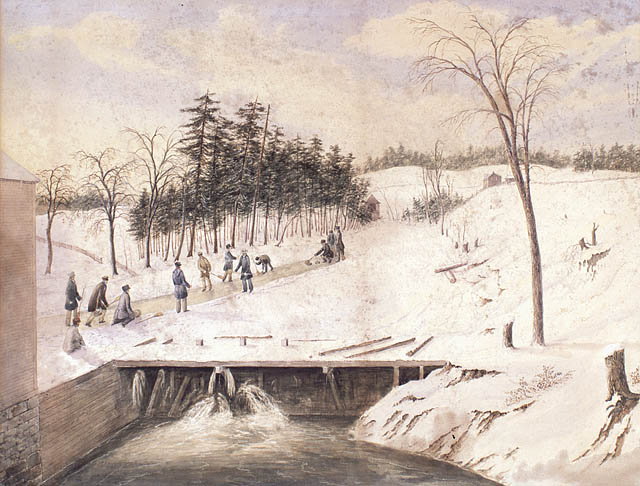
Curling

Curling was a popular winter sport brought over to Canada by early Scottish settlers. Many settlements in Upper Canada had their own curling clubs, some of which exist to this day. Below is a wonderfully bucolic scene of a curling match in Toronto, circa 1836.

http://www.collectionscanada.gc.ca/pam_archives/public_mikan/index.php?fuseaction=genitem.displayItem&lang=eng&rec_nbr=2837821
Curling on the Don River, Toronto, Watercolour c. 1836, Artist Unknown
Library and Archives Canada
Sources
Library and Archives Canada 2014, "Curling into Canada"
Galt Curling Club 2014, "History of the Galt Curling Club, 175 years and going strong"
Nancy B. Bouchier's 2003 For the Love of the Game

Further Reading
Canadian Curling Association 2014, "History or Curling"

Thursday, December 11, 2014

Shopping in Shade's Mills

For the early settlers arriving and establishing themselves in Shade's Mills/Galt, there were but a few options when it came to purchasing the goods they needed and/or wanted.

Excerpt from James Young's Reminiscences of Galt, Page 54
The first option was to visit the combined home/general store of Absalom Shade and his second wife, Isabella. This two-storey log home was the first to be built in the new settlement (c.1816), and was located near the corner of Main and Water streets. (Young, 31) By the following year a blacksmith's shop had opened, thus providing the necessary materials and equipment for life on a farm. Mr. Shade was able to secure for himself a bit of a monopoly for his general store, and later increased his trade in 1824 with the opening of a second and larger shop, known as the Red store. (Young, 48) With a promise from William Dickson that no land would be sold to anyone else wishing to construct or operate a shop, Shade was able to comfortably grow his personal fortune.

Nearly a decade later, Mr. Shade added the 'White store' to his holdings (c.1832). Different from the Red store which conducted business in credit or barter, the White store worked in cash. (Young, 109) There was also now a hatter in the village, as well as a tavern, and a hotel. As the population of Dumfries township and surrounding areas grew, so to did competition. In neighbouring Preston, and in Waterloo, shops were able to offer goods at lower prices. The construction of roads, relative ease of transport (as compared to the previous decades), growing industry in other larger towns, and increased demand for "luxury" items encouraged businessmen to open up new enterprises.* By 1838 a former pedlar had opened a shop in the heart of Galt, and Shade's monopoly was effectively broken.

Sources
Black Sheet Iron Money Box, c.1830-1850
Dictionary of Canadian Biography 2014, "Shade, Absalom"James Young's 1880, Reminiscences of the early history of Galt
McCalla, Douglas. “Retailing in the Countryside: Upper Canadian General Stores in the Mid-Nineteenth Century”. In Business and Economic History, Winter 1997; 26, 2. Pages 393-403.

Further Reading
For more information on the credit and barter systems, you can check out a previous blog post here.
W. Hamish Fraser's 1981 The Coming of the Mass Market,1850-1914
Michael Gonder Scherck's 1905 Early Pioneer Life in Upper Canada.

* It has been shown that villages/towns with populations over 500 tend to see the growth of specialised shops. For example, rather than visiting a general store for items you might need, you can visit the shoemaker, the harness shop, the carpenter, or the grocer's separately. Ideally, these specialised shops would be able to offer you more selection, and possibly better prices. (McCalla)

Thursday, December 4, 2014

Huron County Museum

Central School, constructed in 1856
A few weeks ago I happily seized upon an opportunity to visit the Huron County Museum and Historic Gaol in Goderich, Ontario. This was my first visit to the museum, though once inside I felt right at home. The permanent exhibits focus on development - development of the Huron Tract from forests to farms to thriving modern communities; development of agricultural technology and methods over the past two hundred-plus years; and the development of the people from settlers to soldiers, and from farmers to Victorian and Edwardian fashionistas.

1913 Steam Locomotive
The settlement of Goderich is a product of the Canada Company (at that time headed by John Galt), and it's Warden of the Woods and Forests, William "Tiger" Dunlop. Founded in 1827, and linked by a "muddy sleigh track" to Guelph by the following year, it became a popular destination for early British settlers. By its incorporation date in 1850, it had amassed a population of about 800 people. Today, the town of Goderich is home to 7,500.

The Huron County Museum is located near the radial core of Goderich, and is housed within a former schoolhouse (c.1856) and a large, modern addition (c.1989). The layout of the museum is such that it keeps you guessing what might be around the next corner. As I zigzagged through each space, I was constantly surprised and delighted at what I found. Particular exhibits of interest were the replica settlers' cabin (displaying the conditions in which early settlers lived), and of course the Huron County Main Street (for a little 19th century window shopping).
Two-Headed Calf

Finding Goderich and the museum is easy. When I give friends directions I always like to say that if you've driven into Lake Huron, you've gone too far. The museum itself has incredibly friendly staff, and the low admission includes your own audio guide. On your way out you can visit their gift shop and take home some very unique items - like the two-headed calf toy pictured here (they have a taxidermy specimen in the reception area that has become popular with adults and children alike). I would recommend the Huron County Museum to anyone, at any time of year. In the summer you can head out to the beach after your visit, or in the winter you can enjoy a snowy drive and Christmas shopping in the "prettiest town in Canada".

Sources
Huron County Museum and Historic Gaol Online
Hilary Stead 2002, Guelph: A People's Heritage 1827-2002
You can get a head-start by taking a look at the museum's floor plan, here.
Huron County Museum Blog, 2014

Further Reading
Ontario's West Coast 2010, "Huron History"
Immigrants to Canada, "Letters Collected by the Canada Company, to Encourage Emigration 1842" Many of these letters reference the road between Guelph and Goderich; its condition, construction, and uses.

Thursday, November 27, 2014

Ugh, Women Settlers

The following in an excerpt from Anna Brownell Jameson's Winter Studies and Summer Rambles in Canada. First published in 1838, Jameson's travel diary takes readers on a journey through a pre-rebellion Upper Canada. Making stops in Toronto, Niagara, St. Catherine's, London, and up Lake Huron to Manitoulin Island, Jameson writes about her thoughts and interactions with the people and places making up the colony.

"He said he should be quite happy here, were it not for his wife, who fretted and pined continually after her 'home.'

'But,' said I, 'surely wherever you are, is her home, and she ought to be happy where she sees you getting on better, and enjoying more of comfort and independence than you could have hoped to obtain in the old country.'
'Well, yes,' said he, hesitatingly; 'and I can't say but that my wife is a good woman: I've no particular fault to find with her; and it's very natural she should mope, for she has no friend or acquaintance, you see, and she doesn't take to the people, and the ways here; and at home she had her mother and sister to talk to; they lived with us, you see. Then, I'm out all day long, looking after my business, and she feels quite lonely like, and she's crying when I come back - and I'm sure I don't know what to do!'
The case of this poor fellow with his discontented wife is no unfrequent occurrence in Canada; and among the better class of settlers the matter is worse still, the suffering more acute, and of graver consequences.
I have not often in my life met with contented and cheerful-minded women, but I never met with so many repining and discontented women as in Canada. I never met with one woman recently settled here, who considered herself happy in her new home and country: I had heard of one, and doubtless there are others, but they are the exceptions to the general rule. Those born here, or brought here early by their parents and relations, seemed to me very happy, and many of them had adopted a sort of pride in their new country, which I liked very much. There was always a great desire to visit England, and some little airs of self-complacency and superiority in those that had been there, though for a few months only; but all, without a single exception, returned with pleasure, unable to forego the early habitual influences of their native land.
...
Anna Brownell Jameson
calotype 1843-1848 by David Octavius Hill
I have observed that really accomplished women, accustomed to what is called the best society, have more resources here, and manage better, than some women who have no pretensions of any kind, and whose claims to social distnction could not have been great any where, but whom I found lamenting over themselves as if they had been so many exiled princesses"

I found this passage interesting for a couple of reasons. First, Jameson doesn't seem to understand the irony of her opinions. She herself was in an unhappy marriage that only after a few years ended in separation... a separation which allowed her to happily return to England. She critiques any lady who pines for home and family left behind, yet does the same herself in her diaries. She even goes so far as to say that being of the better classes makes the remembrance of home harder, presumably because they have more friends, family members, and luxuries to miss. I also like this passage as it reminds me of countless other (borderline humourous) accounts from this period of women critiquing women. We have always been our own harshest critics, but in the 19th century it really was made into an art form.

Anna had made her journey to the Canadas at the request of her husband, Robert Simpson Jameson, who had recently been appointed chief justice of Upper Canada and who had settled in Toronto. Unhappy in love and life, she travelled the southern portion of the province before returning to England the next year, in 1837.

Sources
Anna Brownell Jameson's 1838, Winter Studies and Summer Rambles in Canada.

Thursday, November 20, 2014

Lands in Upper Canada

Clicking on the image below with enable you to zoom in on this advertisement for settlement, printed in 1835 in London, England.
http://static.torontopubliclibrary.ca/da/pdfs/ohq-ephe-c-w-89.pdf

Some excerpts from the advertisement include:

"The ordinary baggage of Emigrants consists of their wearing apparel, with such bedding, and utensils for cooking, as may be required on the voyage, and any articles of clothing, not intended to be used at sea, ought to be packed in water-tight cases or trunks, not exceeding eighty or ninety pounds in weight."

"The class of persons chiefly required in Upper Canada, and who, of course, will find it best suited to their purposes, are small Capitalists, Farmers, Mechanics, and Labourers."

Sources
Toronto Public Library Digital Archive 2014, "Lands in Upper Canada"

Thursday, November 6, 2014

John Galt and the Elgin Marbles

This is an example of one of those times when I've very audibly (and embarrassingly) shouted "NO way!" while doing research. This is also an example which proves just how small and interconnected our world really is. It's the story of how many of the Elgin Marbles came incredibly close to being known to us today as the Galt Marbles.

Portion of the east side of the Parthenon pediment,
on display at the British Museum
John Galt was doing what any 19th century man of his means would do when under the weather, or otherwise evading creditors or looking for distraction; tour the continent. He left London in 1809, and by 1811 had found himself in Italy and in Greece. The Mediterranean was a popular place at the time, especially for Romantic poets and writers eager for inspiration from the "East". Lord Byron, one of Galt's contemporaries and sometimes travel companion, was also in Greece at this time. It is Galt's connection to Byron that introduces him to the world of opportunistic art sales.

In his book Byron and Scotland: Radical or Dandy, Angus Calder describes Byron's friendship with Signore Luseri, an Italian Agent and artist-in-residence in Athens for Lord Elgin. Luseri had been working with Elgin for almost a decade in Greece on the documentation and eventual removal of the Parthenon sculptures to Britain. Despite Byron's protests that such removals of ancient artefacts were tantamount to rape,  he continued his friendship with Luseri.

It is during the second shipment of the marble statues out of Athens that John Galt becomes involved to the point where his morals are set firmly aside.  He learns from Luseri that Elgin is having financial issues, and may be unable to pay the freight (the cost of the ship, etc.) when it arrives in Malta. The ship would then of course confiscate its cargo in lieu of payment, and deal with the sculptures as the captain sees fit. Galt is not the only one to hear of this desperate news, however, for the French as also keen to add to their collection.

Monsieur Favelle, the French Consul in Athens, had been instructed to remove any and all possible works of antiquity from Greece and supply them to the Musee Napoleon (the Louvre) for permanent and glorious display. Upon hearing of Elgin's money woes, Favelle sees a chance to seize the shipload and claim the pieces for the Emperor. Galt decides (aboard the very ship that the marbles are travelling on) that he will pay the freight, save the day for Britain, and make a tidy sum for himself once he sells the cargo to eager and illustrious buyers in London.

John Galt, from his Autobiography in 1833
The plan could have worked wonderfully. The British Museum could now be in possession of the Galt Marbles, as well as the Elgin Marbles. Galt could have been an even wealthier man - would he have spent those funds creating more settlements in Upper Canada? Luseri, however, was a man of business and persuasion. He managed to alleviate the debts of Elgin in Malta and retain possession of the Greek artefacts; eventually sending them all the way to Britain. Galt was admittedly conflicted by this outcome. While he was saddened by the loss of fortune and fame that the sculptures would bring him back home, he was also steadfast in his agreement with Byron that the works were taken wrongfully in the first place.

Sources
The British Museum 2014, "What are the 'Elgin Marbles'?"
John Galt's 1833, The Autobiography of John Galt
Angus Calder's 1989, Byron and Scotland: Radical or Dandy?
Ozlem Caykent's 2010, "John Galt's Travels"

Further Reading
Encyclopaedia Britannica 2014, "Thomas Bruce, 7th Earl of Elgin"
Biography.com 2014, "Lord Byron Biography"
Metropolitan Museum of Art 2014, "Romanticism"

Thursday, October 23, 2014

The Credit, Barter, and Three-Way Systems of Payment

Let's pretend you're living with your family in Upper Canada in the first half of the nineteenth century. You own a productive farm, and keep sheep and chickens in addition to various crops such as apples, wheat, and barley. Life is good - you have everything you need. One day while in the village, you pass by the General Store and lo and behold there's a window full of things you want: Fabrics for making new clothes for the family, spices to make just about everything taste better, and tools that will make farm work easier. Remember, life is good, and you decide to head in to the store. After a few of your items have been wrapped in paper, the shopkeeper gives you the total. How are you going to pay for these luxuries? 

Responding to the needs of their customers, and accepting of the fact that currency was scarce in most rural communities, shopkeepers offered many of their goods on credit. (Fraser, 86) The prices of purchased goods were noted in an account book (ledger) or on a bill.  From time to time, most customers paid all or part of that bill by service, cash or trade.  In order for the credit-based system to work, not only did the customers have to be honest, trustworthy and able to pay off their debts in a timely fashion, but the shop owner had to be equally as honest, trustworthy, and able to bear the various debts of often an entire village.  In many cases, the shop owner was a man in good circumstances and was able to wait until sales of crops or livestock enabled farmers to pay for items purchased throughout the year.


Crysler's Store, Upper Canada Village
Morriston Ontario
A shop could quite easily fail due to bad debts, or the inability of the store owner to collect in a timely manner.  Collection of debts could be tricky for the shop owner.  If he came on too strong, he would lose the customer (and the money). If he was too lenient, he might end up out of business, unable to pay his own debts. Opening a store where family and neighbourly ties are stronger was an effective way to stay in business.  By knowing his customers on a more intimate level, the credit system had a better chance of succeeding. (Fleming, 141) The shop owner could appeal to his friends (who presumably wished him to succeed) to pay off their debts, and could visit them with a kindly reminder when they did not.  Knowing your customers had another advantage, for it allowed the shop owner to “avoid sales to those who would not pay, and to increase sales, especially of goods that carried the highest mark-up, to those most likely to pay”. (McCalla, 401)


There were a number of ways in which a family or individual could repay the store owner for items purchased on credit.  The three most popular methods include payment through service or labour; delayed payment using cash, or payment through trade.  Payment through service or labour included for example, splitting and piling wood for the shop owner, lending the shop owner a horse or ox for a project, or lending skills such as blacksmithing, etc. (Fleming, 127-129) Payment using cash occurred whenever the family or individual had some to spare – usually in the fall of each year, after the “threshing” or the “killing”. (Sherck) It was also not uncommon for the shop owner to institute a monthly collection whereby accounts were required to be settled by the end of each calendar month.

Some debts could be repaid by trading in chickens, eggs, or butter.  In October 1861, James Watson, a shop owner in Lindsay advertised through the local newspaper that he would accept “all kinds of country produce” as payment. (Fleming, 26) A Manilla shop owner, Adam Gordon, also advertised that he would purchase “Wheat, Pork, and other farm produce, at the Highest Market Prices”. (Fleming, 26) Payment through trade was extremely common, but must not be confused with pure bartering.  Each object (usually by weight) had a dollar amount attached to it, and customers did not, for example, simply trade eggs for tea.  Every transaction was entered into the ledgers, and one dollar’s worth of tea must be offset by at least one dollar’s worth of eggs.

There were also many instances where arrangements were made between businesses which allowed for labourers to be paid in credit to the local general store or to a trade, eliminating the need for workers to handle cash:  “Every builder or contractor made an arrangement with the various trades and stores for a line of credit, by which they could pay their workman as much of their wages as possible with the smallest amount of cash.” (Guillet, 240) Worker’s wives would then go and pick up items from the store as needed without the requirement for currency to exchange hands.  The items purchased would simply be deducted from the credit provided by the employer. Likewise, the Three-Way System involved little to no exchange of money.  For example “In Glencarin, Ontario (west of Barrie), millworkers paid for their laundry indirectly. Storekeeper and mill owner M.N. Stephens would deduct a dollar or two from wages and enter that amount as a credit on the laundry woman’s account”. (Fleming, 138)

General Store Interior, Black Creek Pioneer Village
Toronto, Ontario
As communities grew, and the connections between shop owner and neighbour became more distant, the need for payment upfront and in cash increased.  Additionally, the amount of individuals travelling through the province and purchasing goods was also rising.  Itinerant purchasers could little be expected to be tracked down if they did not live in the area, and so they too were expected to pay in cash.  As the cost of some goods also increased, so too did the debts of the shop owners. (Fraser, 90) Eventually, the general store moved away from the credit, trade, and Three-Way systems and adopted the more streamlined cash system.


Sources
W. Hamish Fraser's 1981 The Coming of the Mass Market,1850-1914
Michael Gonder Scherck's 1905 Early Pioneer Life in Upper Canada. 
Edwin C. Guillet's 1934 Toronto, from Trading Post to Great City. 
McCalla, Douglas. “Retailing in the Countryside: Upper Canadian General Stores in the Mid-Nineteenth Century”. In Business and Economic History, Winter 1997; 26, 2. Pages 393-403.

Thursday, October 2, 2014

From the Pen of William Dickson

The Honourable William Dickson was educated, eloquent, and greatly opinionated (in addition to his also being the founder of the Township of Dumfries, and of Galt); Three qualities which were often demonstrated in his personal correspondence and at various speaking engagements. His sentiments are so clear that you can almost picture him preaching the benefits of a conservative and obedient life under the Crown (the dour expression in the photo below should assist you should you need inspiration). I always find learning about history through the eyes and pens of its participants particularly appealing. Thus, the following are excerpts from a speech delivered to his fellow Galtonians in 1839 on the occasion of his 70th birthday. His words give us a glimpse into his world, and into his mind, on all things political, social, and emotional.*

On the Difficulties of Settlement
"Embarrassments and difficulties beset me - despondency sometimes showed her unwelcome visage." (JY, 176)

"Many of you have had your days and nights of gloom - you have encountered privations, toil, trouble, and uphill exertions, but many of you have attained the summit of your wishes, and others are in a progressive advance." (JY, 177)

On the creation of Upper Canada in 1791
"I was then at Niagara, when General Simcoe first addressed the assembled Legislature; and well do I remember the joy and enthusiasm which pervaded all classes and ranks, on such a boon being granted." (JY, 177)

On Upper Canadian prosperity
"If the people of Upper Canada are not happy and contented, it must mainly be their own fault." (JY, 181)

On Dumfries / Galt
"... I entertain, and shall always continue to feel, a lively interest in all that relates to Dumfries; and I have especial pleasure in receiving the evidence of the satisfaction and prosperity which seems to prevail among its inhabitants." (JY, 173)

On the French and politics
"The Constitution and form of Government that was at that time conferred on the Canadas has worked well in practice in Upper Canada, and would have worked equally well in Lower Canada, had not the malignant, ambitious, and selfish French demagogues poisoned the minds of an illiterate peasantry - inducing them at length to throw off the mask of moderation, and factiously to resort to insurrection, treason, and rebellion." (JY, 177-178)

On the United States and civil war
"Reflecting on the change in the national character of the descendants of British subjects, I am almost warranted in adopting an opinion that the elective principle, carried on to an extreme stretch, has changed the pulse of men and inoculated the people of the United States with principles destructive of liberty and good government, and that the time may yet arrive, when, on the revolving wheels of their government, the clog of despotism may be found not to be that far distant from that of democracy, and when civil broils and a servile war may madden to a contest, which, for the sake of humanity, may kind Providence in his mercy avert." (JY, 180)

*As these are excerpts, they are taken somewhat out of their original context. To fully understand his words, be sure to check the source material referenced.

Other interesting Dickson facts
- He was challenged to a duel in 1808 by a colleague, Mr. Weeks, who had felt he had been publicly insulted by him. Dickson won, and Mr. Weeks died three hours later. (JY, 16)
- He was captured in Niagara-on-the-Lake (at that time known simply as Niagara) by American forces in June 1813 and jailed in Albany until the following January. When he returned he found his house, and the village had been razed.(JK)
- He was a member of the Family Compact

Sources:
(JK) James E. Kerr's 1916, "Sketch of the Life of the Honourable William Dickson"
(JY) James Young's 1880, "Reminiscences of the Early History of Galt and the Settlement of Dumfries in the Province of Ontario"

Further Reading:
Dictionary of Canadian Biography 2014, "William Dickson"
Cambridge Archives and Records Centre, "Honourable William Dickson"

Thursday, September 11, 2014

Waste Not, Want Not (When Mackenzie Came to Town)

No matter where you're from, being able to make a connection to a (in)famous individual through a specific location can be a source of pride. While I'm not personally for violent rebellion, I was nonetheless a bit starstruck that William Lyon Mackenzie had once visited the fair little village of Galt. His effigy was there too... and as it turns out, neither of them fared too well.

William Lyon Mackenzie
It was 1833 and William Lyon Mackenzie was touring the province; speaking to small crowds of men from all walks of life, attempting to drum up support for political reform. He was a well known critic of the ruling Family Compact and its individual members, and indeed had been expelled numerous times from the Upper Canada Assembly (only to be re-elected back in each time). What he wanted were investigations into past alleged abuses of power on behalf of the government, and better representation for the people of the growing settlements in the province.

While support for Mackenzie continued to exist throughout Upper Canada, it began to wane as his ideas became viewed as too radical, or disloyal to the Crown. Thus, when he decided to speak at the little (and only) tavern in Galt in 1833 there were both fellow reformers and adversarial Tories in attendance. From neighbouring townships there amassed a crowd estimated to be a few hundred strong, but as we all know, it only takes one to ruin a party.

As supporters were eagerly listening to Mackenzie in the afternoon sun, there could be seen an unusual pair of shapes coming toward them from Main Street. Those shapes were in fact, "a person with a blackened face and fantastic dress... carrying a hideous-looking effigy" (Young). Supposedly to continue the theme, the effigy (meant to be Mackenzie) was also fully dressed for the occasion with the addition of a parcel of gunpowder hidden within. A group of Mackenzie and reform detractors were looking to make it quite clear that such men and policies were not welcome in their village.
Men's Leather Shoe, 1799
Bata Shoe Museum Collection

The gun powder lit and the effigy exploded into flames in front of its horrified audience. Mackenzie meanwhile continued his speech completely unfazed - shouting his words with a smile on his face from the tavern window to the crowd below. Among his supporters, and a member of that crowd, was a young farmer by the name of Marshall. By his attendance at Mackenzie's speech that day Marshall demonstrated his desire for political change. Equally, by his exceedingly hasty exit from that speech along with the very boots that adorned the inflamed effigy, he demonstrated his desire for decent footwear.

Why let good things go to waste?

Sources
James Young's 1880, Reminisces of the Early History of Galt and the Settlement of Dumfries in the Province of Ontario.
James Young's 1912, Public Men and Public Life in Canada: The Story of the Canadian Confederacy
Historica Canada, 2013, "Rebellion in Upper Canada"
Dictionary of Canadian Biography, 1976, "William Lyon Mackenzie"

Further Reading
Bata Shoe Museum, 2014


Thursday, September 4, 2014

Mill Creek

The confluence of Mill Creek and the Grand River is where William Dickson and Absalom Shade first decided to begin the settlement that would eventually become Galt, and later Cambridge. For some reason Mill Creek is plainly visible in Google Maps... but disappears once it hits Main Street in the Satellite view. Is it there or isn't it?


It turns out that Mill Creek was in fact there in a very big way, and still is. It has simply been altered over time to suit the needs of those developing the area since the early nineteenth century. Today, the creek has simply been diverted underground to accommodate a more modern way of living - one that's not as dependant on the productivity of mills and water-powered factories, etc. The following two images are part of a series of six completed by PLANT Architect Inc. in Toronto, Ontario. I encourage you to visit their site to see all of the maps in sequence.


In an upcoming blog I'll be detailing the importance and inner working of various mills in the Galt area; so stay tuned! In the meantime, feel free to browse the Further Reading links provided.

Sources
PLANT Architect Inc. 2012, "Mill Creek Galt"
Google Maps, 2014, "Cambridge"

Further Reading
Grand River Conservation Authority, 2014, "Low Water Response: Mill Creek"
April Souwand and Derek Coleman, A Natural History of Cambridge, Ontario
The Township of North Dumfries, 2014, "History"