Showing posts with label Agriculture. Show all posts

Thursday, March 26, 2015

Henry Stephens on Sheep

Henry Stephens is the author of the immensely popular Book of the Farm. Published in 1844, it enjoyed numerous re-prints and again became a highly sought after farming guide in the 21st century after being highlighted in BBC's Victorian Farm. Stephens himself was a Scot who studied chemistry, mathematics and agriculture in Dundee and in Edinburgh, and later went on to apprentice on a farm for several years. A tour of the continent allowed Stephens to compare methods and technologies, of which there seemed to be new ones every day. In the end, financial difficulties forced him away from farm management, and toward writing. He published a series of articles and books before his death in 1874 at the age of 79.

The following excerpts come from the edited version of Stephens' work produced by Alex Langlands of "Victorian Farm" fame. 

The Shepherd
His duty is to undertake the entire management of the sheep; and when he bestows the pains he should on his flock, he has little leisure for any other work. His time is occupied from early dawn, when he should be among his flock before they rise from their lair, and during the whole day, to the evening, when they again lie down for the night. To inspect a large flock at least three times a day, over extensive bounds, implies a walking to fatigue. Besides this daily exercise, he has to attend to the feeding of the young sheep on turnips in winter, the lambing of the ewes in spring, the washing and shearing of the fleece in summer, and the bathing of the flock in autumn. And, over and above these major operations, there are minor ones of weaning, milking, drafting and marking, at appointed times; not to omit the unwearied attention to be bestowed, for a time, on the whole flock, to evade the attacks of insects. (20)

By-Products of Sheep
The sheep is one of the most useful, and therefore one of the most valuable, of our domestic animals; it not only supports our life by its nutritious flesh, but clothes our bodies with its comfortable wool. All writers on diet have agreed in describing mutton as the most valuable of articles of human food. But the products of sheep are not merely useful to man, they also promote his luxuries. The skin of sheep is made into leather and, when so manufactured with the fleece on, makes comfortable mats for the doors of our rooms, and rugs for our carriages. For this purpose the best skins are selected, and covered with the longest and most beautiful fleece. Tanned sheepskin is used in bookbinding. (65-66)

Sources
Alex Langlands' 2011 edited and abridged Book of the Farm (I'm quite partial to my own copy of this book, as I had it signed by Ruth Goodman after attending a lecture by her in Waterloo, Ontario in 2011)
Henry Stephens' 1844 Book of the Farm

Further Reading
The Guardian, "TV show turns long out-of-print farming manual into hot seller"

I'd like to thank Caroline Bendiner for contributing to Sheep Month here on Upper Canada Scots. If you missed her three-part series on wool in the 19th century, simply scroll down or click on March 2015 in the archives. I'd also like to thank everyone who visited this blog in the last month - who knew sheep would be so popular a topic? If there's another aspect of colonial life that you'd like me to focus on, just let me know in the comments below. Happy March!

Monday, March 23, 2015

Start to Finish

http://www.thecanadianencyclopedia.ca/en/article/sheep-farming/
Detail from Lewis Parker's Upper Canada
Detail of Lewis Parker's Upper Canada, showing sheep being washed, sheared and released to frolic while the fleece is washed, dried, carded, and spun. Visit the Canadian Encyclopedia, "Sheep Farming".

Thursday, March 19, 2015

Wool in the 19th Century - Part Three

Ontario’s early history of sheep and wool is less about any financial benefits and more about basic survival in harsh, isolated, and extreme environments.  Many newly arrived settlers in the 18th and early 19th centuries were unaware of the extremes in climate in this area. Autumns could bring unexpected frost during the night, freezing many livestock to death.  Settlers had to fear other predators attacking their sheep and livestock: foxes, minx, weasels, and wolves would find their way into animal barns and make a meal of the farmers’ livestock.  Winter brought even colder temperatures, and hungrier predators.

From the 18th century to the first few decades of the 19th century, many early settlers were working with wool solely to clothe themselves rather than for business purposes.  The entire wool production process was very time consuming, and a couple would be lucky to make enough socks to keep their feet warm during their first winter on their land, let alone make sweaters and cloaks.

As early settlers arrived on their properties, the task of creating a farm and home for their family took precedence over spinning an entire wardrobe’s worth of wool.  Time may not allow for much at all to be spun.  About 5 hours of spinning can produce enough yarn to make a pair of socks.  This does not include the shearing, cleaning, carding, and eventual knitting to make the socks.  After the first few years on their farm, a family would probably have produced enough wool to live on, and would be at a point where they can sell or trade any surplus of woollen goods with other neighbours in need.

By the 1830s, the image of the early settler woman sitting in her cabin and spinning wool on the spinning wheel becomes increasingly obsolete.  Early settlers moved up from their tiny cabins to established farm houses, and availability of goods made spinning their own wool less of a necessity for survival.  At this point, it becomes more of a hobby for those that could afford the leisure time.  Spinning thus becomes a nostalgic image of early settlers and their struggle to clothe themselves warmly for the harsh winters.  To this day, nothing can beat a nice home spun woollen toque, mitts, or scarf.

This three-part series "Wool in the 19th Century" was written by Caroline Bendiner, Culture Coordinator for the Township of King.  She has a BA in history from Queen's University and a post graduate certificate in Cultural Site Management from Centennial College. Caroline has a strong passion for history and sharing history with the public.

Monday, March 16, 2015

The Sheep Advocate

"Sheep Farming in Canada
Taken from the Colonial Advocate, Thursday, June 3, 1824. Published by W. L. Mackenzie, Bookseller, Queenston, Upper Canada.

We were called on some business conected with our private affairs, to York, in the early part of May last, and wishing to take the head of lake Ontario in our way, on our journey home, we returned in that direction, and meeting with indifferent weather on Flamboro' mountain, we sent the innkeeper's boy back with the horses, and made up our mind to rest for the night, and enjoy the pleasure of a chat about local improvements, with our esteemed acquaintance, Mr Alexander Brown, of East Flamboro'. Disappointment is the lot of man, and so it fared with us, for Mr. Brown whose plain, sound, Scotch judgement, (as Mr. Wilberforce would call it) is held in much respect by his neighbours, was absent acting as umpire upon some dispute which had occured between two of them in regard to a property. Mrs. B. however, prepared a comfortable cup of tea, and when her husband resturned, we informed him that, next day we would desire his opinion on a subject, o which he was well qualified to give correct information, viz. The rearing of sheep. Accordingly, next morning we proposed our queries, nearly in the order in which they are now arranged. Mr. Brown's answers we give entire adding nothing, and we conceive their publication in every paper in the Colonies, would be a benefit conferred on the country. We will in future numbers, consider the Canada woolen manufacture; it is a most important branch of our domestic industry, even now; and, be it remembered, it is also the principal, and favourite manufacture of old England.
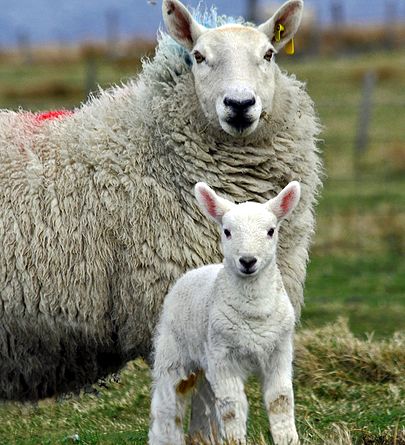
Cheviot ewe with lamb

Question 1. Do you improve your land by keeping sheep, or is it rendered poorer?

Answer. Sheep do not hurt a farm, the pasture need not be long if it is clear; sheep do well enough in summer, though kept on very indifferent pasture. I do not conceive from my experience that sheep improve a farm.

Question 2. What breed of sheep thrive best in Upper Canada?

Answer. I believe the common sheep of the country, the Cheviot breed do, but I would prefer the Liecestershire breed, if they could be easily kept, as being a much heavier sheep, and affording a much greater quantity of wool, and either I consider more advantageous than the full blooded merino. I have the full blooded merino, its wool is too fine, and does not suit the machinery in use in the country, neither will this sheep stand the winter like the Cheviot breed of sheep.

The merino breed crossed with the Cheviot, if kept carefully during the winter, are better adapted for this climate, and their wool being of an intermediate quality, between the former and the latter, is far better suited to our domestic manufacture.

Question 3. When should the rams be allowed to go to the ewes?

Answer. From my experience, not before the 15th or 24th of November, because the ewes if not very full in condition, will not nurse or attend their lambs. In this case, the lambing time will be from the 5th to the 24th of April, (a sheep going 5 months) and at this period, the season is becoming daily milder, so as not to chill the lambs, and there is generally grass enough come up to form a great proportion of sheeps' food. If the sheep lamb in February or March, we have little chance of succeding in saving the lambs, ten or eleven out of twelve die, the grass not being grown, and the weather being too cold.

Question 4. In your knowledge, and with good management, your ewes being sixty, and taking one year with another, how many lambs wil you have each season?

Answer. I should expect sixty lambs; some of the ewes will be barren, others will have two lambs, and perhaps a few lambs may die.

Question 5. What is your general method of managing flocks of sheep during the winter?

Answer. During the winter season, I keep my ewes of two years old and upwards, with my wethers, in a body apart by themselves, and give them plenty of good hay, but not red clover hay, which is not good for them. I have sheds for them at night; when the weather is stormy, and the snow deep, they are kept in these sheds in the day time; but only in such cases, as it is of the utmost importance to sheep to have freedom, when the weather renders it at all possible.

The sping lambs, and the wether sheep, I keep apart by themselves in a comfortable place, giving them, besides good hay, occasionally a little grain, oats, pease or maize are good, I do not think much of buck-wheat, but though I have not had much experience of oil-cake, I know that its mixture with wheat, or bran, will answer well. I give all my sheep salt, once a week, two quarts serve 100 sheep.

Question 6. Do you think it advantages to let the spring lambs breed the first year?

Answer. I do not. In small flocks it cannot be prevented, but I would advise, where large flocks are kept, that the lambs be weaned about the lasy of July, or beginning of August, and then kept seperated from the rest of the flock, until the following spring, and that in no case the rams be let amongst them. Sheep which are then prevented from bearing lambs the first year, become much better and stronger, they greatly improve the stock, &c by weaning the lambs as above. They are no worse, and it gives the ewe time to get in better order to stand our long winters.

Question 7. How ought sheep to be kept in the summer?

Answer. I should say, in the open field, or in a large space; sheep kept very close together at night, become unhealthy.

Question 8. Are sheep liable to many disorders in this country?

Answer. The worst disorder to which sheep are here liable, is cold; most commonly caused by over early shearing and washing. I disapprove of washing before shearing, in general, as it is made a frolic of; sheep are handled too roughly and are apt to get hurt. The best time for shearing, if the weather is not too cold, is early in June. I entirely disapprove of shearing at an earlier period. By this time the new wool is some grown, the sheep therefore can be easier shorn, and it will thereafter feel comfortable. An objection has been raised by many, that the new wool is shorn and intermixed with the old, and that my that means, the wool is injured in the carding machine. From my experience in this country, I can say that I have always shorn my sheep late, and that the carders have assured me that no better wool to work than mine has ever passed through their hands. I have had 15 years experience in Britain before  came to this country; and in the last five years before I emigrated, I aided and assisted in shearing 25,000 sheep, yet I never heard a complaint of this nature made. I know of no other disorder generally affecting sheep in Canada, unless sometimes blindness - The cure in this case is to let blood in a small vein in the hollow below the eye, and let the blood run into the eye.

Question 9. Do you think the risk in keeping sheep is so great here as in Britain?

Answer. I should say, no. As regards disorders, there are much fewer natural deaths; the risk in winter is less. But wolves, though unknown in Britain, are very destructive to flocks in most places in this province, I conceive the bounty offered for their destruction to be a measure of general utility. There is little risk of losing sheep in winter, if they are duly attended to.

Question 10. Have you any other remark of importance to make concerning the improvement of sheep?

Answer. To improve the stock, I would draw off some of my oldest ewes and weakest lambs and dispose of them to some one having a smaller stock who could tend them better. The old ewes may be known by looking in their mouths to see if all their teeth are in good order. If any of the teeth are lost, or become very long and sharp, I would put them away, unless in a rare instance of a very good ewe. In all stocks, change the rams occasionally.

Question 11. You have, doubtless, from your long experience, a correct idea of the profits to be derived from the keeping of sheep flocks; state your opinion on the subject?

Answer. I average about 3 lbs of wool yearly from each sheep. The expense of keeping sheep, taking one with another throughout the year, I calculate at about a dollar a head. Ewes will do to keep 9 or 10 years, or till their mouths get very bad, so as that they cannot eat; but wethers, if they are fat, should be killed at 4 or 5 years, as they never will be so good food after that age. Even at the price which wool now fetches in the best settled part of the province, I should say that it would pay the expenses and risk of keeping the sheep. By keeping on the stock of wether lambs, and selling the old wethers fat in the spring or early in the summer at 4 or 5 years, there is a profit; 5 or 6 dollars has in many cases been paid, (the fleece being on;) the average price is about a guinea.

In a flock of 100 sheep, and allowing for all accidents, I should suppose 40 lambs to be the increase yearly; Iike enough a half would prove to be rams - Twenty wethers could thus be sold every year, and the stock would still be on the increase. This gives a profit of twenty guineas, besides an increase of twenty ewe lambs in one year, after paying all expenses and trouble. The profit is indeed much greater than this, but I have conceived it best to be under, rather than over the truth. I think that sheep are the most profitable stock a farmer can keep in this country, for such as have farms that will permit the keeping of them."

We informed Mr. Brown that we would publish his observations in an early paper, to which he agreed; indeed, we have made it a rule that what we obtain of information, in private, we never shall make public, using our informant's name, without his consent. We now took our leave of this worthy and opulent farmer and his family, and descended the mountain, fully enjoying the beautiful, interesting, and varied scenery, which the grand amphitheatre around Burlington Bay presents, thinking, all the while, upon the bonny highland hills, sheep cots, and green knowes of our native Scotland, and lifting merrily one of those songs of the inimitable Ramsay, which we had first heard sung amidst the echoes of our native glens and heather mountains, (and which our readers, if in cheerful mood, may find the pretty pastoral, "the Gentle Shepherd.") We soon reached the valley by the narrow craggy road least travelled, and in rather better than an hour found ourselves in the busy little village of Coote's Paradise, better know by its other name, Dundas."

Thursday, February 26, 2015

Special Announcement!

http://www.scottish-blackface.co.uk/
Scottish Blackface Sheep
Each post during the month of March will be dedicated to sheep in Upper Canada/Canada West - who kept them, how many, which breeds were preferred, and of course their many uses.

Why sheep? Why not?

As a special bonus this month I've teamed up with fellow colleague and wool aficionado Caroline Bendiner. She's prepared guest blog posts on early 19th century methods of turning fleece into wool, as well as where you can see these methods being used today.

For March there will also be a number of extra posts related to sheep facts. Never again will you come face to face with an Ovis aries and not know that while it may have four stomachs, it has no top front teeth.

Don't forget to check back often, and of course feel free to comment - let's show our guest blogger some love!

Thursday, January 29, 2015

From Adze to Zouave Jackets

A brief A-Z glossary of words one might encounter when studying life in Upper Canada.  For more detail on each of the words, phrases, names, and titles, simply follow the source links provided.

A - Adze
Used with the hewing axe to make the log faces as smooth as possible. Any divots, chunks, or "juggle marks" in the logs made by the hewing axe allow water to penetrate the wood, creating rot. In winter, this moisture will form ice build-up, stress the wood and cause the building to shift. (The Dalziel Barn) See image 1.
1. An Adze at work
2. Neeps along with haggis and potatoes
3. Toulouse Geese (with a gentleman
for scale)
4. Example of a Zouave Jacket and dress
from 1862.
B - Bairn
Noun, Scot. and North England for a child; son or daughter. (Dictionary.com)
C - Ceilidh
A Scottish and Irish term for a party with music, dancing, and often storytelling. (Wikipedia
D - Dovetail Joint (Dovetailing)
A joint formed by one or more dovetails fitting tightly within corresponding mortises. (Visual Dictionary of Architecture)
E - Emigration
Emigration is the act of leaving one's native country with the intent to settle permanently or temporarily elsewhere. Conversely, immigration describes the movement of persons into one country from another. (Dictionary.com) Remember that one always emigrates from and immigrates to a place.
F - Fermentation
Fermentation is a metabolic process that converts sugar to acids, gases, and/or alcohol. Important particularly when discussing beer and its importance in pioneer life in Upper Canada. It was often safer to drink than water, had a number of medicinal uses, and contained a number of vitamins and minerals needed by hardworking homesteaders. By the 1860s there were 300 breweries across Upper Canada, not to mention the fact that beer was also brewed at home in the kitchen. (Virtual Museum of Canada)
G - Gaelic
Noun; any of the closely related languages of the Celts in Ireland, Scotland, or (formerly) the Isle of Man. Adjective; of, denoting, or relating to the Celtic people of Ireland, Scotland, or the Isle of Man or their language or customs.(Dictionary.com)
H - Hogmanay
It is believed that many of the traditional Hogmanay celebrations were originally brought to Scotland by the invading Vikings in the early 8th and 9th centuries. There are several traditions and superstitions that should be taken care of before midnight on the 31st December: these include cleaning the house and taking out the ashes from the fire, there is also the requirement to clear all your debts before "the bells" sound midnight, the underlying message being to clear out the remains of the old year, have a clean break and welcome in a young, New Year on a happy note. (Historic UK)
I - Indian
Indian people are one of three cultural groups, along with Inuit and Métis, recognized as Aboriginal people under section 35 of the Constitution Act. There are legal reasons for the continued use of the term "Indian." Such terminology is recognized in the Indian Act, and is used by the Government of Canada when making reference to this particular group of Aboriginal people. (Aboriginal Affairs)
J - James Young
The Honourable James Young was born in Galt on 24 May 1835. Raised in Galt, he worked as a journalist before spending 25 years in politics (12 years of which in the federal parliament). It was at this time that Mr Young wrote his history of early Galt, titled "Reminiscences of the Early History of Galt and the Settlement of Dumfries" and published in 1880. The book remains one of the major sources of information about the early development of our community. (City of Cambridge)
K - Kirk
Kirk is a Scottish word meaning a church, or more specifically, the Church of Scotland. (The Church of Scotland)
L - Land-Jobber
A man who makes a business of buying land on speculation, or of buying and selling for the profit of bargains, or who buys and sells for others.
M - Mortise and Tenon
A joint made between two pieces of wood where the projecting part of one piece fits into a corresponding cu-tout on another. (Architectural Terms)
N - Neeps
A popular (and delicious) side to a haggis dinner; made primarily of boiled and mashed turnips. See image 2.
O - Orkneymen
Immigrants from the Orkney Islands, off the north coast of Scotland, Orkneymen played a major and largely unrecognized part in the exploration and settlement of Canada's North-West in the 18th and 19th centuries. At the peak of their involvement with the HBC in 1800, Orkneymen comprised 80% of a labour force of almost 500. (Canadian Encyclopedia)
P - Parritch
Although it is by no means a dish confined to Scotland, parritch (an altered pronunciation of the earlier form “potage”) was until quite recently such a staple of the Scots diet that it became the foundation, not only for a day’s work, but also for wisdom. Parritch figures strongly in a number of Scottish proverbs. Today the term "porridge" has become more popular. (Scots Language Centre)
Q - Quoin
A quoin is an angle at the outside corner of a building. You can call the corner itself a quoin, or use the word for the special stones or bricks that reinforce corners of brick or stone buildings. Some quoins are decorative features, providing variety and pattern to the corner where two exterior walls meet. (Vocabulary.com)
R - Rebellion
The 1837 rebellion in Upper Canada [Ontario] was a less violent, more limited affair than the insurrection that same year in neighbouring Lower Canada [Quebec], although its leaders, including William Lyon Mackenzie, were no less serious in their demands for democratic reform, and an end to the rule of a privileged oligarchy. The rebellion itself failed, yet its very failure helped pave the way for more moderate and careful political change in British North America, including the union of Upper and Lower Canada, and the eventual arrival of responsible government. (Canadian Encyclopedia)
S - Saltire (St. Andrew's Cross)
The Saltire is the national flag of Scotland and, with a white diagonal cross on a blue background, it represents the crucifixion of the apostle St. Andrew Scotland’s patron saint. Believed to be the oldest flag in Europe, the origin of the flag comes from an old legend. Tradition has it that the flag originated in a battle fought near the East Lothian village of Athelstaneford in AD 832. (Visit Scotland)
T - Toulouse Goose
The name Toulouse is used for several types of gray geese descended from the European Greylag. People have selected Toulouse as general purpose farm birds, as producers of fois gras, and as show-birds. In the past, goose fat was a primary source for cooking fats and lubricants. Historically farmers often raised Dewlap Toulouse geese in cages to limit their movement, valuing their ability to put on large quantities of fat when fed plenty of food with no room to exercise. (The Livestock Conservancy) See image 3.
U - United Empire Loyalists
The United Empire Loyalists were generally those who had been settled in the thirteen colonies at the outbreak of the American Revolution, who remained loyal to and took up the Royal Standard, and who settled in what is now Canada at the end of the war. (United Empire Loyalists Association of Canada)
V - Venison
Noun, the flesh of a deer or similar animal as used for food. (Dictionary.com)
W - Wattle and Daub
Wattle and daub is a composite building material used for making walls, in which a woven lattice of wooden strips [or branches, etc.] called wattle is daubed with a sticky material usually made of some combination of wet soil, clay, sand, animal dung and straw. (Wikipedia)
Y - Yoke
Wooden shoulder yokes [for people] were used to carry two buckets of milk from the cow to the dairy in the days when cows were milked in the fields. They were also heavily used to collect water for household use.  The yoke was made from a beam of wood, usually willow for lightness, but ash and sycamore were also used. It is concave at the centre to fit comfortably around the shoulders, with a recess to fit around the neck of the wearer. The ends of the yoke tapered to terminate just beyond the wearer's shoulders. Chains were then hung from the ends with hooks to fix onto the buckets. (Object Lessons)
Z - Zouave Jacket
A woman’s short embroidered jacket or bodice, with or without sleeves, resembling the jacket of the Zouave uniform. (Oxford English Dictionary) See image 4.

Thursday, December 4, 2014

Huron County Museum

Central School, constructed in 1856
A few weeks ago I happily seized upon an opportunity to visit the Huron County Museum and Historic Gaol in Goderich, Ontario. This was my first visit to the museum, though once inside I felt right at home. The permanent exhibits focus on development - development of the Huron Tract from forests to farms to thriving modern communities; development of agricultural technology and methods over the past two hundred-plus years; and the development of the people from settlers to soldiers, and from farmers to Victorian and Edwardian fashionistas.

1913 Steam Locomotive
The settlement of Goderich is a product of the Canada Company (at that time headed by John Galt), and it's Warden of the Woods and Forests, William "Tiger" Dunlop. Founded in 1827, and linked by a "muddy sleigh track" to Guelph by the following year, it became a popular destination for early British settlers. By its incorporation date in 1850, it had amassed a population of about 800 people. Today, the town of Goderich is home to 7,500.

The Huron County Museum is located near the radial core of Goderich, and is housed within a former schoolhouse (c.1856) and a large, modern addition (c.1989). The layout of the museum is such that it keeps you guessing what might be around the next corner. As I zigzagged through each space, I was constantly surprised and delighted at what I found. Particular exhibits of interest were the replica settlers' cabin (displaying the conditions in which early settlers lived), and of course the Huron County Main Street (for a little 19th century window shopping).
Two-Headed Calf

Finding Goderich and the museum is easy. When I give friends directions I always like to say that if you've driven into Lake Huron, you've gone too far. The museum itself has incredibly friendly staff, and the low admission includes your own audio guide. On your way out you can visit their gift shop and take home some very unique items - like the two-headed calf toy pictured here (they have a taxidermy specimen in the reception area that has become popular with adults and children alike). I would recommend the Huron County Museum to anyone, at any time of year. In the summer you can head out to the beach after your visit, or in the winter you can enjoy a snowy drive and Christmas shopping in the "prettiest town in Canada".

Sources
Huron County Museum and Historic Gaol Online
Hilary Stead 2002, Guelph: A People's Heritage 1827-2002
You can get a head-start by taking a look at the museum's floor plan, here.
Huron County Museum Blog, 2014

Further Reading
Ontario's West Coast 2010, "Huron History"
Immigrants to Canada, "Letters Collected by the Canada Company, to Encourage Emigration 1842" Many of these letters reference the road between Guelph and Goderich; its condition, construction, and uses.

Thursday, November 20, 2014

Lands in Upper Canada

Clicking on the image below with enable you to zoom in on this advertisement for settlement, printed in 1835 in London, England.
http://static.torontopubliclibrary.ca/da/pdfs/ohq-ephe-c-w-89.pdf

Some excerpts from the advertisement include:

"The ordinary baggage of Emigrants consists of their wearing apparel, with such bedding, and utensils for cooking, as may be required on the voyage, and any articles of clothing, not intended to be used at sea, ought to be packed in water-tight cases or trunks, not exceeding eighty or ninety pounds in weight."

"The class of persons chiefly required in Upper Canada, and who, of course, will find it best suited to their purposes, are small Capitalists, Farmers, Mechanics, and Labourers."

Sources
Toronto Public Library Digital Archive 2014, "Lands in Upper Canada"

Thursday, November 13, 2014

The Royal Agricultural Winter Fair

The Royal Agricultural Winter Fair in Toronto is for me one of the most anticipated events of the year. While I'm not personally involved in any of the competitions, I can certainly appreciate good husbandry and perfect grooming when I see it. I can also appreciate any opportunity to get up close and personal with so many sheep and goats that I can't keep count.

Feeding the goats is definitely a
highlight for me each year
The Royal Agricultural Winter Fair was given its Royal designation by King George V in 1920, and since 1922 it has been attracting hundreds of thousands of visitors each year. Over 300,000 people visited last year alone. The fair is home to a number of Agriculture Competitions, Horse Shows, and opportunities for people to learn about local agriculture through exhibitors, activities, and presentations. There are also a number of vendors selling everything from locally made cheeses and skeins of hand spun alpaca yarns to leather goods and gourmet honey. Many of the vendors come to the Royal each year, and I've made a habit of calling on my favourites each time I visit. My perennial favourites include The Upper Canada Cheese Company, Bouchard's Poutinery, and Tandy Leather.


http://www.coloribus.com/adsarchive/prints/royal-agricultural-winter-fair-family-vs-goats-13548755/
2009 ad for The Royal (One of my favourites)
I will admit that with all the wonderful exhibits and vendors, I still make a bee-line to the petting zoo. I love visiting the goats and sheep and getting to interact with them. For a couple dollars you can buy a cup of food for them to nibble out of your hand. Some of the larger goats can get a bit pushy, but they're hungry too, and I try to make sure to spread the wealth. The petting zoo area is also home of some gorgeous rare breed show birds, such as Cayuga Ducks, African Geese, and Sebastopol Geese.

Admission can be a bit high for some ($24 per adult), but there is a way around it. It isn't advertised on their website, but if you visit the Royal after 4:00pm, admission is 2-for-1. Most of the competitions and horse riding events happen during the day, so you will miss out on those, but you will also miss out on the 18,000+ school children that visit each year (they're usually back on their busses by 3:00pm).

This year the Royal runs from November 7-16, so check it out!

Sources
The Royal Agricultural Winter Fair 2014 Website

Further Reading
Farmers Feed Cities 2014 Website
Ontario Beekeeper's Association 2014 Website

Thursday, October 30, 2014

Making Butter

Jean-Francois Millet's 1855
"Woman Churning Butter"

Metropolitan Museum of Art
And now the dairy claims her choicest care,
And half her household find employment there;
Slow rolls the Churn; its load of cloging cream
At once foregoes its quality and name,
From knotty particles first floating wide,
Congealing butter's dashed from side to side;
New milk around, through flowing coolers stray
And snow-white Curd abounds, and wholesome whey;
(excerpt from Robert Bloomfield's The Farmer's Boy, written in 1800)

Sources
Robert Bloomfield's 1800, The Farmer's Boy
Encyclopaedia Britannica, "Robert Bloomfield"
Henry Stephens quotes this passage in his chapter on the making of butter and cheese in The Book of the Farm, Volume III published in 1844

Further Reading
The Metropolitan Museum of Art 2014, "Woman Churning Butter"
Collections Canada 2006 "Women and Their Work in Upper Canada" by Jane Errington
Nick Mika et al, 2000 Black Creek Pioneer Village: Toronto's Living History Village, read page 25 on the process of making butter in the early 19th century

Thursday, October 9, 2014

Model Railway and Local History

This past weekend I visited the St. Jacobs and Aberfoyle Model Railway in St. Jacobs, Ontario. The 3,000 square foot display focuses on Southern Ontario in the 1950s, and includes various urban and rural scenes (during the day and night).

The detail in each of the hand-made elements of this model is astounding, and I spent a great deal of time examining each building (in many cases there were little people going about their "lives" inside). The most endearing features of the exhibit, however, are the many nods to local life, geography, and architecture. Ah nostalgia!

A Mennonite barn raising is in progress next to a small farm and sawmill, while a man and a cat watch from the farmhouse porch. At a small campsite a tent has been pitched and a bear spies on a family as they sit around a small campfire. The Niagara Escarpment is an integral feature of the display, and the cliffs and foliage act as the perfect canvas for the scenes below.

In the more urban sections of the model railway, I was drawn immediately to a building that many in Galt (Cambridge) would recognize: The Galt Post Office.


"Built between 1884 and 1887, the Former Galt Post Office served an important function as the home of the post office, customs, and other government services. This post office was one of the many buildings erected during the course of a program of government construction in small communities and towns across Canada under the direction of Thomas Fuller, Chief Architect of the Department of Public Works from 1881 to 1896. The high standard of design imposed by Fuller is evident in the former Galt Post Office. Typical of his designs, the building features an round-arched entrance portico, symmetrical twin façades and a clock tower, in this case uniquely adapted to be visible from both the street and the Grand River. The steeply pitched mansard roof, as well as the use of contrasting colours and textures and the accomplished stonework, come together to create a striking blend of the Gothic, Second Empire and Romanesque styles." (HP)

Of course I could not cap off this trip to the Model Railway without a stop in Galt for dinner right across from the old post office - this time in full scale.

I would absolutely recommend that everyone who has the opportunity to visit the Model Railway should do so. Admission is $8 for adults, and the volunteer staff are amazing. When you're done exploring you can head out and spend the rest of the day in St. Jacobs, making sure of course to stop at A Touch of Scotland for some mushy peas, tartans, and other Scottish treats.

Sources
St. Jacobs and Aberfoyle Model Railway Website, 2014

Further Reading
Canadian Encyclopedia Online, 2013 "Thomas Fuller"
Your Heritage Waterloo Region, 2014 "Old Galt Post Office" Search Results for some great images

Thursday, August 7, 2014

Debating Societies

As a means of self-improvement for gentlemen, and as an “inner and outer polish” for young men preparing for their entrance into respectable society, a number of debating societies were created in Galt in the mid-nineteenth century. (Holman, 123) Such types of intellectual clubs were popular throughout the Victorian period, as it allowed men to practice and hone their speaking skills, as well as network with respected members of their community. 

Above: Homer Watson's Collecting the Hay
Below: Royal Exchange Square, Glasgow
In his Reminiscences, James Young describes one such debating society, established in 1834, which would meet at the home of Mr. John Reid on cold winter evenings to discuss the most relevant topics of the day. (Young, 70) The questions raised and discussed at these meetings covered all manner of subjects from politics to religion, from gender issues to education, and from science to the arts. Many are so timeless (and so philosophical) that they can still be debated at great length today.

Five of the questions regularly put towards the abovementioned group include:
  • Which is the most benefit to mankind, Agriculture or Commerce?
  • Whether is the profane man or the hypocrite most injury to society?
  • Which is the most destructive element, fire or water?
  • Whether does wood or iron most benefit mankind?
  • Would a ship made of iron sink or swim?
Other subjects were a bit more controversial by today's standards: "Whether or Not Woman is Mentally Inferior to Man". To perhaps add to the controversy, the decisions of the various debating clubs were printed in local newspapers. In December 1860, the Reformer published the Galt Literary and Debating Society decision that woman was in fact inferior to man. (Holman, 123)

I encourage you, next time you're with a group of friends or colleagues, to bring up a few of these questions and see what happens. (If you're really keen you can attempt to debate these issues from a Victorian male, or female, point of view.)


Further Reading