Showing posts with label Reference. Show all posts

Thursday, April 23, 2015

"Back In Pioneer Times" (Or, Semantics and the Past)

"I'm not a pilgrim! That was centuries ago!"
Jean Piaget explains, in his theory of cognitive development, that children are first able to distinguish the present from the past during the preoperational stage (ages 2-7 years old), and one past from another during the concrete operational stage (ages 7-11 years old). Knowledge of such development and learning theories are crucial for any museum education department, as well as for any adult who thinks that the past is just one amorphous blob and that "it's all the same anyway". Young museum visitors and students are able to discern various periods in time, and can associate with each differently - so help them out by being specific, and getting it right.

Much in the same way that "Upper Canada" and "Canada West" indicate certain geographical areas within specific periods of time, so to do the terms listed below. They are not all interchangeable, and should only really be used where appropriate. Oversimplifying for the sake of time or argument tends to rob historical groups of their accomplishments (for better or worse). It may also serve to confuse or mislead the person or group you're talking to - dangerous territory if you're dealing with students attempting to mentally map out a timeline.

Pioneer: A person who is among the first to explore or settle a new country or area
Settler: A person who settles in an area, typically one with no or few previous inhabitants.
Puritan: A member of a group of English Protestants of the late 16th and 17th centuries who regarded the Reformation of the Church of England under Elizabeth as incomplete and sought to simplify and regulate forms of worship.
Pilgrim: A member of a group of English Puritans fleeing religious persecution who sailed in the Mayflower (etc) and founded the colony of Plymouth, Massachusetts, in 1620.
Voyageur: (especially in Canada) A boatman employed by the fur companies in transporting goods and passengers to and from trading posts.
Colonial: Relating to the period of the British colonies in America before independence (1776).

To add to this, Victorians (1838-1901) for example, are not Puritans, Pilgrims, or Voyageurs, but can be pioneers or settlers depending on the place and the time. In Canada it's easy to visualize settlement as moving westward. Vancouver did not become an incorporated city until 1886 versus many Ontario towns which were founded in the early and mid-19th century, and by extension many Quebec and east coast settlements founded in the 17th and 18th centuries. So despite the 19th century being quite recent, many Victorians were the first to settle and establish many areas in the west.

As a former British colony, and as a member of the Commonwealth, we (Canadians) often denote specific periods of time in our history according to the reigning monarch. The Tudor period runs from 1485-1603; The Georgian period is often considered to span 1714-1830, and the Edwardian period from 1901-1914.

Sources
Simply Psychology 2012, "Jean Piaget"

Further Reading
TheFreeDictionary.com
The Commonwealth 2015, "Member countries"

Monday, March 16, 2015

The Sheep Advocate

"Sheep Farming in Canada
Taken from the Colonial Advocate, Thursday, June 3, 1824. Published by W. L. Mackenzie, Bookseller, Queenston, Upper Canada.

We were called on some business conected with our private affairs, to York, in the early part of May last, and wishing to take the head of lake Ontario in our way, on our journey home, we returned in that direction, and meeting with indifferent weather on Flamboro' mountain, we sent the innkeeper's boy back with the horses, and made up our mind to rest for the night, and enjoy the pleasure of a chat about local improvements, with our esteemed acquaintance, Mr Alexander Brown, of East Flamboro'. Disappointment is the lot of man, and so it fared with us, for Mr. Brown whose plain, sound, Scotch judgement, (as Mr. Wilberforce would call it) is held in much respect by his neighbours, was absent acting as umpire upon some dispute which had occured between two of them in regard to a property. Mrs. B. however, prepared a comfortable cup of tea, and when her husband resturned, we informed him that, next day we would desire his opinion on a subject, o which he was well qualified to give correct information, viz. The rearing of sheep. Accordingly, next morning we proposed our queries, nearly in the order in which they are now arranged. Mr. Brown's answers we give entire adding nothing, and we conceive their publication in every paper in the Colonies, would be a benefit conferred on the country. We will in future numbers, consider the Canada woolen manufacture; it is a most important branch of our domestic industry, even now; and, be it remembered, it is also the principal, and favourite manufacture of old England.
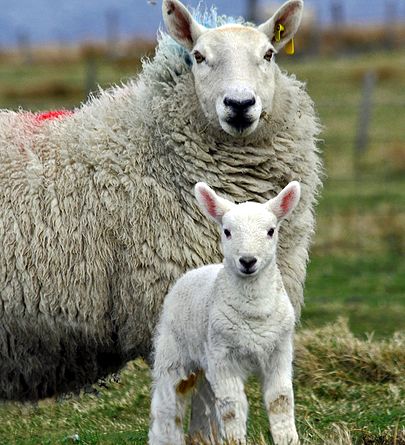
Cheviot ewe with lamb

Question 1. Do you improve your land by keeping sheep, or is it rendered poorer?

Answer. Sheep do not hurt a farm, the pasture need not be long if it is clear; sheep do well enough in summer, though kept on very indifferent pasture. I do not conceive from my experience that sheep improve a farm.

Question 2. What breed of sheep thrive best in Upper Canada?

Answer. I believe the common sheep of the country, the Cheviot breed do, but I would prefer the Liecestershire breed, if they could be easily kept, as being a much heavier sheep, and affording a much greater quantity of wool, and either I consider more advantageous than the full blooded merino. I have the full blooded merino, its wool is too fine, and does not suit the machinery in use in the country, neither will this sheep stand the winter like the Cheviot breed of sheep.

The merino breed crossed with the Cheviot, if kept carefully during the winter, are better adapted for this climate, and their wool being of an intermediate quality, between the former and the latter, is far better suited to our domestic manufacture.

Question 3. When should the rams be allowed to go to the ewes?

Answer. From my experience, not before the 15th or 24th of November, because the ewes if not very full in condition, will not nurse or attend their lambs. In this case, the lambing time will be from the 5th to the 24th of April, (a sheep going 5 months) and at this period, the season is becoming daily milder, so as not to chill the lambs, and there is generally grass enough come up to form a great proportion of sheeps' food. If the sheep lamb in February or March, we have little chance of succeding in saving the lambs, ten or eleven out of twelve die, the grass not being grown, and the weather being too cold.

Question 4. In your knowledge, and with good management, your ewes being sixty, and taking one year with another, how many lambs wil you have each season?

Answer. I should expect sixty lambs; some of the ewes will be barren, others will have two lambs, and perhaps a few lambs may die.

Question 5. What is your general method of managing flocks of sheep during the winter?

Answer. During the winter season, I keep my ewes of two years old and upwards, with my wethers, in a body apart by themselves, and give them plenty of good hay, but not red clover hay, which is not good for them. I have sheds for them at night; when the weather is stormy, and the snow deep, they are kept in these sheds in the day time; but only in such cases, as it is of the utmost importance to sheep to have freedom, when the weather renders it at all possible.

The sping lambs, and the wether sheep, I keep apart by themselves in a comfortable place, giving them, besides good hay, occasionally a little grain, oats, pease or maize are good, I do not think much of buck-wheat, but though I have not had much experience of oil-cake, I know that its mixture with wheat, or bran, will answer well. I give all my sheep salt, once a week, two quarts serve 100 sheep.

Question 6. Do you think it advantages to let the spring lambs breed the first year?

Answer. I do not. In small flocks it cannot be prevented, but I would advise, where large flocks are kept, that the lambs be weaned about the lasy of July, or beginning of August, and then kept seperated from the rest of the flock, until the following spring, and that in no case the rams be let amongst them. Sheep which are then prevented from bearing lambs the first year, become much better and stronger, they greatly improve the stock, &c by weaning the lambs as above. They are no worse, and it gives the ewe time to get in better order to stand our long winters.

Question 7. How ought sheep to be kept in the summer?

Answer. I should say, in the open field, or in a large space; sheep kept very close together at night, become unhealthy.

Question 8. Are sheep liable to many disorders in this country?

Answer. The worst disorder to which sheep are here liable, is cold; most commonly caused by over early shearing and washing. I disapprove of washing before shearing, in general, as it is made a frolic of; sheep are handled too roughly and are apt to get hurt. The best time for shearing, if the weather is not too cold, is early in June. I entirely disapprove of shearing at an earlier period. By this time the new wool is some grown, the sheep therefore can be easier shorn, and it will thereafter feel comfortable. An objection has been raised by many, that the new wool is shorn and intermixed with the old, and that my that means, the wool is injured in the carding machine. From my experience in this country, I can say that I have always shorn my sheep late, and that the carders have assured me that no better wool to work than mine has ever passed through their hands. I have had 15 years experience in Britain before  came to this country; and in the last five years before I emigrated, I aided and assisted in shearing 25,000 sheep, yet I never heard a complaint of this nature made. I know of no other disorder generally affecting sheep in Canada, unless sometimes blindness - The cure in this case is to let blood in a small vein in the hollow below the eye, and let the blood run into the eye.

Question 9. Do you think the risk in keeping sheep is so great here as in Britain?

Answer. I should say, no. As regards disorders, there are much fewer natural deaths; the risk in winter is less. But wolves, though unknown in Britain, are very destructive to flocks in most places in this province, I conceive the bounty offered for their destruction to be a measure of general utility. There is little risk of losing sheep in winter, if they are duly attended to.

Question 10. Have you any other remark of importance to make concerning the improvement of sheep?

Answer. To improve the stock, I would draw off some of my oldest ewes and weakest lambs and dispose of them to some one having a smaller stock who could tend them better. The old ewes may be known by looking in their mouths to see if all their teeth are in good order. If any of the teeth are lost, or become very long and sharp, I would put them away, unless in a rare instance of a very good ewe. In all stocks, change the rams occasionally.

Question 11. You have, doubtless, from your long experience, a correct idea of the profits to be derived from the keeping of sheep flocks; state your opinion on the subject?

Answer. I average about 3 lbs of wool yearly from each sheep. The expense of keeping sheep, taking one with another throughout the year, I calculate at about a dollar a head. Ewes will do to keep 9 or 10 years, or till their mouths get very bad, so as that they cannot eat; but wethers, if they are fat, should be killed at 4 or 5 years, as they never will be so good food after that age. Even at the price which wool now fetches in the best settled part of the province, I should say that it would pay the expenses and risk of keeping the sheep. By keeping on the stock of wether lambs, and selling the old wethers fat in the spring or early in the summer at 4 or 5 years, there is a profit; 5 or 6 dollars has in many cases been paid, (the fleece being on;) the average price is about a guinea.

In a flock of 100 sheep, and allowing for all accidents, I should suppose 40 lambs to be the increase yearly; Iike enough a half would prove to be rams - Twenty wethers could thus be sold every year, and the stock would still be on the increase. This gives a profit of twenty guineas, besides an increase of twenty ewe lambs in one year, after paying all expenses and trouble. The profit is indeed much greater than this, but I have conceived it best to be under, rather than over the truth. I think that sheep are the most profitable stock a farmer can keep in this country, for such as have farms that will permit the keeping of them."

We informed Mr. Brown that we would publish his observations in an early paper, to which he agreed; indeed, we have made it a rule that what we obtain of information, in private, we never shall make public, using our informant's name, without his consent. We now took our leave of this worthy and opulent farmer and his family, and descended the mountain, fully enjoying the beautiful, interesting, and varied scenery, which the grand amphitheatre around Burlington Bay presents, thinking, all the while, upon the bonny highland hills, sheep cots, and green knowes of our native Scotland, and lifting merrily one of those songs of the inimitable Ramsay, which we had first heard sung amidst the echoes of our native glens and heather mountains, (and which our readers, if in cheerful mood, may find the pretty pastoral, "the Gentle Shepherd.") We soon reached the valley by the narrow craggy road least travelled, and in rather better than an hour found ourselves in the busy little village of Coote's Paradise, better know by its other name, Dundas."

Thursday, February 19, 2015

It Takes a Village

A census is a wonderful tool for looking back at a population at a particular point in time. What were their names? Where did they come from? What did they do to get by? While census data is often bare-bones and provides the most basic facts, it can help us to understand a community and create a framework that can later be filled in by other source material.

In 1851 a census was completed for Galt, which included information on its 2,246 residents: Name, Place of birth; Religion; Occupation; Age; Marriage status; etc. If you've ever wondered what you might do for a living in a small Victorian village, take a look at the graph I've compiled below. Not every census taker had an occupation listed, and I have a sneaking suspicion that there were in fact more farmers... but this information, though incomplete, is eye-opening. You can check out the rest of the census in an easy to read PDF document here.


You do what exactly? Well, a Spinster is an unmarried (and not likely to become married) woman. She might be living and looking after the welfare of older relatives, or living with and looking after the education of nieces and nephews. Coopers are makers and repairers of casks and barrels. A Teamster is someone who drives a team of draft animals and a wagon. You can think of them as the equivalent of transport truck drivers today. Sadlers make, sell and.or repair saddlery. A Mill Wright is someone who builds and maintains mills and their internal machinery. Cordwainers are actually shoemakers who work with cordovan leather. Fleshers flesh hides and skins and tan them in the production of leather. They may also sell meat - in other words, a butcher. Pedlers are travelling salesmen, often going from door to door to trade and sell any number of items. Lime Burners process limestone (by means of baking it in large kilns) into a number of agricultural and home products such as quicklime for home construction, whitewash, and for spreading on fields as a fertilizer. A House Joiner is a type of carpenter that cuts and fits wood without the use of nails, screws, or other metal fasteners. Lastly, a Carriage Trimmer is someone who preps and finishes the lace, linings, and other trimmings for carriage makers.

Sources
Waterloo Region 1851 Census, Transcribed by the Ontario Genealogical Society in 2001.

Thursday, February 5, 2015

Guelph and Stirling, 1840s

To follow up on a previous post comparing (somewhat arbitrarily) early Galt and Edinburgh circa 1820, I present to you now a visual comparison of Guelph and Stirling circa 1840s:

Guelph in 1842, population: Approximately 1,300
http://www.torontopubliclibrary.ca/detail.jsp?Entt=RDMDC-PICTURES-R-323&R=DC-PICTURES-R-323
1842 Pencil and Brown Wash Drawing of Guelph
Stirling in 1845, population: Approximately 2,159
1840 Engraving of Stirling and Castle by R.S. Michie

Thursday, January 29, 2015

From Adze to Zouave Jackets

A brief A-Z glossary of words one might encounter when studying life in Upper Canada.  For more detail on each of the words, phrases, names, and titles, simply follow the source links provided.

A - Adze
Used with the hewing axe to make the log faces as smooth as possible. Any divots, chunks, or "juggle marks" in the logs made by the hewing axe allow water to penetrate the wood, creating rot. In winter, this moisture will form ice build-up, stress the wood and cause the building to shift. (The Dalziel Barn) See image 1.
1. An Adze at work
2. Neeps along with haggis and potatoes
3. Toulouse Geese (with a gentleman
for scale)
4. Example of a Zouave Jacket and dress
from 1862.
B - Bairn
Noun, Scot. and North England for a child; son or daughter. (Dictionary.com)
C - Ceilidh
A Scottish and Irish term for a party with music, dancing, and often storytelling. (Wikipedia
D - Dovetail Joint (Dovetailing)
A joint formed by one or more dovetails fitting tightly within corresponding mortises. (Visual Dictionary of Architecture)
E - Emigration
Emigration is the act of leaving one's native country with the intent to settle permanently or temporarily elsewhere. Conversely, immigration describes the movement of persons into one country from another. (Dictionary.com) Remember that one always emigrates from and immigrates to a place.
F - Fermentation
Fermentation is a metabolic process that converts sugar to acids, gases, and/or alcohol. Important particularly when discussing beer and its importance in pioneer life in Upper Canada. It was often safer to drink than water, had a number of medicinal uses, and contained a number of vitamins and minerals needed by hardworking homesteaders. By the 1860s there were 300 breweries across Upper Canada, not to mention the fact that beer was also brewed at home in the kitchen. (Virtual Museum of Canada)
G - Gaelic
Noun; any of the closely related languages of the Celts in Ireland, Scotland, or (formerly) the Isle of Man. Adjective; of, denoting, or relating to the Celtic people of Ireland, Scotland, or the Isle of Man or their language or customs.(Dictionary.com)
H - Hogmanay
It is believed that many of the traditional Hogmanay celebrations were originally brought to Scotland by the invading Vikings in the early 8th and 9th centuries. There are several traditions and superstitions that should be taken care of before midnight on the 31st December: these include cleaning the house and taking out the ashes from the fire, there is also the requirement to clear all your debts before "the bells" sound midnight, the underlying message being to clear out the remains of the old year, have a clean break and welcome in a young, New Year on a happy note. (Historic UK)
I - Indian
Indian people are one of three cultural groups, along with Inuit and Métis, recognized as Aboriginal people under section 35 of the Constitution Act. There are legal reasons for the continued use of the term "Indian." Such terminology is recognized in the Indian Act, and is used by the Government of Canada when making reference to this particular group of Aboriginal people. (Aboriginal Affairs)
J - James Young
The Honourable James Young was born in Galt on 24 May 1835. Raised in Galt, he worked as a journalist before spending 25 years in politics (12 years of which in the federal parliament). It was at this time that Mr Young wrote his history of early Galt, titled "Reminiscences of the Early History of Galt and the Settlement of Dumfries" and published in 1880. The book remains one of the major sources of information about the early development of our community. (City of Cambridge)
K - Kirk
Kirk is a Scottish word meaning a church, or more specifically, the Church of Scotland. (The Church of Scotland)
L - Land-Jobber
A man who makes a business of buying land on speculation, or of buying and selling for the profit of bargains, or who buys and sells for others.
M - Mortise and Tenon
A joint made between two pieces of wood where the projecting part of one piece fits into a corresponding cu-tout on another. (Architectural Terms)
N - Neeps
A popular (and delicious) side to a haggis dinner; made primarily of boiled and mashed turnips. See image 2.
O - Orkneymen
Immigrants from the Orkney Islands, off the north coast of Scotland, Orkneymen played a major and largely unrecognized part in the exploration and settlement of Canada's North-West in the 18th and 19th centuries. At the peak of their involvement with the HBC in 1800, Orkneymen comprised 80% of a labour force of almost 500. (Canadian Encyclopedia)
P - Parritch
Although it is by no means a dish confined to Scotland, parritch (an altered pronunciation of the earlier form “potage”) was until quite recently such a staple of the Scots diet that it became the foundation, not only for a day’s work, but also for wisdom. Parritch figures strongly in a number of Scottish proverbs. Today the term "porridge" has become more popular. (Scots Language Centre)
Q - Quoin
A quoin is an angle at the outside corner of a building. You can call the corner itself a quoin, or use the word for the special stones or bricks that reinforce corners of brick or stone buildings. Some quoins are decorative features, providing variety and pattern to the corner where two exterior walls meet. (Vocabulary.com)
R - Rebellion
The 1837 rebellion in Upper Canada [Ontario] was a less violent, more limited affair than the insurrection that same year in neighbouring Lower Canada [Quebec], although its leaders, including William Lyon Mackenzie, were no less serious in their demands for democratic reform, and an end to the rule of a privileged oligarchy. The rebellion itself failed, yet its very failure helped pave the way for more moderate and careful political change in British North America, including the union of Upper and Lower Canada, and the eventual arrival of responsible government. (Canadian Encyclopedia)
S - Saltire (St. Andrew's Cross)
The Saltire is the national flag of Scotland and, with a white diagonal cross on a blue background, it represents the crucifixion of the apostle St. Andrew Scotland’s patron saint. Believed to be the oldest flag in Europe, the origin of the flag comes from an old legend. Tradition has it that the flag originated in a battle fought near the East Lothian village of Athelstaneford in AD 832. (Visit Scotland)
T - Toulouse Goose
The name Toulouse is used for several types of gray geese descended from the European Greylag. People have selected Toulouse as general purpose farm birds, as producers of fois gras, and as show-birds. In the past, goose fat was a primary source for cooking fats and lubricants. Historically farmers often raised Dewlap Toulouse geese in cages to limit their movement, valuing their ability to put on large quantities of fat when fed plenty of food with no room to exercise. (The Livestock Conservancy) See image 3.
U - United Empire Loyalists
The United Empire Loyalists were generally those who had been settled in the thirteen colonies at the outbreak of the American Revolution, who remained loyal to and took up the Royal Standard, and who settled in what is now Canada at the end of the war. (United Empire Loyalists Association of Canada)
V - Venison
Noun, the flesh of a deer or similar animal as used for food. (Dictionary.com)
W - Wattle and Daub
Wattle and daub is a composite building material used for making walls, in which a woven lattice of wooden strips [or branches, etc.] called wattle is daubed with a sticky material usually made of some combination of wet soil, clay, sand, animal dung and straw. (Wikipedia)
Y - Yoke
Wooden shoulder yokes [for people] were used to carry two buckets of milk from the cow to the dairy in the days when cows were milked in the fields. They were also heavily used to collect water for household use.  The yoke was made from a beam of wood, usually willow for lightness, but ash and sycamore were also used. It is concave at the centre to fit comfortably around the shoulders, with a recess to fit around the neck of the wearer. The ends of the yoke tapered to terminate just beyond the wearer's shoulders. Chains were then hung from the ends with hooks to fix onto the buckets. (Object Lessons)
Z - Zouave Jacket
A woman’s short embroidered jacket or bodice, with or without sleeves, resembling the jacket of the Zouave uniform. (Oxford English Dictionary) See image 4.

Thursday, January 15, 2015

To Scotchmen in the Colonies...

Click to view a larger version of this image
Printing in Victorian Canada was often a very time consuming process. Just one paragraph from the paper shown here would take about 90 minutes to set up - letter by letter, space by space on a setting stick. The entire sheet adds up to almost 21 hours of work, done by the Printer, or divided amongst any apprentices. Add to that the effort of printing each sheet individually (a speedy professional could press 40-50 sheets an hour), and the drying time for the ink as well as the time needed to bring all the printed sheets together into what we would recognize as a "newspaper", and, well... let's just say you've got a lot of work cut out for you.

All of that work would of course be completed after the author had written their piece, and had paid the Printer for the space in their publication. As the many supplies required for a printing press (including paper) began to be manufactured in Canada in the 1830s, prices dropped, and the entire process became more accessible. More printers, a greater number of publications, and increased readership led to staggering amounts of personal opinions becoming public. During times of political and cultural tension these opinions tended towards the lengthy, but were anything but prosaic. Grandiose Victorian language simply meant more work for the apprentice, and more money for the Printer.

Sources
Toronto Reference Library 2015, "To Scotchmen in the Colonies and at Home"
The Canadian Encyclopedia 2013, "Print Industry"
YouTube, "BCPrinter" A brief video showing a visit to the Print Shop at Black Creek Pioneer Village, Toronto.

Thursday, October 16, 2014

Mini Review: How the Scots Invented Canada

How the Scots Invented Canada is Ken McGoogan's biographical response to Arthur Herman's 2001 How the Scots Invented the Modern World. Rather than discussing larger themes that effect an international diaspora, McGoogan has opted to narrow the scope to (exactly 60) important Scottish individuals on the Canadian scene. There were a lot to choose from - 13 of our 22 prime ministers have Scottish heritage, not to mention the many explorers, settlers, inventors and visionaries up to present day.

"Early arrivals included explorers Alexander Mackenzie, Simon Fraser and the 'Scotch West Indian', James Douglas. Later, Scots such as Lord Selkirk and John Galt encouraged thousands to immigrate. Nation-builders followed, among them John A. Macdonald, James McGill and the reformer Nellie McClung. Then came the visionaries, Scottish Canadians such as Tommy Douglas, Doris Anderson and Marshall McLuhan, who have turned Canada into a nation that revels in diversity." (From the publisher)

My review of this book is a bit mixed, in that many of the things I find great about Scots are the same things that I dislike, or see as a failing. Maybe balanced is a better word? Here's what I mean:

One of the first things I'd noticed when I was flipping through the book at the store was the amount of archival images that McGoogan has included; portraits, photographs, ephemera, you name it. At the time I thought that was wonderful, and I continued to think that while I was reading until I realized that none of the source information for the images is included. Which archives is it from? Is it on display in a museum or gallery? Who painted that image? The best part about sharing information with others is the possibility that it might actually inspire them to want to learn more. With the lack of photograph/archives credits in Scots I feel like many people (myself included) will be left out in the cold.

This dearth of source information extends to the research as well. There are no footnotes or endnotes... only a suggested reading list in the appendix to let you know where McGoogan's facts might have come from. (I'm one of those people that love reading the footnotes; not just to check sources, but also for small anecdotes or related facts.) That being said, not all books have notes. Some books are not meant for an academic audience, but rather for a popular audience looking for an enjoyable and easy read.

The story-telling quality that McGoogan gives to his books is enjoyed so much that he was the recipient of the 2006 Pierre Berton Award for popularising Canadian history. Now, while I do enjoy McGoogan's more informal take on historic personalities and their contributions to Canadian society, I could do without the personal anecdotes of his own Scottish vacations and family connections. I don't think that these particular extras add to the reader's understanding of the book, and indeed at times made me feel like I had been tricked into watching a slideshow of someone else's vacation. That being said, I understand that many might find McGoogan's personal approach in this regard an accessible way to break into Canadian/Scottish history.

I would recommend this book to a casual reader with an interest in history - someone looking to increase their general knowledge in all things Canadian. As far as using the book for academic means, I would treat it the same way I treat Wikipedia; it's the perfect jumping off point for ideas and research, but should by no means be your only source.

Sources
Harper Collins Canada, 2014 "How the Scots Invented Canada"
Roy MacSkimming's 2010 Globe and Mail Review of How the Scots Invented Canada
D. Grant Black's 2010 Toronto Star Review of How the Scots Invented Canada
Canada's History Magazine Online 2014, "Ken McGoogan: 2006 Pierre Berton Award Winner"

Further Reading
You can find your own copy of How the Scots Invented Canada at Amazon or Chapters.
Visit Ken McGoogan's Blog here
University of Sheffield, History Matters 2013, "Writing Popular History: Comfortable, Unchallenging Nostalgia-Fodder?"
Harvard University, Harvard Guide to Using Sources 2014, "What's Wrong with Wikipedia?"

Thursday, September 18, 2014

The Scottish Referendum

Today the people of Scotland are being asked "Should Scotland be an independent country? Yes/No".

While I've been keeping track of the referendum for just over a year, many have been on top of it (and part of it) for decades (and some would even argue centuries). If you're new to the issues, or are simply looking for some clarification, here are some links to help you learn more. They cover news of the referendum, why it's happening, and what might be the possible outcomes of today's vote.

BBC News: Scotland Decides - As always the BBC has done an excellent job of keeping it's readers informed. Everything from what would happen to food prices, currency, defence, and citizenship have been covered from multiple angles. They also have a poll tracker that compiles data from several different sources, and maps out events that may have changed the minds of voters.

The Scottish Government: Scotland's Referendum - This site offers highly accessible and easy to understand facts on the history of the Scottish Government, and answers questions that every day people would have about a possible Yes outcome. They even claim to have an entire section of infographics to help people understand the various issues related to the vote... I say claim because I don't think that coloured font qualifies as an infographic, but you can see for yourself.

The Telegraph - The UK-based newspaper has compiled its articles (which include opinion pieces, polls, and photos) on the referendum online; one of which explains how everyone's finances will be effected by the referendum. Likewise, The Guardian has dedicated a page to their coverage.

Here in Canada, the CBC has also covered the election, although not nearly as comprehensively.

If you'd like to learn more about the YES campaign for an independent Scotland, you can visit www.yesscotland.net For the Better Together campaign for a continued United Kingdom, visit www.bettertogether.net The Better Together site also claims to have infographics, and ones that you can share on Facebook no less... the thing is, is that these aren't infographics* either, they're just photographs.

Going through the above sites should give you a pretty good idea about what's at stake for either campaign. If you'd like even more background about why the Scots feel the need to have a referendum in the first place, the following histories are recommended:

Neil Oliver / BBC's, A History of Scotland
J.D. Mackie's, History of Scotland (You can read my review of this work here)
Michael Lynch's, Scotland: A New History
Daniel Szechi's 1715: The Great Jacobite Rebellion
Geoffrey Plank's Rebellion and Savagery: TheJacobite Rising of 1745 and the British Empire

Final results of the Scottish referendum will be made public the morning of September 19th 2014.

*For the record, an infographic is "a visual image such as a chart or diagram used to represent information or data". Here is an example, and one of my favourites: Star Trek The Original Series

Thursday, July 10, 2014

Mini-Review: A History of Scotland

J.D. Mackie's A History of Scotland is exactly that - a comprehensive history of Scotland from 11th century to the 1970s. At only 380 pages, this book is packed with information, and has long been regarded as the book to reach for on the subject. Mackie  was Professor of Scottish History and Literature at the University of Glasgow from 1930 to 1957, and became Her Majesty's Historiographer in Scotland in 1958. He had published numerous books on various related topics until his death in 1978.

"For a generation, this book - intelligent, fair-minded and accurate - has been acclaimed as the definitive one-volume history of a great nation." (From the publisher)

A History of Scotland has been immeasurably helpful to me in three ways. First, it provided a detailed introduction to the places and people of Scotland's past which helped me to further appreciate everything I saw during my trip to Edinburgh and the Highlands this past March. Second, it gives an amazing historical background to any examination of Scottish settlement in Canada - knowing the push and pull factors of why settlers were compelled to leave their homes and start anew. And lastly, it has helped me to better understand the current political and social climate in Scotland with regards to the upcoming September referendum - seeing all sides of an argument and being able to put everything into context is strangely satisfying.

When reading this book, I strongly advise you to have a map of Scotland handy, and be prepared to look up names and terms. There is so much information in this book that at times it can feel as though you're simply reading lists of battles, treaties, and nobles. Don't be intimidated, however; when a person or event is of great significance, Mackie will spend a paragraph or two explaining why before moving on.

If the book has any shortcomings it's that it has no illustrations or images, and only five historical maps. For a region with such a stunning landscape and a wonderful visual culture, it was a bit disappointing. Additionally, many early kings share the same name, and it would've been nice to be able to "see" each individual. I found it helpful to pause between sections of the book to watch episodes of the BBC produced "A History of Scotland", hosted by Neil Oliver. Being able to visualise the personalities through the ages and have names repeated is one of the best ways (for me anyway) to memorise things.

I would absolutely recommend this book to anyone interested in the history of Scotland and its peoples, or are interested in British history in general.* I've shared some links below where you can pick up your own copy.

Sources
J.D. Mackie, A History of Scotland, Penguin Books, 1984 (Revised Edition)
BBC One, "A History of Scotland"

Further Reading
You can find your own copy of A History of Scotland on Amazon or Chapters
BBC News, 2014 "Scotland Decides"
Diana Gabaldon's Website
The Outlander series on Amazon and Chapters

* I will also mention (for those readers of Diana Gabaldon's Outlander series) that this book provides a perfect background to the social, political, and religious undertones to the Jacobite rebellions and life in 1740s Scotland.