Showing posts with label History. Show all posts

Thursday, April 30, 2015

Mr. Dickson's House

View of Galt, Ontario, including Scotch church and Mr. Dixon's House
Drawing by Alice E. Brown in 1857, Currently a part of the Archives of Ontario collection
Sources
Archives of Ontario, 2014 "View of Galt..."
James Young's 1880, Reminiscences of the early history of Galt
First United Church, Cambridge "About Us"

Further Reading
Lucille H. Campey's 2005, The Scottish Pioneers of Upper Canada, 1784-1855: Glengarry and Beyond

Thursday, April 23, 2015

"Back In Pioneer Times" (Or, Semantics and the Past)

"I'm not a pilgrim! That was centuries ago!"
Jean Piaget explains, in his theory of cognitive development, that children are first able to distinguish the present from the past during the preoperational stage (ages 2-7 years old), and one past from another during the concrete operational stage (ages 7-11 years old). Knowledge of such development and learning theories are crucial for any museum education department, as well as for any adult who thinks that the past is just one amorphous blob and that "it's all the same anyway". Young museum visitors and students are able to discern various periods in time, and can associate with each differently - so help them out by being specific, and getting it right.

Much in the same way that "Upper Canada" and "Canada West" indicate certain geographical areas within specific periods of time, so to do the terms listed below. They are not all interchangeable, and should only really be used where appropriate. Oversimplifying for the sake of time or argument tends to rob historical groups of their accomplishments (for better or worse). It may also serve to confuse or mislead the person or group you're talking to - dangerous territory if you're dealing with students attempting to mentally map out a timeline.

Pioneer: A person who is among the first to explore or settle a new country or area
Settler: A person who settles in an area, typically one with no or few previous inhabitants.
Puritan: A member of a group of English Protestants of the late 16th and 17th centuries who regarded the Reformation of the Church of England under Elizabeth as incomplete and sought to simplify and regulate forms of worship.
Pilgrim: A member of a group of English Puritans fleeing religious persecution who sailed in the Mayflower (etc) and founded the colony of Plymouth, Massachusetts, in 1620.
Voyageur: (especially in Canada) A boatman employed by the fur companies in transporting goods and passengers to and from trading posts.
Colonial: Relating to the period of the British colonies in America before independence (1776).

To add to this, Victorians (1838-1901) for example, are not Puritans, Pilgrims, or Voyageurs, but can be pioneers or settlers depending on the place and the time. In Canada it's easy to visualize settlement as moving westward. Vancouver did not become an incorporated city until 1886 versus many Ontario towns which were founded in the early and mid-19th century, and by extension many Quebec and east coast settlements founded in the 17th and 18th centuries. So despite the 19th century being quite recent, many Victorians were the first to settle and establish many areas in the west.

As a former British colony, and as a member of the Commonwealth, we (Canadians) often denote specific periods of time in our history according to the reigning monarch. The Tudor period runs from 1485-1603; The Georgian period is often considered to span 1714-1830, and the Edwardian period from 1901-1914.

Sources
Simply Psychology 2012, "Jean Piaget"

Further Reading
TheFreeDictionary.com
The Commonwealth 2015, "Member countries"

Thursday, April 16, 2015

Pipes, Guitar, and Flute, Oh My!

With the warmer weather upon us (finally!), it's time to venture out and experience another season of festivals, events, and games in Ontario. Many of these gatherings are a great opportunity to experience and learn more about the Scottish traditions which remain vital to many communities. What can be more Scottish than bagpipes?

Thursday, April 23, 2015 starting at 7:00pm
McDougall Cottage, Cambridge
Tel: 519-624-8250
89 Grande Ave S.
N1S 2L7

New performer. Join multi-talented musician Mark Fletcher for a fabulous evening of traditional Scottish fiddle music and song. Mark performs small pipes, mandola, guitar, flute, whistles and Highland pipes. He is joined by fellow performer Drew Skuce (bodhran) for a fantastic evening of Scottish tunes. Music spanning 4 centuries, from both the Scottish Borders and the Highlands will be featured; some linked to history and historical figures and some just for the fun of the music. www.markfletcher.ca.

Admission by cash donation.

Thursday, April 9, 2015

All Aboard!

This image has nothing overtly to do with early settlement and Scottish culture, but it caught my attention enough that I thought it worth sharing. I love coming across images of home from different periods and perspectives. Galt at the start of the 20th century was absolutely bursting with potential and promise - all aboard!

Galt, Preston and Hespeler Street Railway, 1903
Sources
Waterloo Public Library, "Galt, Preston and Hespeler Street Railway"

Further Reading
Kitchener-Waterloo Street Railway 2007, "A History..."
TheRecord.com March 27, 2015 "Century-old streetcar line found under LRT construction"
The Globe and Mail 2010, "No desire for this Waterloo streetcar"
CBC February 25, 2015 "LRT construction set to close King Street in Kitchener in March"

Thursday, April 2, 2015

Cover Girl

A few weeks ago I found out that I made the cover of the 2015 Black Creek Pioneer Village Guidebook, and I'll be honest, I was quite excited. It's fun to think that my smiley profile and berlin work might help encourage people to learn more about history in Ontario. (Berlin work is a style of needlepoint which incorporated the bright new colours of yarn being developed from aniline dyes. Stitching into canvas meant that the pieces were also more durable and could be shown off by the lady who stitched them. The pattern and colours I was using came from a pattern created in 1852, and was for the top of an ottoman - we turned it into a cushion instead for the gift shop.)

I'm (not so secretly) proud of my hair that day.
Visiting an historical village is an excellent way to gain knowledge and understanding of a previous era, or, of another culture. You are allowed the opportunity to walk through buildings decorated and filled with consumer goods/tools/furnishings/foods etc. and talk with interpreters on the importance of those items, and how they were used. You often get to see interpreters and skilled tradespeople at work. Blacksmiths, printers, tinsmiths, and millers are eager to show you how things were done in a particular period. Not only that, you also get to see what the women were up to: baking, running households, spinning wool, doing needlework, or overseeing the Inn. These examples of course come from Black Creek, which represents an 1860s rural village, but variations can be applied to other sites.

What I think visitors have to be aware of before they visit any historical village, is how it came into being, when, and what the interpretive method/goals of the institution are. To use Black Creek as an example, I'll answer these questions and demonstrate their importance.

The 1860s "village" is an assemblage of buildings relocated there from throughout Southern Ontario. Their movement to the site just north of Toronto was spurred on by the rise (and excitement) of historical awareness and funding during Canada's Centennial (1967), as well as an availability of undevelopable land (Hurricane Hazel did not hesitate to show in 1954 that the area was in a massive floodplain). Classic nostalgia for a pre-war era informed the village's creators and their inclusion, placement, and interpretation of buildings. The Victorians are, after all, the originators of the nuclear family, and the cementers of gender-roles. Black Creek Pioneer Village is lucky to have so many original buildings - other sites that interpret older periods of history must rely on reconstructions. No rural village would be complete without the farm, and Black Creek's farm buildings are the only ones that are original to the site (ie. never been moved). That being said, farms were generally hundreds of acres large, and wouldn't have had so many neighbours, so close. Here's a map of the village to give you a better idea.

The finished product: A 22" square pillow that sold in the
Black Creek Pioneer Village gift shop, 2012.
Knowing these things brings out a more critical eye in the visitor. Black Creek isn't so much of a village as it is an (amazing!) outdoor museum with a collection of historic buildings and artefacts. The interpreters and their demonstrations help to create a story which often ends up nostalgizing the lives of those from the past - which is ok for a family outing on a Sunday afternoon so long as you realize there's more to the story.

Thinking of my time as a costumed interpreter reminds me of the many and varied interactions I've had with visitors. My favourite visitor of all time was an American gentleman who asked "what Confederation was all about anyway". My historic heart leapt. For the next 20 minutes we chatted about the formation of Canada in the kitchen of a house built before Confederation was even an idea. One of my proudest accomplishments was finishing this piece of berlin work in under three months using only daylight or oil lamps for light. The awkward always follows the good, however, so I would be remiss if I didn't include the following: Remember that interpreters and historic site staff are not automatons, or props, or seals. They go home at the end of the day, have feelings, get hot wearing seven layers of clothing in July, and want to teach rather than simply entertain. They are people. Best of all, they're well educated people (who are often volunteers) that are there for you! They want to answer your questions, teach you something new, dispel myths, and inspire you to learn more. As you venture out this spring/summer to historic villages and sites in your area, or beyond, remember to acknowledge the interpreters that bring that site to life. If you ask nicely, they might even pose for your own photos.

Sources
The Canadian Encyclopedia Online, "Confederation"
Black Creek Pioneer Village, Homepage

Further Reading
American Needlepoint Guild 2000, "Berlin Work"

Thursday, March 26, 2015

Henry Stephens on Sheep

Henry Stephens is the author of the immensely popular Book of the Farm. Published in 1844, it enjoyed numerous re-prints and again became a highly sought after farming guide in the 21st century after being highlighted in BBC's Victorian Farm. Stephens himself was a Scot who studied chemistry, mathematics and agriculture in Dundee and in Edinburgh, and later went on to apprentice on a farm for several years. A tour of the continent allowed Stephens to compare methods and technologies, of which there seemed to be new ones every day. In the end, financial difficulties forced him away from farm management, and toward writing. He published a series of articles and books before his death in 1874 at the age of 79.

The following excerpts come from the edited version of Stephens' work produced by Alex Langlands of "Victorian Farm" fame. 

The Shepherd
His duty is to undertake the entire management of the sheep; and when he bestows the pains he should on his flock, he has little leisure for any other work. His time is occupied from early dawn, when he should be among his flock before they rise from their lair, and during the whole day, to the evening, when they again lie down for the night. To inspect a large flock at least three times a day, over extensive bounds, implies a walking to fatigue. Besides this daily exercise, he has to attend to the feeding of the young sheep on turnips in winter, the lambing of the ewes in spring, the washing and shearing of the fleece in summer, and the bathing of the flock in autumn. And, over and above these major operations, there are minor ones of weaning, milking, drafting and marking, at appointed times; not to omit the unwearied attention to be bestowed, for a time, on the whole flock, to evade the attacks of insects. (20)

By-Products of Sheep
The sheep is one of the most useful, and therefore one of the most valuable, of our domestic animals; it not only supports our life by its nutritious flesh, but clothes our bodies with its comfortable wool. All writers on diet have agreed in describing mutton as the most valuable of articles of human food. But the products of sheep are not merely useful to man, they also promote his luxuries. The skin of sheep is made into leather and, when so manufactured with the fleece on, makes comfortable mats for the doors of our rooms, and rugs for our carriages. For this purpose the best skins are selected, and covered with the longest and most beautiful fleece. Tanned sheepskin is used in bookbinding. (65-66)

Sources
Alex Langlands' 2011 edited and abridged Book of the Farm (I'm quite partial to my own copy of this book, as I had it signed by Ruth Goodman after attending a lecture by her in Waterloo, Ontario in 2011)
Henry Stephens' 1844 Book of the Farm

Further Reading
The Guardian, "TV show turns long out-of-print farming manual into hot seller"

I'd like to thank Caroline Bendiner for contributing to Sheep Month here on Upper Canada Scots. If you missed her three-part series on wool in the 19th century, simply scroll down or click on March 2015 in the archives. I'd also like to thank everyone who visited this blog in the last month - who knew sheep would be so popular a topic? If there's another aspect of colonial life that you'd like me to focus on, just let me know in the comments below. Happy March!

Thursday, March 19, 2015

Wool in the 19th Century - Part Three

Ontario’s early history of sheep and wool is less about any financial benefits and more about basic survival in harsh, isolated, and extreme environments.  Many newly arrived settlers in the 18th and early 19th centuries were unaware of the extremes in climate in this area. Autumns could bring unexpected frost during the night, freezing many livestock to death.  Settlers had to fear other predators attacking their sheep and livestock: foxes, minx, weasels, and wolves would find their way into animal barns and make a meal of the farmers’ livestock.  Winter brought even colder temperatures, and hungrier predators.

From the 18th century to the first few decades of the 19th century, many early settlers were working with wool solely to clothe themselves rather than for business purposes.  The entire wool production process was very time consuming, and a couple would be lucky to make enough socks to keep their feet warm during their first winter on their land, let alone make sweaters and cloaks.

As early settlers arrived on their properties, the task of creating a farm and home for their family took precedence over spinning an entire wardrobe’s worth of wool.  Time may not allow for much at all to be spun.  About 5 hours of spinning can produce enough yarn to make a pair of socks.  This does not include the shearing, cleaning, carding, and eventual knitting to make the socks.  After the first few years on their farm, a family would probably have produced enough wool to live on, and would be at a point where they can sell or trade any surplus of woollen goods with other neighbours in need.

By the 1830s, the image of the early settler woman sitting in her cabin and spinning wool on the spinning wheel becomes increasingly obsolete.  Early settlers moved up from their tiny cabins to established farm houses, and availability of goods made spinning their own wool less of a necessity for survival.  At this point, it becomes more of a hobby for those that could afford the leisure time.  Spinning thus becomes a nostalgic image of early settlers and their struggle to clothe themselves warmly for the harsh winters.  To this day, nothing can beat a nice home spun woollen toque, mitts, or scarf.

This three-part series "Wool in the 19th Century" was written by Caroline Bendiner, Culture Coordinator for the Township of King.  She has a BA in history from Queen's University and a post graduate certificate in Cultural Site Management from Centennial College. Caroline has a strong passion for history and sharing history with the public.

Monday, March 16, 2015

The Sheep Advocate

"Sheep Farming in Canada
Taken from the Colonial Advocate, Thursday, June 3, 1824. Published by W. L. Mackenzie, Bookseller, Queenston, Upper Canada.

We were called on some business conected with our private affairs, to York, in the early part of May last, and wishing to take the head of lake Ontario in our way, on our journey home, we returned in that direction, and meeting with indifferent weather on Flamboro' mountain, we sent the innkeeper's boy back with the horses, and made up our mind to rest for the night, and enjoy the pleasure of a chat about local improvements, with our esteemed acquaintance, Mr Alexander Brown, of East Flamboro'. Disappointment is the lot of man, and so it fared with us, for Mr. Brown whose plain, sound, Scotch judgement, (as Mr. Wilberforce would call it) is held in much respect by his neighbours, was absent acting as umpire upon some dispute which had occured between two of them in regard to a property. Mrs. B. however, prepared a comfortable cup of tea, and when her husband resturned, we informed him that, next day we would desire his opinion on a subject, o which he was well qualified to give correct information, viz. The rearing of sheep. Accordingly, next morning we proposed our queries, nearly in the order in which they are now arranged. Mr. Brown's answers we give entire adding nothing, and we conceive their publication in every paper in the Colonies, would be a benefit conferred on the country. We will in future numbers, consider the Canada woolen manufacture; it is a most important branch of our domestic industry, even now; and, be it remembered, it is also the principal, and favourite manufacture of old England.
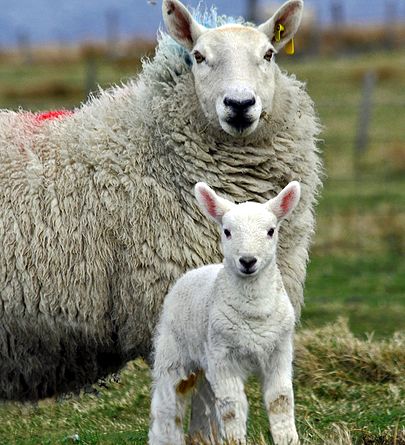
Cheviot ewe with lamb

Question 1. Do you improve your land by keeping sheep, or is it rendered poorer?

Answer. Sheep do not hurt a farm, the pasture need not be long if it is clear; sheep do well enough in summer, though kept on very indifferent pasture. I do not conceive from my experience that sheep improve a farm.

Question 2. What breed of sheep thrive best in Upper Canada?

Answer. I believe the common sheep of the country, the Cheviot breed do, but I would prefer the Liecestershire breed, if they could be easily kept, as being a much heavier sheep, and affording a much greater quantity of wool, and either I consider more advantageous than the full blooded merino. I have the full blooded merino, its wool is too fine, and does not suit the machinery in use in the country, neither will this sheep stand the winter like the Cheviot breed of sheep.

The merino breed crossed with the Cheviot, if kept carefully during the winter, are better adapted for this climate, and their wool being of an intermediate quality, between the former and the latter, is far better suited to our domestic manufacture.

Question 3. When should the rams be allowed to go to the ewes?

Answer. From my experience, not before the 15th or 24th of November, because the ewes if not very full in condition, will not nurse or attend their lambs. In this case, the lambing time will be from the 5th to the 24th of April, (a sheep going 5 months) and at this period, the season is becoming daily milder, so as not to chill the lambs, and there is generally grass enough come up to form a great proportion of sheeps' food. If the sheep lamb in February or March, we have little chance of succeding in saving the lambs, ten or eleven out of twelve die, the grass not being grown, and the weather being too cold.

Question 4. In your knowledge, and with good management, your ewes being sixty, and taking one year with another, how many lambs wil you have each season?

Answer. I should expect sixty lambs; some of the ewes will be barren, others will have two lambs, and perhaps a few lambs may die.

Question 5. What is your general method of managing flocks of sheep during the winter?

Answer. During the winter season, I keep my ewes of two years old and upwards, with my wethers, in a body apart by themselves, and give them plenty of good hay, but not red clover hay, which is not good for them. I have sheds for them at night; when the weather is stormy, and the snow deep, they are kept in these sheds in the day time; but only in such cases, as it is of the utmost importance to sheep to have freedom, when the weather renders it at all possible.

The sping lambs, and the wether sheep, I keep apart by themselves in a comfortable place, giving them, besides good hay, occasionally a little grain, oats, pease or maize are good, I do not think much of buck-wheat, but though I have not had much experience of oil-cake, I know that its mixture with wheat, or bran, will answer well. I give all my sheep salt, once a week, two quarts serve 100 sheep.

Question 6. Do you think it advantages to let the spring lambs breed the first year?

Answer. I do not. In small flocks it cannot be prevented, but I would advise, where large flocks are kept, that the lambs be weaned about the lasy of July, or beginning of August, and then kept seperated from the rest of the flock, until the following spring, and that in no case the rams be let amongst them. Sheep which are then prevented from bearing lambs the first year, become much better and stronger, they greatly improve the stock, &c by weaning the lambs as above. They are no worse, and it gives the ewe time to get in better order to stand our long winters.

Question 7. How ought sheep to be kept in the summer?

Answer. I should say, in the open field, or in a large space; sheep kept very close together at night, become unhealthy.

Question 8. Are sheep liable to many disorders in this country?

Answer. The worst disorder to which sheep are here liable, is cold; most commonly caused by over early shearing and washing. I disapprove of washing before shearing, in general, as it is made a frolic of; sheep are handled too roughly and are apt to get hurt. The best time for shearing, if the weather is not too cold, is early in June. I entirely disapprove of shearing at an earlier period. By this time the new wool is some grown, the sheep therefore can be easier shorn, and it will thereafter feel comfortable. An objection has been raised by many, that the new wool is shorn and intermixed with the old, and that my that means, the wool is injured in the carding machine. From my experience in this country, I can say that I have always shorn my sheep late, and that the carders have assured me that no better wool to work than mine has ever passed through their hands. I have had 15 years experience in Britain before  came to this country; and in the last five years before I emigrated, I aided and assisted in shearing 25,000 sheep, yet I never heard a complaint of this nature made. I know of no other disorder generally affecting sheep in Canada, unless sometimes blindness - The cure in this case is to let blood in a small vein in the hollow below the eye, and let the blood run into the eye.

Question 9. Do you think the risk in keeping sheep is so great here as in Britain?

Answer. I should say, no. As regards disorders, there are much fewer natural deaths; the risk in winter is less. But wolves, though unknown in Britain, are very destructive to flocks in most places in this province, I conceive the bounty offered for their destruction to be a measure of general utility. There is little risk of losing sheep in winter, if they are duly attended to.

Question 10. Have you any other remark of importance to make concerning the improvement of sheep?

Answer. To improve the stock, I would draw off some of my oldest ewes and weakest lambs and dispose of them to some one having a smaller stock who could tend them better. The old ewes may be known by looking in their mouths to see if all their teeth are in good order. If any of the teeth are lost, or become very long and sharp, I would put them away, unless in a rare instance of a very good ewe. In all stocks, change the rams occasionally.

Question 11. You have, doubtless, from your long experience, a correct idea of the profits to be derived from the keeping of sheep flocks; state your opinion on the subject?

Answer. I average about 3 lbs of wool yearly from each sheep. The expense of keeping sheep, taking one with another throughout the year, I calculate at about a dollar a head. Ewes will do to keep 9 or 10 years, or till their mouths get very bad, so as that they cannot eat; but wethers, if they are fat, should be killed at 4 or 5 years, as they never will be so good food after that age. Even at the price which wool now fetches in the best settled part of the province, I should say that it would pay the expenses and risk of keeping the sheep. By keeping on the stock of wether lambs, and selling the old wethers fat in the spring or early in the summer at 4 or 5 years, there is a profit; 5 or 6 dollars has in many cases been paid, (the fleece being on;) the average price is about a guinea.

In a flock of 100 sheep, and allowing for all accidents, I should suppose 40 lambs to be the increase yearly; Iike enough a half would prove to be rams - Twenty wethers could thus be sold every year, and the stock would still be on the increase. This gives a profit of twenty guineas, besides an increase of twenty ewe lambs in one year, after paying all expenses and trouble. The profit is indeed much greater than this, but I have conceived it best to be under, rather than over the truth. I think that sheep are the most profitable stock a farmer can keep in this country, for such as have farms that will permit the keeping of them."

We informed Mr. Brown that we would publish his observations in an early paper, to which he agreed; indeed, we have made it a rule that what we obtain of information, in private, we never shall make public, using our informant's name, without his consent. We now took our leave of this worthy and opulent farmer and his family, and descended the mountain, fully enjoying the beautiful, interesting, and varied scenery, which the grand amphitheatre around Burlington Bay presents, thinking, all the while, upon the bonny highland hills, sheep cots, and green knowes of our native Scotland, and lifting merrily one of those songs of the inimitable Ramsay, which we had first heard sung amidst the echoes of our native glens and heather mountains, (and which our readers, if in cheerful mood, may find the pretty pastoral, "the Gentle Shepherd.") We soon reached the valley by the narrow craggy road least travelled, and in rather better than an hour found ourselves in the busy little village of Coote's Paradise, better know by its other name, Dundas."

Thursday, March 12, 2015

Wool in the 19th Century - Part Two

Dyeing wool is a step that can take place either before or after the actual spinning process.  Early settlers in Ontario were dyeing their wool predominately to hide the dirt and filth on their clothes from their intense agricultural work.  They may not necessarily have an abundance of clothing, so to dye their one or two dresses brown would make going to church on Sundays less embarrassing because any dirt would be less noticeable.

Skeins of black walnut dyed wool
One of the most popular local dyes used in Ontario is mad from the shell of a black walnut.  Black walnut trees are native to Ontario.  In fact, many of the Pennsylvania-Dutch settlers that arrived in Ontario c.1790s-1830s believed black walnut trees to be a sign of fertility of the land, and would make their settlements near any growth.  This theory is explained in The Trail of the Black Walnut by G. Elmore Reaman, where the migration of the Pennsylvanian-Dutch from American to early Canada can be traced by the growth of black walnut trees throughout southern Ontario.  The black walnut itself can make a fantastic, and very intense, brown.  Perfect for masking any dirt!  After boiling the shells in hot water, you strain the water, and place the wool in the dye bath.  After sitting for just a few hours, you can get a fantastic brown dyed fabric!

This three-part series "Wool in the 19th Century" was written by Caroline Bendiner, Culture Coordinator for the Township of King.  She has a BA in history from Queen's University and a post graduate certificate in Cultural Site Management from Centennial College. Caroline has a strong passion for history and sharing history with the public.

Thursday, March 5, 2015

Wool in the 19th Century - Part One

Spinning Wool at Black Creek Pioneer Village
in Toronto, Ontario
One of the most iconic images of the early settler period of Ontario is that of a pioneer woman sitting in her tiny log cabin spinning wool.

The process of turning fleece into wool is simple, yet takes a lot of practice to truly perfect.  The first step is to shear the sheep; normally done once, sometimes twice, a year in the early spring.  This allows the sheep to be comfortable during the summer weather, while growing back their wool to maintain warmth through cooler seasons.

The next step is to clean the fleece.  To make the cleaning process more efficient, some would pick it apart first, removing any overly matted bits or large clumps of dirt or excrement.  How do you clean fleece?  You can literally place it in a tub of cold water with minimal soap.  Hot water can threaten the fibres and too much soap can remove some of the natural oils (lanolin) that even to this day we can separate and harness for other purposes (hand lotions, soaps).  Having some of the natural oils on the wool also makes it easier to spin.  Some settlers may change the water once or twice to remove as much of the dirt as possible.  

Traditional Sheep Shears
Once the fleece is clean, and before spinning it, it is integral to card the wool.  This involves using two brushes (carders) and brushing the wool in opposite directions.  The fibres that create the wool become straight after they’re carded, and the wool becomes easier to control when spinning.

Spinning wool is essentially the twisting of the fibres at a rapid pace to connect them and link them into one whole string.  The thickness and consistency of that string is all dependent on the spinner.  An early settler spinning wool to make socks for their children may not care so much for the consistently and quality of the string as someone spinning for a business.  It is completely possible to spin several strings together to create a thicker yarn.

This three-part series "Wool in the 19th Century" was written by Caroline Bendiner, Culture Coordinator for the Township of King. She has a BA in history from Queen's University and a post graduate certificate in Cultural Site Management from Centennial College. Caroline has a strong passion for history and sharing history with the public.

Thursday, February 19, 2015

It Takes a Village

A census is a wonderful tool for looking back at a population at a particular point in time. What were their names? Where did they come from? What did they do to get by? While census data is often bare-bones and provides the most basic facts, it can help us to understand a community and create a framework that can later be filled in by other source material.

In 1851 a census was completed for Galt, which included information on its 2,246 residents: Name, Place of birth; Religion; Occupation; Age; Marriage status; etc. If you've ever wondered what you might do for a living in a small Victorian village, take a look at the graph I've compiled below. Not every census taker had an occupation listed, and I have a sneaking suspicion that there were in fact more farmers... but this information, though incomplete, is eye-opening. You can check out the rest of the census in an easy to read PDF document here.


You do what exactly? Well, a Spinster is an unmarried (and not likely to become married) woman. She might be living and looking after the welfare of older relatives, or living with and looking after the education of nieces and nephews. Coopers are makers and repairers of casks and barrels. A Teamster is someone who drives a team of draft animals and a wagon. You can think of them as the equivalent of transport truck drivers today. Sadlers make, sell and.or repair saddlery. A Mill Wright is someone who builds and maintains mills and their internal machinery. Cordwainers are actually shoemakers who work with cordovan leather. Fleshers flesh hides and skins and tan them in the production of leather. They may also sell meat - in other words, a butcher. Pedlers are travelling salesmen, often going from door to door to trade and sell any number of items. Lime Burners process limestone (by means of baking it in large kilns) into a number of agricultural and home products such as quicklime for home construction, whitewash, and for spreading on fields as a fertilizer. A House Joiner is a type of carpenter that cuts and fits wood without the use of nails, screws, or other metal fasteners. Lastly, a Carriage Trimmer is someone who preps and finishes the lace, linings, and other trimmings for carriage makers.

Sources
Waterloo Region 1851 Census, Transcribed by the Ontario Genealogical Society in 2001.

Thursday, February 12, 2015

The Log Cabin Myth

Pioneers lived in log cabins... right? Well, it really depends on the period and the area in question. It also depends on your understanding of the definition of what constitutes a "log cabin". These excerpts from Hugh Morrison's Early American Architecture: From the First Colonial Settlements to the National Period help to explain:

http://www.torontopubliclibrary.ca/detail.jsp?R=DC-PICTURES-R-2500
Log House in Orillia Township, Ontario
1844 Picture by Titus Hibbert Ware
"By 'log cabin' we mean a dwelling built of round logs, laid horizontally on one another, with notched corners and protruding ends.... Spaces between logs, if any, are chinked with moss, clay, or oak chips.... the log cabin did not exist in any of the English colonies in the seventeenth century and was used very little throughout most of the eighteenth century. Neither did the Dutch use it in New Netherland, nor the French in Canada. It was a form of construction unknown in England, France, Holland, and southern Europe generally; it was likewise unknown to the American Indian.
...
It is tempting to believe that our early ancestors, gifted with ingenuity as well as courage, invented such an admirable solution to their urgent problem of quick and durable shelter. 
Apparently they did not. The English colonists did built blockhouses and prisons using logs hewn square and notched at the corners for either lapped or dovetail joints. This is indeed a superior type of construction, but it requires many tools and much skill and more time. The log cabin, if it had been known, would have supplanted the flimsy dugouts and cabins and wigwams the pioneer settlers actually built.
True log-cabin construction is thought to have been introduced into this country [the United States] by the Swedes when they settled Delaware in 1638.... In the eighteenth century, German settlers in Pennsylvania built large numbers of log houses, using both squared-log and round-log construction. Since most of the Germans entered the country by way of the Delaware valley, they must have acquired the technique from the Swedes...." (12-13)

Sources
Hugh Morrison's 1987, Early American Architecture
Harold Robert Shurtleff's 1939, The log cabin myth: a study of the early dwellings of the English colonists in North America

Further Reading
History News Network 2015, "Top 10 Myths About Thanksgiving"

Thursday, January 1, 2015

Hogmanay - A Scottish New Year Celebration

http://blog.britishnewspaperarchive.co.uk/2012/12/31/the-origins-history-and-traditions-of-hogmanay/
Hull Daily Mail – Tuesday 30 December 1930
Hogmanay is more than just a wildly fun all-night New Years' Eve street party in Edinburgh; it's a long-standing (and apparently somewhat mysterious) tradition that goes back centuries.

Celebrations today may include fire-dancers, fireworks, the consumption of copious amounts of alcohol, live music in the streets, dancing, parades and more. Edinburgh's Hogmanay celebration is the largest in Scotland, and attracts visitors from around the world.

First Footing is a New Years tradition that begins at midnight and continues into the early morning. This custom involves being (or welcoming) the first person through the threshold of your home for the New Year. This 'first footer' would bring any number of symbolic gifts to the homeowner, each of which would bring a different sort of luck for the year ahead: Salt (for flavour), coal (for warmth), shortbread (for food), or whisky (good cheer). If you are short, blonde, and a female, it is recommended that you not attempt to beat anyone through a Scot's doorway at midnight - you're bad luck. A tall, dark, and handsome man is who's really desired, as it would indicate that that family inside would have a financially prosperous year. The Greeks have a similar tradition.

The Illustrated London News
December 30, 1882
"The First Foot: A Scottish Custom on New Years' Eve"
In preparation for Hogmanay in Upper Canada, Scottish settlers would thoroughly clean their homes, finish any mending that needed to be done, change bedding, do any polishing, pay off any debts and return any items that had been borrowed over the past year - in other words, they would put their lives, homes, and businesses in order for the New Year.

Sources
Hogmanay.net 2014, "Hogmanay FAQs"
Edinburgh's Hogmanay 2014/2015 Website

Further Reading
Wikipedia 2014 "Hogmanay" for an overview of some popular traditions/customs.
Ava Laboy Capo's 2013 Traditions/Superstitions From Around the World!: To Bring in the New Year!

I'd like to take this opportunity to wish everyone a very happy and healthy New Year! Here comes 2015!

Thursday, December 11, 2014

Shopping in Shade's Mills

For the early settlers arriving and establishing themselves in Shade's Mills/Galt, there were but a few options when it came to purchasing the goods they needed and/or wanted.

Excerpt from James Young's Reminiscences of Galt, Page 54
The first option was to visit the combined home/general store of Absalom Shade and his second wife, Isabella. This two-storey log home was the first to be built in the new settlement (c.1816), and was located near the corner of Main and Water streets. (Young, 31) By the following year a blacksmith's shop had opened, thus providing the necessary materials and equipment for life on a farm. Mr. Shade was able to secure for himself a bit of a monopoly for his general store, and later increased his trade in 1824 with the opening of a second and larger shop, known as the Red store. (Young, 48) With a promise from William Dickson that no land would be sold to anyone else wishing to construct or operate a shop, Shade was able to comfortably grow his personal fortune.

Nearly a decade later, Mr. Shade added the 'White store' to his holdings (c.1832). Different from the Red store which conducted business in credit or barter, the White store worked in cash. (Young, 109) There was also now a hatter in the village, as well as a tavern, and a hotel. As the population of Dumfries township and surrounding areas grew, so to did competition. In neighbouring Preston, and in Waterloo, shops were able to offer goods at lower prices. The construction of roads, relative ease of transport (as compared to the previous decades), growing industry in other larger towns, and increased demand for "luxury" items encouraged businessmen to open up new enterprises.* By 1838 a former pedlar had opened a shop in the heart of Galt, and Shade's monopoly was effectively broken.

Sources
Black Sheet Iron Money Box, c.1830-1850
Dictionary of Canadian Biography 2014, "Shade, Absalom"James Young's 1880, Reminiscences of the early history of Galt
McCalla, Douglas. “Retailing in the Countryside: Upper Canadian General Stores in the Mid-Nineteenth Century”. In Business and Economic History, Winter 1997; 26, 2. Pages 393-403.

Further Reading
For more information on the credit and barter systems, you can check out a previous blog post here.
W. Hamish Fraser's 1981 The Coming of the Mass Market,1850-1914
Michael Gonder Scherck's 1905 Early Pioneer Life in Upper Canada.

* It has been shown that villages/towns with populations over 500 tend to see the growth of specialised shops. For example, rather than visiting a general store for items you might need, you can visit the shoemaker, the harness shop, the carpenter, or the grocer's separately. Ideally, these specialised shops would be able to offer you more selection, and possibly better prices. (McCalla)

Thursday, December 4, 2014

Huron County Museum

Central School, constructed in 1856
A few weeks ago I happily seized upon an opportunity to visit the Huron County Museum and Historic Gaol in Goderich, Ontario. This was my first visit to the museum, though once inside I felt right at home. The permanent exhibits focus on development - development of the Huron Tract from forests to farms to thriving modern communities; development of agricultural technology and methods over the past two hundred-plus years; and the development of the people from settlers to soldiers, and from farmers to Victorian and Edwardian fashionistas.

1913 Steam Locomotive
The settlement of Goderich is a product of the Canada Company (at that time headed by John Galt), and it's Warden of the Woods and Forests, William "Tiger" Dunlop. Founded in 1827, and linked by a "muddy sleigh track" to Guelph by the following year, it became a popular destination for early British settlers. By its incorporation date in 1850, it had amassed a population of about 800 people. Today, the town of Goderich is home to 7,500.

The Huron County Museum is located near the radial core of Goderich, and is housed within a former schoolhouse (c.1856) and a large, modern addition (c.1989). The layout of the museum is such that it keeps you guessing what might be around the next corner. As I zigzagged through each space, I was constantly surprised and delighted at what I found. Particular exhibits of interest were the replica settlers' cabin (displaying the conditions in which early settlers lived), and of course the Huron County Main Street (for a little 19th century window shopping).
Two-Headed Calf

Finding Goderich and the museum is easy. When I give friends directions I always like to say that if you've driven into Lake Huron, you've gone too far. The museum itself has incredibly friendly staff, and the low admission includes your own audio guide. On your way out you can visit their gift shop and take home some very unique items - like the two-headed calf toy pictured here (they have a taxidermy specimen in the reception area that has become popular with adults and children alike). I would recommend the Huron County Museum to anyone, at any time of year. In the summer you can head out to the beach after your visit, or in the winter you can enjoy a snowy drive and Christmas shopping in the "prettiest town in Canada".

Sources
Huron County Museum and Historic Gaol Online
Hilary Stead 2002, Guelph: A People's Heritage 1827-2002
You can get a head-start by taking a look at the museum's floor plan, here.
Huron County Museum Blog, 2014

Further Reading
Ontario's West Coast 2010, "Huron History"
Immigrants to Canada, "Letters Collected by the Canada Company, to Encourage Emigration 1842" Many of these letters reference the road between Guelph and Goderich; its condition, construction, and uses.

Thursday, November 27, 2014

Ugh, Women Settlers

The following in an excerpt from Anna Brownell Jameson's Winter Studies and Summer Rambles in Canada. First published in 1838, Jameson's travel diary takes readers on a journey through a pre-rebellion Upper Canada. Making stops in Toronto, Niagara, St. Catherine's, London, and up Lake Huron to Manitoulin Island, Jameson writes about her thoughts and interactions with the people and places making up the colony.

"He said he should be quite happy here, were it not for his wife, who fretted and pined continually after her 'home.'

'But,' said I, 'surely wherever you are, is her home, and she ought to be happy where she sees you getting on better, and enjoying more of comfort and independence than you could have hoped to obtain in the old country.'
'Well, yes,' said he, hesitatingly; 'and I can't say but that my wife is a good woman: I've no particular fault to find with her; and it's very natural she should mope, for she has no friend or acquaintance, you see, and she doesn't take to the people, and the ways here; and at home she had her mother and sister to talk to; they lived with us, you see. Then, I'm out all day long, looking after my business, and she feels quite lonely like, and she's crying when I come back - and I'm sure I don't know what to do!'
The case of this poor fellow with his discontented wife is no unfrequent occurrence in Canada; and among the better class of settlers the matter is worse still, the suffering more acute, and of graver consequences.
I have not often in my life met with contented and cheerful-minded women, but I never met with so many repining and discontented women as in Canada. I never met with one woman recently settled here, who considered herself happy in her new home and country: I had heard of one, and doubtless there are others, but they are the exceptions to the general rule. Those born here, or brought here early by their parents and relations, seemed to me very happy, and many of them had adopted a sort of pride in their new country, which I liked very much. There was always a great desire to visit England, and some little airs of self-complacency and superiority in those that had been there, though for a few months only; but all, without a single exception, returned with pleasure, unable to forego the early habitual influences of their native land.
...
Anna Brownell Jameson
calotype 1843-1848 by David Octavius Hill
I have observed that really accomplished women, accustomed to what is called the best society, have more resources here, and manage better, than some women who have no pretensions of any kind, and whose claims to social distnction could not have been great any where, but whom I found lamenting over themselves as if they had been so many exiled princesses"

I found this passage interesting for a couple of reasons. First, Jameson doesn't seem to understand the irony of her opinions. She herself was in an unhappy marriage that only after a few years ended in separation... a separation which allowed her to happily return to England. She critiques any lady who pines for home and family left behind, yet does the same herself in her diaries. She even goes so far as to say that being of the better classes makes the remembrance of home harder, presumably because they have more friends, family members, and luxuries to miss. I also like this passage as it reminds me of countless other (borderline humourous) accounts from this period of women critiquing women. We have always been our own harshest critics, but in the 19th century it really was made into an art form.

Anna had made her journey to the Canadas at the request of her husband, Robert Simpson Jameson, who had recently been appointed chief justice of Upper Canada and who had settled in Toronto. Unhappy in love and life, she travelled the southern portion of the province before returning to England the next year, in 1837.

Sources
Anna Brownell Jameson's 1838, Winter Studies and Summer Rambles in Canada.

Thursday, November 6, 2014

John Galt and the Elgin Marbles

This is an example of one of those times when I've very audibly (and embarrassingly) shouted "NO way!" while doing research. This is also an example which proves just how small and interconnected our world really is. It's the story of how many of the Elgin Marbles came incredibly close to being known to us today as the Galt Marbles.

Portion of the east side of the Parthenon pediment,
on display at the British Museum
John Galt was doing what any 19th century man of his means would do when under the weather, or otherwise evading creditors or looking for distraction; tour the continent. He left London in 1809, and by 1811 had found himself in Italy and in Greece. The Mediterranean was a popular place at the time, especially for Romantic poets and writers eager for inspiration from the "East". Lord Byron, one of Galt's contemporaries and sometimes travel companion, was also in Greece at this time. It is Galt's connection to Byron that introduces him to the world of opportunistic art sales.

In his book Byron and Scotland: Radical or Dandy, Angus Calder describes Byron's friendship with Signore Luseri, an Italian Agent and artist-in-residence in Athens for Lord Elgin. Luseri had been working with Elgin for almost a decade in Greece on the documentation and eventual removal of the Parthenon sculptures to Britain. Despite Byron's protests that such removals of ancient artefacts were tantamount to rape,  he continued his friendship with Luseri.

It is during the second shipment of the marble statues out of Athens that John Galt becomes involved to the point where his morals are set firmly aside.  He learns from Luseri that Elgin is having financial issues, and may be unable to pay the freight (the cost of the ship, etc.) when it arrives in Malta. The ship would then of course confiscate its cargo in lieu of payment, and deal with the sculptures as the captain sees fit. Galt is not the only one to hear of this desperate news, however, for the French as also keen to add to their collection.

Monsieur Favelle, the French Consul in Athens, had been instructed to remove any and all possible works of antiquity from Greece and supply them to the Musee Napoleon (the Louvre) for permanent and glorious display. Upon hearing of Elgin's money woes, Favelle sees a chance to seize the shipload and claim the pieces for the Emperor. Galt decides (aboard the very ship that the marbles are travelling on) that he will pay the freight, save the day for Britain, and make a tidy sum for himself once he sells the cargo to eager and illustrious buyers in London.

John Galt, from his Autobiography in 1833
The plan could have worked wonderfully. The British Museum could now be in possession of the Galt Marbles, as well as the Elgin Marbles. Galt could have been an even wealthier man - would he have spent those funds creating more settlements in Upper Canada? Luseri, however, was a man of business and persuasion. He managed to alleviate the debts of Elgin in Malta and retain possession of the Greek artefacts; eventually sending them all the way to Britain. Galt was admittedly conflicted by this outcome. While he was saddened by the loss of fortune and fame that the sculptures would bring him back home, he was also steadfast in his agreement with Byron that the works were taken wrongfully in the first place.

Sources
The British Museum 2014, "What are the 'Elgin Marbles'?"
John Galt's 1833, The Autobiography of John Galt
Angus Calder's 1989, Byron and Scotland: Radical or Dandy?
Ozlem Caykent's 2010, "John Galt's Travels"

Further Reading
Encyclopaedia Britannica 2014, "Thomas Bruce, 7th Earl of Elgin"
Biography.com 2014, "Lord Byron Biography"
Metropolitan Museum of Art 2014, "Romanticism"

Thursday, October 30, 2014

Making Butter

Jean-Francois Millet's 1855
"Woman Churning Butter"

Metropolitan Museum of Art
And now the dairy claims her choicest care,
And half her household find employment there;
Slow rolls the Churn; its load of cloging cream
At once foregoes its quality and name,
From knotty particles first floating wide,
Congealing butter's dashed from side to side;
New milk around, through flowing coolers stray
And snow-white Curd abounds, and wholesome whey;
(excerpt from Robert Bloomfield's The Farmer's Boy, written in 1800)

Sources
Robert Bloomfield's 1800, The Farmer's Boy
Encyclopaedia Britannica, "Robert Bloomfield"
Henry Stephens quotes this passage in his chapter on the making of butter and cheese in The Book of the Farm, Volume III published in 1844

Further Reading
The Metropolitan Museum of Art 2014, "Woman Churning Butter"
Collections Canada 2006 "Women and Their Work in Upper Canada" by Jane Errington
Nick Mika et al, 2000 Black Creek Pioneer Village: Toronto's Living History Village, read page 25 on the process of making butter in the early 19th century

Thursday, October 23, 2014

The Credit, Barter, and Three-Way Systems of Payment

Let's pretend you're living with your family in Upper Canada in the first half of the nineteenth century. You own a productive farm, and keep sheep and chickens in addition to various crops such as apples, wheat, and barley. Life is good - you have everything you need. One day while in the village, you pass by the General Store and lo and behold there's a window full of things you want: Fabrics for making new clothes for the family, spices to make just about everything taste better, and tools that will make farm work easier. Remember, life is good, and you decide to head in to the store. After a few of your items have been wrapped in paper, the shopkeeper gives you the total. How are you going to pay for these luxuries? 

Responding to the needs of their customers, and accepting of the fact that currency was scarce in most rural communities, shopkeepers offered many of their goods on credit. (Fraser, 86) The prices of purchased goods were noted in an account book (ledger) or on a bill.  From time to time, most customers paid all or part of that bill by service, cash or trade.  In order for the credit-based system to work, not only did the customers have to be honest, trustworthy and able to pay off their debts in a timely fashion, but the shop owner had to be equally as honest, trustworthy, and able to bear the various debts of often an entire village.  In many cases, the shop owner was a man in good circumstances and was able to wait until sales of crops or livestock enabled farmers to pay for items purchased throughout the year.


Crysler's Store, Upper Canada Village
Morriston Ontario
A shop could quite easily fail due to bad debts, or the inability of the store owner to collect in a timely manner.  Collection of debts could be tricky for the shop owner.  If he came on too strong, he would lose the customer (and the money). If he was too lenient, he might end up out of business, unable to pay his own debts. Opening a store where family and neighbourly ties are stronger was an effective way to stay in business.  By knowing his customers on a more intimate level, the credit system had a better chance of succeeding. (Fleming, 141) The shop owner could appeal to his friends (who presumably wished him to succeed) to pay off their debts, and could visit them with a kindly reminder when they did not.  Knowing your customers had another advantage, for it allowed the shop owner to “avoid sales to those who would not pay, and to increase sales, especially of goods that carried the highest mark-up, to those most likely to pay”. (McCalla, 401)


There were a number of ways in which a family or individual could repay the store owner for items purchased on credit.  The three most popular methods include payment through service or labour; delayed payment using cash, or payment through trade.  Payment through service or labour included for example, splitting and piling wood for the shop owner, lending the shop owner a horse or ox for a project, or lending skills such as blacksmithing, etc. (Fleming, 127-129) Payment using cash occurred whenever the family or individual had some to spare – usually in the fall of each year, after the “threshing” or the “killing”. (Sherck) It was also not uncommon for the shop owner to institute a monthly collection whereby accounts were required to be settled by the end of each calendar month.

Some debts could be repaid by trading in chickens, eggs, or butter.  In October 1861, James Watson, a shop owner in Lindsay advertised through the local newspaper that he would accept “all kinds of country produce” as payment. (Fleming, 26) A Manilla shop owner, Adam Gordon, also advertised that he would purchase “Wheat, Pork, and other farm produce, at the Highest Market Prices”. (Fleming, 26) Payment through trade was extremely common, but must not be confused with pure bartering.  Each object (usually by weight) had a dollar amount attached to it, and customers did not, for example, simply trade eggs for tea.  Every transaction was entered into the ledgers, and one dollar’s worth of tea must be offset by at least one dollar’s worth of eggs.

There were also many instances where arrangements were made between businesses which allowed for labourers to be paid in credit to the local general store or to a trade, eliminating the need for workers to handle cash:  “Every builder or contractor made an arrangement with the various trades and stores for a line of credit, by which they could pay their workman as much of their wages as possible with the smallest amount of cash.” (Guillet, 240) Worker’s wives would then go and pick up items from the store as needed without the requirement for currency to exchange hands.  The items purchased would simply be deducted from the credit provided by the employer. Likewise, the Three-Way System involved little to no exchange of money.  For example “In Glencarin, Ontario (west of Barrie), millworkers paid for their laundry indirectly. Storekeeper and mill owner M.N. Stephens would deduct a dollar or two from wages and enter that amount as a credit on the laundry woman’s account”. (Fleming, 138)

General Store Interior, Black Creek Pioneer Village
Toronto, Ontario
As communities grew, and the connections between shop owner and neighbour became more distant, the need for payment upfront and in cash increased.  Additionally, the amount of individuals travelling through the province and purchasing goods was also rising.  Itinerant purchasers could little be expected to be tracked down if they did not live in the area, and so they too were expected to pay in cash.  As the cost of some goods also increased, so too did the debts of the shop owners. (Fraser, 90) Eventually, the general store moved away from the credit, trade, and Three-Way systems and adopted the more streamlined cash system.


Sources
W. Hamish Fraser's 1981 The Coming of the Mass Market,1850-1914
Michael Gonder Scherck's 1905 Early Pioneer Life in Upper Canada. 
Edwin C. Guillet's 1934 Toronto, from Trading Post to Great City. 
McCalla, Douglas. “Retailing in the Countryside: Upper Canadian General Stores in the Mid-Nineteenth Century”. In Business and Economic History, Winter 1997; 26, 2. Pages 393-403.