Showing posts with label Ontario. Show all posts

Thursday, April 16, 2015

Pipes, Guitar, and Flute, Oh My!

With the warmer weather upon us (finally!), it's time to venture out and experience another season of festivals, events, and games in Ontario. Many of these gatherings are a great opportunity to experience and learn more about the Scottish traditions which remain vital to many communities. What can be more Scottish than bagpipes?

Thursday, April 23, 2015 starting at 7:00pm
McDougall Cottage, Cambridge
Tel: 519-624-8250
89 Grande Ave S.
N1S 2L7

New performer. Join multi-talented musician Mark Fletcher for a fabulous evening of traditional Scottish fiddle music and song. Mark performs small pipes, mandola, guitar, flute, whistles and Highland pipes. He is joined by fellow performer Drew Skuce (bodhran) for a fantastic evening of Scottish tunes. Music spanning 4 centuries, from both the Scottish Borders and the Highlands will be featured; some linked to history and historical figures and some just for the fun of the music. www.markfletcher.ca.

Admission by cash donation.

Thursday, April 2, 2015

Cover Girl

A few weeks ago I found out that I made the cover of the 2015 Black Creek Pioneer Village Guidebook, and I'll be honest, I was quite excited. It's fun to think that my smiley profile and berlin work might help encourage people to learn more about history in Ontario. (Berlin work is a style of needlepoint which incorporated the bright new colours of yarn being developed from aniline dyes. Stitching into canvas meant that the pieces were also more durable and could be shown off by the lady who stitched them. The pattern and colours I was using came from a pattern created in 1852, and was for the top of an ottoman - we turned it into a cushion instead for the gift shop.)

I'm (not so secretly) proud of my hair that day.
Visiting an historical village is an excellent way to gain knowledge and understanding of a previous era, or, of another culture. You are allowed the opportunity to walk through buildings decorated and filled with consumer goods/tools/furnishings/foods etc. and talk with interpreters on the importance of those items, and how they were used. You often get to see interpreters and skilled tradespeople at work. Blacksmiths, printers, tinsmiths, and millers are eager to show you how things were done in a particular period. Not only that, you also get to see what the women were up to: baking, running households, spinning wool, doing needlework, or overseeing the Inn. These examples of course come from Black Creek, which represents an 1860s rural village, but variations can be applied to other sites.

What I think visitors have to be aware of before they visit any historical village, is how it came into being, when, and what the interpretive method/goals of the institution are. To use Black Creek as an example, I'll answer these questions and demonstrate their importance.

The 1860s "village" is an assemblage of buildings relocated there from throughout Southern Ontario. Their movement to the site just north of Toronto was spurred on by the rise (and excitement) of historical awareness and funding during Canada's Centennial (1967), as well as an availability of undevelopable land (Hurricane Hazel did not hesitate to show in 1954 that the area was in a massive floodplain). Classic nostalgia for a pre-war era informed the village's creators and their inclusion, placement, and interpretation of buildings. The Victorians are, after all, the originators of the nuclear family, and the cementers of gender-roles. Black Creek Pioneer Village is lucky to have so many original buildings - other sites that interpret older periods of history must rely on reconstructions. No rural village would be complete without the farm, and Black Creek's farm buildings are the only ones that are original to the site (ie. never been moved). That being said, farms were generally hundreds of acres large, and wouldn't have had so many neighbours, so close. Here's a map of the village to give you a better idea.

The finished product: A 22" square pillow that sold in the
Black Creek Pioneer Village gift shop, 2012.
Knowing these things brings out a more critical eye in the visitor. Black Creek isn't so much of a village as it is an (amazing!) outdoor museum with a collection of historic buildings and artefacts. The interpreters and their demonstrations help to create a story which often ends up nostalgizing the lives of those from the past - which is ok for a family outing on a Sunday afternoon so long as you realize there's more to the story.

Thinking of my time as a costumed interpreter reminds me of the many and varied interactions I've had with visitors. My favourite visitor of all time was an American gentleman who asked "what Confederation was all about anyway". My historic heart leapt. For the next 20 minutes we chatted about the formation of Canada in the kitchen of a house built before Confederation was even an idea. One of my proudest accomplishments was finishing this piece of berlin work in under three months using only daylight or oil lamps for light. The awkward always follows the good, however, so I would be remiss if I didn't include the following: Remember that interpreters and historic site staff are not automatons, or props, or seals. They go home at the end of the day, have feelings, get hot wearing seven layers of clothing in July, and want to teach rather than simply entertain. They are people. Best of all, they're well educated people (who are often volunteers) that are there for you! They want to answer your questions, teach you something new, dispel myths, and inspire you to learn more. As you venture out this spring/summer to historic villages and sites in your area, or beyond, remember to acknowledge the interpreters that bring that site to life. If you ask nicely, they might even pose for your own photos.

Sources
The Canadian Encyclopedia Online, "Confederation"
Black Creek Pioneer Village, Homepage

Further Reading
American Needlepoint Guild 2000, "Berlin Work"

Monday, March 23, 2015

Start to Finish

http://www.thecanadianencyclopedia.ca/en/article/sheep-farming/
Detail from Lewis Parker's Upper Canada
Detail of Lewis Parker's Upper Canada, showing sheep being washed, sheared and released to frolic while the fleece is washed, dried, carded, and spun. Visit the Canadian Encyclopedia, "Sheep Farming".

Thursday, February 19, 2015

It Takes a Village

A census is a wonderful tool for looking back at a population at a particular point in time. What were their names? Where did they come from? What did they do to get by? While census data is often bare-bones and provides the most basic facts, it can help us to understand a community and create a framework that can later be filled in by other source material.

In 1851 a census was completed for Galt, which included information on its 2,246 residents: Name, Place of birth; Religion; Occupation; Age; Marriage status; etc. If you've ever wondered what you might do for a living in a small Victorian village, take a look at the graph I've compiled below. Not every census taker had an occupation listed, and I have a sneaking suspicion that there were in fact more farmers... but this information, though incomplete, is eye-opening. You can check out the rest of the census in an easy to read PDF document here.


You do what exactly? Well, a Spinster is an unmarried (and not likely to become married) woman. She might be living and looking after the welfare of older relatives, or living with and looking after the education of nieces and nephews. Coopers are makers and repairers of casks and barrels. A Teamster is someone who drives a team of draft animals and a wagon. You can think of them as the equivalent of transport truck drivers today. Sadlers make, sell and.or repair saddlery. A Mill Wright is someone who builds and maintains mills and their internal machinery. Cordwainers are actually shoemakers who work with cordovan leather. Fleshers flesh hides and skins and tan them in the production of leather. They may also sell meat - in other words, a butcher. Pedlers are travelling salesmen, often going from door to door to trade and sell any number of items. Lime Burners process limestone (by means of baking it in large kilns) into a number of agricultural and home products such as quicklime for home construction, whitewash, and for spreading on fields as a fertilizer. A House Joiner is a type of carpenter that cuts and fits wood without the use of nails, screws, or other metal fasteners. Lastly, a Carriage Trimmer is someone who preps and finishes the lace, linings, and other trimmings for carriage makers.

Sources
Waterloo Region 1851 Census, Transcribed by the Ontario Genealogical Society in 2001.

Thursday, January 8, 2015

A Castle Kilbride Christmas


Sometimes the holidays can bring throngs of tourists and visitors to museums and galleries. Sometimes people would rather stay home and relax, or go shopping for Boxing Day specials. Luckily for me the days immediately following Christmas were quiet ones for Castle Kilbride, and I could take my time and explore each highly decorated room at my leisure. Ahh Victorian Ontario.

Castle Kilbride was built in Baden in 1877 by Scottish immigrant and successful industrialist, James Livingston. The Italianate home was named after his birthplace of East Kilbride, just south of Glasgow. Livingston was best known for his empire in flax seed, which allowed him and two further generations of his family to live in Castle Kilbride in the lap of luxury.

"A tour through Castle Kilbride is a journey into the lavish Victorian Era. Castle Kilbride dominates the landscape with its clean Italianate design, towering Belvedere, rich and extravagant furnishings and most importantly, interior artistry the likes of which are unmatched in a private residence in all of Canada." (Castle Kilbride) 

Had I been able to take photos, I'm sure they would have turned out similarly to this example from a professional photographer. Unfortunately, due to the delicate nature of the items on display, and the many hand-painted elements of each space, photography is not permitted.

Castle Kilbride is one of those places that's right in your own backyard, one of those places that everyone's heard of, one of those places that few have been. It can be easier (and more exotic) to travel out of town to "see the sights", but we mustn't forget about the sights close to home. Be a tourist in your hometown! You'll be amazed at what you find. If you do live in Southern Ontario (or even if you don't), I would recommend a stop at Castle Kilbride. The people in Baden are friendly, and happy to show off the jewel of the township.

Sources
Castle Kilbride 2015, "History in the Making"
Waterloo Region Generations 2015, "James Livingston, MP"

Further Reading
Trust for Architectural Easements 2015, "Glossary of Architectural Terms"
Ontario Tourism Website

Thursday, December 18, 2014

Curling

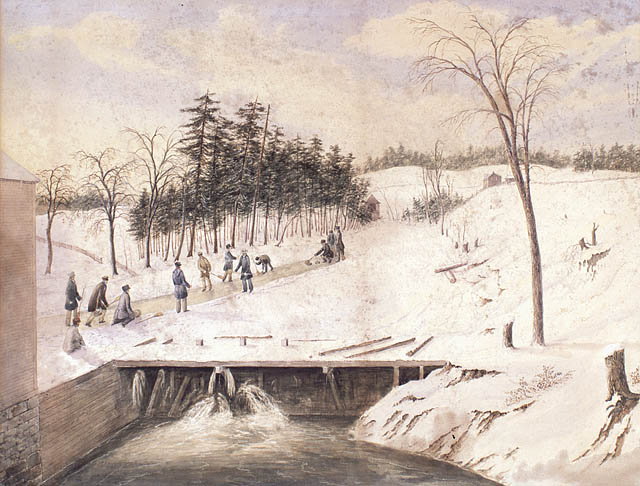
Curling was a popular winter sport brought over to Canada by early Scottish settlers. Many settlements in Upper Canada had their own curling clubs, some of which exist to this day. Below is a wonderfully bucolic scene of a curling match in Toronto, circa 1836.

http://www.collectionscanada.gc.ca/pam_archives/public_mikan/index.php?fuseaction=genitem.displayItem&lang=eng&rec_nbr=2837821
Curling on the Don River, Toronto, Watercolour c. 1836, Artist Unknown
Library and Archives Canada
Sources
Library and Archives Canada 2014, "Curling into Canada"
Galt Curling Club 2014, "History of the Galt Curling Club, 175 years and going strong"
Nancy B. Bouchier's 2003 For the Love of the Game

Further Reading
Canadian Curling Association 2014, "History or Curling"

Thursday, December 4, 2014

Huron County Museum

Central School, constructed in 1856
A few weeks ago I happily seized upon an opportunity to visit the Huron County Museum and Historic Gaol in Goderich, Ontario. This was my first visit to the museum, though once inside I felt right at home. The permanent exhibits focus on development - development of the Huron Tract from forests to farms to thriving modern communities; development of agricultural technology and methods over the past two hundred-plus years; and the development of the people from settlers to soldiers, and from farmers to Victorian and Edwardian fashionistas.

1913 Steam Locomotive
The settlement of Goderich is a product of the Canada Company (at that time headed by John Galt), and it's Warden of the Woods and Forests, William "Tiger" Dunlop. Founded in 1827, and linked by a "muddy sleigh track" to Guelph by the following year, it became a popular destination for early British settlers. By its incorporation date in 1850, it had amassed a population of about 800 people. Today, the town of Goderich is home to 7,500.

The Huron County Museum is located near the radial core of Goderich, and is housed within a former schoolhouse (c.1856) and a large, modern addition (c.1989). The layout of the museum is such that it keeps you guessing what might be around the next corner. As I zigzagged through each space, I was constantly surprised and delighted at what I found. Particular exhibits of interest were the replica settlers' cabin (displaying the conditions in which early settlers lived), and of course the Huron County Main Street (for a little 19th century window shopping).
Two-Headed Calf

Finding Goderich and the museum is easy. When I give friends directions I always like to say that if you've driven into Lake Huron, you've gone too far. The museum itself has incredibly friendly staff, and the low admission includes your own audio guide. On your way out you can visit their gift shop and take home some very unique items - like the two-headed calf toy pictured here (they have a taxidermy specimen in the reception area that has become popular with adults and children alike). I would recommend the Huron County Museum to anyone, at any time of year. In the summer you can head out to the beach after your visit, or in the winter you can enjoy a snowy drive and Christmas shopping in the "prettiest town in Canada".

Sources
Huron County Museum and Historic Gaol Online
Hilary Stead 2002, Guelph: A People's Heritage 1827-2002
You can get a head-start by taking a look at the museum's floor plan, here.
Huron County Museum Blog, 2014

Further Reading
Ontario's West Coast 2010, "Huron History"
Immigrants to Canada, "Letters Collected by the Canada Company, to Encourage Emigration 1842" Many of these letters reference the road between Guelph and Goderich; its condition, construction, and uses.

Thursday, November 27, 2014

Ugh, Women Settlers

The following in an excerpt from Anna Brownell Jameson's Winter Studies and Summer Rambles in Canada. First published in 1838, Jameson's travel diary takes readers on a journey through a pre-rebellion Upper Canada. Making stops in Toronto, Niagara, St. Catherine's, London, and up Lake Huron to Manitoulin Island, Jameson writes about her thoughts and interactions with the people and places making up the colony.

"He said he should be quite happy here, were it not for his wife, who fretted and pined continually after her 'home.'

'But,' said I, 'surely wherever you are, is her home, and she ought to be happy where she sees you getting on better, and enjoying more of comfort and independence than you could have hoped to obtain in the old country.'
'Well, yes,' said he, hesitatingly; 'and I can't say but that my wife is a good woman: I've no particular fault to find with her; and it's very natural she should mope, for she has no friend or acquaintance, you see, and she doesn't take to the people, and the ways here; and at home she had her mother and sister to talk to; they lived with us, you see. Then, I'm out all day long, looking after my business, and she feels quite lonely like, and she's crying when I come back - and I'm sure I don't know what to do!'
The case of this poor fellow with his discontented wife is no unfrequent occurrence in Canada; and among the better class of settlers the matter is worse still, the suffering more acute, and of graver consequences.
I have not often in my life met with contented and cheerful-minded women, but I never met with so many repining and discontented women as in Canada. I never met with one woman recently settled here, who considered herself happy in her new home and country: I had heard of one, and doubtless there are others, but they are the exceptions to the general rule. Those born here, or brought here early by their parents and relations, seemed to me very happy, and many of them had adopted a sort of pride in their new country, which I liked very much. There was always a great desire to visit England, and some little airs of self-complacency and superiority in those that had been there, though for a few months only; but all, without a single exception, returned with pleasure, unable to forego the early habitual influences of their native land.
...
Anna Brownell Jameson
calotype 1843-1848 by David Octavius Hill
I have observed that really accomplished women, accustomed to what is called the best society, have more resources here, and manage better, than some women who have no pretensions of any kind, and whose claims to social distnction could not have been great any where, but whom I found lamenting over themselves as if they had been so many exiled princesses"

I found this passage interesting for a couple of reasons. First, Jameson doesn't seem to understand the irony of her opinions. She herself was in an unhappy marriage that only after a few years ended in separation... a separation which allowed her to happily return to England. She critiques any lady who pines for home and family left behind, yet does the same herself in her diaries. She even goes so far as to say that being of the better classes makes the remembrance of home harder, presumably because they have more friends, family members, and luxuries to miss. I also like this passage as it reminds me of countless other (borderline humourous) accounts from this period of women critiquing women. We have always been our own harshest critics, but in the 19th century it really was made into an art form.

Anna had made her journey to the Canadas at the request of her husband, Robert Simpson Jameson, who had recently been appointed chief justice of Upper Canada and who had settled in Toronto. Unhappy in love and life, she travelled the southern portion of the province before returning to England the next year, in 1837.

Sources
Anna Brownell Jameson's 1838, Winter Studies and Summer Rambles in Canada.

Thursday, November 20, 2014

Lands in Upper Canada

Clicking on the image below with enable you to zoom in on this advertisement for settlement, printed in 1835 in London, England.
http://static.torontopubliclibrary.ca/da/pdfs/ohq-ephe-c-w-89.pdf

Some excerpts from the advertisement include:

"The ordinary baggage of Emigrants consists of their wearing apparel, with such bedding, and utensils for cooking, as may be required on the voyage, and any articles of clothing, not intended to be used at sea, ought to be packed in water-tight cases or trunks, not exceeding eighty or ninety pounds in weight."

"The class of persons chiefly required in Upper Canada, and who, of course, will find it best suited to their purposes, are small Capitalists, Farmers, Mechanics, and Labourers."

Sources
Toronto Public Library Digital Archive 2014, "Lands in Upper Canada"

Thursday, November 13, 2014

The Royal Agricultural Winter Fair

The Royal Agricultural Winter Fair in Toronto is for me one of the most anticipated events of the year. While I'm not personally involved in any of the competitions, I can certainly appreciate good husbandry and perfect grooming when I see it. I can also appreciate any opportunity to get up close and personal with so many sheep and goats that I can't keep count.

Feeding the goats is definitely a
highlight for me each year
The Royal Agricultural Winter Fair was given its Royal designation by King George V in 1920, and since 1922 it has been attracting hundreds of thousands of visitors each year. Over 300,000 people visited last year alone. The fair is home to a number of Agriculture Competitions, Horse Shows, and opportunities for people to learn about local agriculture through exhibitors, activities, and presentations. There are also a number of vendors selling everything from locally made cheeses and skeins of hand spun alpaca yarns to leather goods and gourmet honey. Many of the vendors come to the Royal each year, and I've made a habit of calling on my favourites each time I visit. My perennial favourites include The Upper Canada Cheese Company, Bouchard's Poutinery, and Tandy Leather.


http://www.coloribus.com/adsarchive/prints/royal-agricultural-winter-fair-family-vs-goats-13548755/
2009 ad for The Royal (One of my favourites)
I will admit that with all the wonderful exhibits and vendors, I still make a bee-line to the petting zoo. I love visiting the goats and sheep and getting to interact with them. For a couple dollars you can buy a cup of food for them to nibble out of your hand. Some of the larger goats can get a bit pushy, but they're hungry too, and I try to make sure to spread the wealth. The petting zoo area is also home of some gorgeous rare breed show birds, such as Cayuga Ducks, African Geese, and Sebastopol Geese.

Admission can be a bit high for some ($24 per adult), but there is a way around it. It isn't advertised on their website, but if you visit the Royal after 4:00pm, admission is 2-for-1. Most of the competitions and horse riding events happen during the day, so you will miss out on those, but you will also miss out on the 18,000+ school children that visit each year (they're usually back on their busses by 3:00pm).

This year the Royal runs from November 7-16, so check it out!

Sources
The Royal Agricultural Winter Fair 2014 Website

Further Reading
Farmers Feed Cities 2014 Website
Ontario Beekeeper's Association 2014 Website

Thursday, October 23, 2014

The Credit, Barter, and Three-Way Systems of Payment

Let's pretend you're living with your family in Upper Canada in the first half of the nineteenth century. You own a productive farm, and keep sheep and chickens in addition to various crops such as apples, wheat, and barley. Life is good - you have everything you need. One day while in the village, you pass by the General Store and lo and behold there's a window full of things you want: Fabrics for making new clothes for the family, spices to make just about everything taste better, and tools that will make farm work easier. Remember, life is good, and you decide to head in to the store. After a few of your items have been wrapped in paper, the shopkeeper gives you the total. How are you going to pay for these luxuries? 

Responding to the needs of their customers, and accepting of the fact that currency was scarce in most rural communities, shopkeepers offered many of their goods on credit. (Fraser, 86) The prices of purchased goods were noted in an account book (ledger) or on a bill.  From time to time, most customers paid all or part of that bill by service, cash or trade.  In order for the credit-based system to work, not only did the customers have to be honest, trustworthy and able to pay off their debts in a timely fashion, but the shop owner had to be equally as honest, trustworthy, and able to bear the various debts of often an entire village.  In many cases, the shop owner was a man in good circumstances and was able to wait until sales of crops or livestock enabled farmers to pay for items purchased throughout the year.


Crysler's Store, Upper Canada Village
Morriston Ontario
A shop could quite easily fail due to bad debts, or the inability of the store owner to collect in a timely manner.  Collection of debts could be tricky for the shop owner.  If he came on too strong, he would lose the customer (and the money). If he was too lenient, he might end up out of business, unable to pay his own debts. Opening a store where family and neighbourly ties are stronger was an effective way to stay in business.  By knowing his customers on a more intimate level, the credit system had a better chance of succeeding. (Fleming, 141) The shop owner could appeal to his friends (who presumably wished him to succeed) to pay off their debts, and could visit them with a kindly reminder when they did not.  Knowing your customers had another advantage, for it allowed the shop owner to “avoid sales to those who would not pay, and to increase sales, especially of goods that carried the highest mark-up, to those most likely to pay”. (McCalla, 401)


There were a number of ways in which a family or individual could repay the store owner for items purchased on credit.  The three most popular methods include payment through service or labour; delayed payment using cash, or payment through trade.  Payment through service or labour included for example, splitting and piling wood for the shop owner, lending the shop owner a horse or ox for a project, or lending skills such as blacksmithing, etc. (Fleming, 127-129) Payment using cash occurred whenever the family or individual had some to spare – usually in the fall of each year, after the “threshing” or the “killing”. (Sherck) It was also not uncommon for the shop owner to institute a monthly collection whereby accounts were required to be settled by the end of each calendar month.

Some debts could be repaid by trading in chickens, eggs, or butter.  In October 1861, James Watson, a shop owner in Lindsay advertised through the local newspaper that he would accept “all kinds of country produce” as payment. (Fleming, 26) A Manilla shop owner, Adam Gordon, also advertised that he would purchase “Wheat, Pork, and other farm produce, at the Highest Market Prices”. (Fleming, 26) Payment through trade was extremely common, but must not be confused with pure bartering.  Each object (usually by weight) had a dollar amount attached to it, and customers did not, for example, simply trade eggs for tea.  Every transaction was entered into the ledgers, and one dollar’s worth of tea must be offset by at least one dollar’s worth of eggs.

There were also many instances where arrangements were made between businesses which allowed for labourers to be paid in credit to the local general store or to a trade, eliminating the need for workers to handle cash:  “Every builder or contractor made an arrangement with the various trades and stores for a line of credit, by which they could pay their workman as much of their wages as possible with the smallest amount of cash.” (Guillet, 240) Worker’s wives would then go and pick up items from the store as needed without the requirement for currency to exchange hands.  The items purchased would simply be deducted from the credit provided by the employer. Likewise, the Three-Way System involved little to no exchange of money.  For example “In Glencarin, Ontario (west of Barrie), millworkers paid for their laundry indirectly. Storekeeper and mill owner M.N. Stephens would deduct a dollar or two from wages and enter that amount as a credit on the laundry woman’s account”. (Fleming, 138)

General Store Interior, Black Creek Pioneer Village
Toronto, Ontario
As communities grew, and the connections between shop owner and neighbour became more distant, the need for payment upfront and in cash increased.  Additionally, the amount of individuals travelling through the province and purchasing goods was also rising.  Itinerant purchasers could little be expected to be tracked down if they did not live in the area, and so they too were expected to pay in cash.  As the cost of some goods also increased, so too did the debts of the shop owners. (Fraser, 90) Eventually, the general store moved away from the credit, trade, and Three-Way systems and adopted the more streamlined cash system.


Sources
W. Hamish Fraser's 1981 The Coming of the Mass Market,1850-1914
Michael Gonder Scherck's 1905 Early Pioneer Life in Upper Canada. 
Edwin C. Guillet's 1934 Toronto, from Trading Post to Great City. 
McCalla, Douglas. “Retailing in the Countryside: Upper Canadian General Stores in the Mid-Nineteenth Century”. In Business and Economic History, Winter 1997; 26, 2. Pages 393-403.

Thursday, October 2, 2014

From the Pen of William Dickson

The Honourable William Dickson was educated, eloquent, and greatly opinionated (in addition to his also being the founder of the Township of Dumfries, and of Galt); Three qualities which were often demonstrated in his personal correspondence and at various speaking engagements. His sentiments are so clear that you can almost picture him preaching the benefits of a conservative and obedient life under the Crown (the dour expression in the photo below should assist you should you need inspiration). I always find learning about history through the eyes and pens of its participants particularly appealing. Thus, the following are excerpts from a speech delivered to his fellow Galtonians in 1839 on the occasion of his 70th birthday. His words give us a glimpse into his world, and into his mind, on all things political, social, and emotional.*

On the Difficulties of Settlement
"Embarrassments and difficulties beset me - despondency sometimes showed her unwelcome visage." (JY, 176)

"Many of you have had your days and nights of gloom - you have encountered privations, toil, trouble, and uphill exertions, but many of you have attained the summit of your wishes, and others are in a progressive advance." (JY, 177)

On the creation of Upper Canada in 1791
"I was then at Niagara, when General Simcoe first addressed the assembled Legislature; and well do I remember the joy and enthusiasm which pervaded all classes and ranks, on such a boon being granted." (JY, 177)

On Upper Canadian prosperity
"If the people of Upper Canada are not happy and contented, it must mainly be their own fault." (JY, 181)

On Dumfries / Galt
"... I entertain, and shall always continue to feel, a lively interest in all that relates to Dumfries; and I have especial pleasure in receiving the evidence of the satisfaction and prosperity which seems to prevail among its inhabitants." (JY, 173)

On the French and politics
"The Constitution and form of Government that was at that time conferred on the Canadas has worked well in practice in Upper Canada, and would have worked equally well in Lower Canada, had not the malignant, ambitious, and selfish French demagogues poisoned the minds of an illiterate peasantry - inducing them at length to throw off the mask of moderation, and factiously to resort to insurrection, treason, and rebellion." (JY, 177-178)

On the United States and civil war
"Reflecting on the change in the national character of the descendants of British subjects, I am almost warranted in adopting an opinion that the elective principle, carried on to an extreme stretch, has changed the pulse of men and inoculated the people of the United States with principles destructive of liberty and good government, and that the time may yet arrive, when, on the revolving wheels of their government, the clog of despotism may be found not to be that far distant from that of democracy, and when civil broils and a servile war may madden to a contest, which, for the sake of humanity, may kind Providence in his mercy avert." (JY, 180)

*As these are excerpts, they are taken somewhat out of their original context. To fully understand his words, be sure to check the source material referenced.

Other interesting Dickson facts
- He was challenged to a duel in 1808 by a colleague, Mr. Weeks, who had felt he had been publicly insulted by him. Dickson won, and Mr. Weeks died three hours later. (JY, 16)
- He was captured in Niagara-on-the-Lake (at that time known simply as Niagara) by American forces in June 1813 and jailed in Albany until the following January. When he returned he found his house, and the village had been razed.(JK)
- He was a member of the Family Compact

Sources:
(JK) James E. Kerr's 1916, "Sketch of the Life of the Honourable William Dickson"
(JY) James Young's 1880, "Reminiscences of the Early History of Galt and the Settlement of Dumfries in the Province of Ontario"

Further Reading:
Dictionary of Canadian Biography 2014, "William Dickson"
Cambridge Archives and Records Centre, "Honourable William Dickson"

Thursday, August 28, 2014

Alexander or Donald?

I had recently come across a line in a novel that said that in Scotland (in the mid-18th century) every man's name was either Alexander or Donald. While that's obviously an exaggeration, it got me thinking, and I decided to see just how popular those names were within the context of Scottish settlement in Upper Canada.

Five most popular names for listed
male settlers 1790-1849
Looking at the 15 extant passenger lists of ships departing from Scotland to Quebec (between 1790-1849 with settlers intended on travelling through to Upper Canada), I was able to distinguish 1,153 male names (Campey). These names are mostly the heads of families; children's names were rarely provided. In some instances not every man travelling aboard a vessel was accounted for by name, however, the five most popular names listed are:
  1. John (261 individuals)
  2. Donald (101)
  3. Alexander (100)
  4. William (93)
  5. Duncan (59)
The next most popular names were Robert (54), Archibald (40), Angus (28), Allan and Andrew (each with 16), and Dougald (7). So it would seem that this novel wasn't too far off the mark. As you can see from the donut graph here, the top five names cover just more than half of the total, and if you were a listed male passenger aboard one of these ships, there was a nearly one in four chance that your name was John. As for modern day, the five most popular names for boys in Ontario between the years 1917-2010 were 1. Joseph, 2. John, 3. William, 4. Robert, and 5. James. Looks like in about 200 years of settlement we haven't strayed too far from the mark.

Five most popular names for listed
female settlers 1790-1849
For those interested in the most popular names for the ladies aboard the same ships, it's "Mrs." and "Wife of". All jokes aside, I was able to find 533 listed female passengers, and the most popular recorded names are:
  1. Mary (86 individuals)
  2. Catherine (80)
  3. Janet (57)
  4. Anne (46)
  5. Margaret (45)
The next most popular names to round off the top ten were Isobel/la (23), Marion and Flora (each with 19), Elizabeth (17), and Euphemia (8). In modern day Ontario between the years 1917-2010, the most popular girls names were 1. Mary, 2. Marie, 3. Jennifer, 4. Margaret, and 5. Patricia.

Sources
Lucille H. Campey's 2005 The Scottish Pioneers of Upper Canada, 1784-1855: Glengarry and Beyond

Further Reading
Behind the Name, "Scottish Names" Here you can learn a little more about the Gaelic roots to many of the names mentioned above. For example, "Duncan: Anglicized form of the Gaelic name Donnchadh meaning "brown warrior", derived from Gaelic donn "brown" and cath "warrior". This was the name of two kings of Scotland, including the one who was featured in Shakespeare's play 'Macbeth' (1606).


Thursday, July 31, 2014

Inglis Falls

My own photos, featuring my dog Perry.
Last weekend I decided to get out of the city and back to nature... just over two hours drive later, I found myself at Inglis Falls in Owen Sound, Ontario.

"...Inglis Falls is an 18 metre high cascade, created by the Sydenham River meeting the edge of the Niagara Escarpment. The erosive power of the water has carved a deep gorge at the base of the falls." (Inglis Falls Conservation Area)

While the seeing the falls and hiking through the conservation area was very enjoyable (save for the few mosquito bites on my hands and legs), it was also fun to learn about the area's own beginnings as a Scottish settlement. In 1845 a Scotsman by the name of Peter Inglis purchased the 300 acre property (which included the falls and an unfinished grist mill that had been started by another Scotsman in 1842). Inglis' finished mill would become very successful, and he would eventually add to it a sawmill, a store, a house, and by the 1870s a wool mill. Inglis lived in his home with his wife and six children who went on to take over the family business. (OAP) The mills at Inglis Falls produced flour, bran, wool, and lumber for 87 years. (Visit Grey)

I would recommend a visit to Inglis Falls to anyone. Not only is it worth the drive, but the drive is worth the drive. Highways 10 and 6 are stunning in the summer with high rolling hills of forest and field, interspersed with small villages and late Victorian brick homes.


Sources
Grey Sauble Conservation, 2013, Inglis Falls Conservation Area
Conservation Ontario, 2012, Inglis Falls Conservation Area
OAP (Ontario Abandoned Places), Inglis Falls
Visit Grey, Inglis Falls

Further Reading
Niagara Escarpment Commission, 2014, Niagara Escarpment 
Canadian Encyclopedia, 2013, Glaciation

Thursday, July 24, 2014

The Canada Company

Canada Company Coat of Arms
The country does not alter the race
The Canada Company, founded in 1825, was established to promote and assist in the colonization of Upper Canada. As a private firm however, its main goal was the sale of land (primarily in south-western Ontario) to new immigrants. The company had purchased about 2.5 million acres from the government in 1826 for this purpose, and in so doing ushered in a new era of development; private firms in charge of land administration rather than the crown.

Many Scottish immigrants took advantage of the new organization and had nothing but praise for the company (and land) after having been settled: "The land here [North Easthope Township, now the Township of Perth East in Perth Countyis good and well-watered, the terms of the Upper Canada Land Company are liberal, requiring the settler only pay a fifth of the purchase money when the land is applied for, and the remainder in five yearly instalments with interest at six per cent. The Company at present [1836] sell their land at 12s. 6d. currency per acre being equal to 10s. 8d. British, and the only stipulation is to clear off each year about three and a half acres for every 100 acres owned by a settler... There are grist mills and saw mills within a few miles of us east and west, also a store where goods of all kinds are sold. This settlement is mostly Scotch, almost wholly so where we are settled, and the utmost goodwill and unanimity prevails. We enjoy, though obtained at present by hard labour and perseverance, all the necessary worldly comforts and with the prospect, if we and our families are spared, of seeing them and us all independent and comfortable farmers, farming our own land." (Campey, 131) 

http://www.canadianmysteries.ca/sites/donnellys/prelude/settlingin/indexen.html
Canada Company Poster
While a great many immigrants benefited from the company as settlers, the company was not without its controversies. One Reverend Patrick Bell, a Presbyterian minister from Angus referred to the men working for the Canada Company as "cruel seducers" who would lead poor Scots out into the wilderness to starve (Campey, 130). Some settlers in later years would complain that the price per acre had become too high. Still others considered the professional relationship between the Canada Company and the Family Compact to be a little too close for comfort. In fact, many considered them to be one and the same; An exclusive club of elites who only work for and with each other. Political animosity towards the ruling Family Compact resulted in open rebellion in 1837 and 1838. After that period and the sharp decline of those ruling elites, the Canada Company streamlined its operations, became far more inclusive, and continued to operate until all of its lands were finally sold off in 1951.

John Galt (the Scottish novelist and founder of Guelph and of Goderich in 1827, and the namesake of the former Shade's Mills) was the first Secretary and Superintendent of the Canada Company. His tenure was cut short however, by company directors who considered him a little too interested in the actual welfare of settlers over profit margins. Galt spent only three years in the province before heading back to Scotland; dying in 1839. A further discussion of Galt and his achievements will be forthcoming in another post. In the meantime, please check out the further reading links below to some of the original documents related to the creation of the Canada Company.

Sources
Wikipedia, 2014 "Canada Company" (not a bad place to start for some good overview and a list of members/positions)
Canadian Encyclopedia, 2013 "Canada Company"
Canada in the Making, "Post-Loyalist Settlement (1814-1830)"
Canadian Dictionary of Biography, 1988, "John Galt"
Lucille H. Campey's 2005, The Scottish Pioneers of Upper Canada, 1784-1855

Further Reading
'A Bill to enable His Majesty to grant to a Company, to be incorporated by charter, to be called "The Canada Company," certain lands in the province of Upper Canada, and to invest the said company with certain powers and privileges relating thereto' (London, House of Commons, 1825).
National Archives of Canada, Map of the Lands of the Huron Tract Belonging to the Canada Company by Samuel Oliver Tazewell.

Thursday, July 3, 2014

Embro Highland Games 2014

This Canada Day (July 1st) I very happily made a drive out into rural Ontario for the 77th Embro Highland Games. Located within Zorra Township (close to Woodstock, Ontario), Embro is a small village set amongst rolling green fields of corn and pasture. By chance I happened to hear about the Games on the radio, and decided to visit.

There were a number of events taking place throughout the day: tug-of-war, caber toss, hammer throw, stone throw, pipe band competitions, and highland dance competitions. I also watched a sheep herding demonstration and was able to peruse the vendors' stalls. It was great to hear the pipe music and see so many people in kilts celebrating the culture.

There were really only two things that I found to be a bit disappointing about the Games: There was no haggis, and not enough vendors. I am a big fan of haggis - I love it. I was hoping that this would be a great opportunity to eat some and take some home with me for later. I settled for a steak and haggis pie that was mostly steak (and still delicious). As for vendors, I was hoping to see more in way of traditional crafts, or products from traditional Scottish livestock.

The cover charge is a bit steep at $15 for this small (but long-running) event, but it was a fun day out in the sun in bucolic Southern Ontario, and I'd recommend it for next year.

Sources
Embro Highland Games Website
You can buy some pretty decent haggis from The Healthy Butcher in Toronto and in Kitchener.

Thursday, June 26, 2014

You Were Here

It is only natural that when presented with a map - any map - one will always look for a familiar place name or feature. Being able to place oneself somewhere within the map's borders makes it more relevant. It also makes it more exciting. I recently came across this map of Galt, produced in 1861, in which I can clearly see the property lines for my childhood home.
Tremaine's Map of the County of Waterloo, Canada West. Compiled & Drawn from
 Actual & Original Surveys by the Publishers. Geo. R. & G.M. Tremaine, Toronto, 1861.
 (City of Cambridge Archives)
Davidson Street!

Thursday, June 19, 2014

What's in a Name? History

Many are familiar with the place names listed below, but are unaware that each denotes a very specific period in the history of the province of Ontario.

Pays d'en Haut (1500s-1763) From initial discovery to France's loss to the English in the Seven Years' War, Ontario was a wilderness region of New France referred to as "the upper country".

Quebec (1763-1791) After the Treaty of Paris in 1763, the British crown took over New France, named it Quebec, and included the large colony into it's already substantial North American holdings.

Upper Canada (1791-1841) The American Revolution, ending in 1883, encouraged thousands of loyalists to move north to Quebec (which remained a part of the Crown). With this new influx of settlers came a demand for English laws and government - as opposed to the French civil system still in operation in the colony. The Constitution Act of 1791 divided Quebec into Upper and Lower Canada, and provided Upper Canadians with their own Lieutenant Governor and legal system.

Canada West (1841-1867) Upper and Lower Canada were rejoined in 1841 as the Province of Canada in a political and cultural attempt to overpower the then dominant French population (as well as any potential rebels on both sides). Although the province was now unified, each region remained distinct as Canada West, and Canada East.

Ontario (1867- ) With Confederation came yet another separation as the Province of Canada was divided into roughly the Ontario and Quebec we know today. Ontario's borders were finally established to the north and west by 1912.
Maps depicting borders in 1774 and 1791
Maps depicting borders in 1867 and 1912
Name changes also apply to the smaller scale of villages and cities:

Shade's Mills (1816-1827) Named after Absalom Shade who was hired by founder William Dickson to manage and superintend the new settlement in Dumfries. Shade quickly established a saw and grist mill as well as a shop and home for himself and his family.

Galt (1827-1973) For many settlements, the establishment of a post office is a big deal. It's an opportunity to put your name on the map (and subsequently make it easier for everyone to find you and do business with you). Many settlements stick with the name they've started with, while others take this opportunity to change theirs to something else.* William Dickson decided to change the name of Shade's Mills to Galt after Scottish poet and friend, John Galt.

Cambridge (1973- ) In 1973 the city of Galt, the towns of Preston and Hespeler, and the hamlet of Blair amalgamated to become Cambridge.

*Some communities didn't have a choice in the matter once they realized that they share the same name as another settlement that already received a post office. You can't have two Burwick, Canada Wests: So the community just north of what is now Toronto changed their name to Woodbridge in 1855.

Sources
Dictionary of Canadian Biography, 2014 "Absalom Shade"
Archives of Ontario, 2011 "The Changing Shape of Ontario" (Economic Atlas of Ontario / Atlas Économique de l'OntarioW. G. Dean, Editor/ Directeur; G. J. Mathews, Cartographer/ CartographePrinted 1969 by University of Toronto Press for the Government of Ontario)
City of Vaughan, "A Brief History of Woodbridge"

Further Reading
Canadian Encyclopedia, "Seven Years' War"
Canadian Encyclopedia, "Durham Report"
Canadian Museum of History, 2014 "Virtual Museum of New France"