Thursday, February 26, 2015

Special Announcement!

http://www.scottish-blackface.co.uk/
Scottish Blackface Sheep
Each post during the month of March will be dedicated to sheep in Upper Canada/Canada West - who kept them, how many, which breeds were preferred, and of course their many uses.

Why sheep? Why not?

As a special bonus this month I've teamed up with fellow colleague and wool aficionado Caroline Bendiner. She's prepared guest blog posts on early 19th century methods of turning fleece into wool, as well as where you can see these methods being used today.

For March there will also be a number of extra posts related to sheep facts. Never again will you come face to face with an Ovis aries and not know that while it may have four stomachs, it has no top front teeth.

Don't forget to check back often, and of course feel free to comment - let's show our guest blogger some love!

Thursday, February 19, 2015

It Takes a Village

A census is a wonderful tool for looking back at a population at a particular point in time. What were their names? Where did they come from? What did they do to get by? While census data is often bare-bones and provides the most basic facts, it can help us to understand a community and create a framework that can later be filled in by other source material.

In 1851 a census was completed for Galt, which included information on its 2,246 residents: Name, Place of birth; Religion; Occupation; Age; Marriage status; etc. If you've ever wondered what you might do for a living in a small Victorian village, take a look at the graph I've compiled below. Not every census taker had an occupation listed, and I have a sneaking suspicion that there were in fact more farmers... but this information, though incomplete, is eye-opening. You can check out the rest of the census in an easy to read PDF document here.


You do what exactly? Well, a Spinster is an unmarried (and not likely to become married) woman. She might be living and looking after the welfare of older relatives, or living with and looking after the education of nieces and nephews. Coopers are makers and repairers of casks and barrels. A Teamster is someone who drives a team of draft animals and a wagon. You can think of them as the equivalent of transport truck drivers today. Sadlers make, sell and.or repair saddlery. A Mill Wright is someone who builds and maintains mills and their internal machinery. Cordwainers are actually shoemakers who work with cordovan leather. Fleshers flesh hides and skins and tan them in the production of leather. They may also sell meat - in other words, a butcher. Pedlers are travelling salesmen, often going from door to door to trade and sell any number of items. Lime Burners process limestone (by means of baking it in large kilns) into a number of agricultural and home products such as quicklime for home construction, whitewash, and for spreading on fields as a fertilizer. A House Joiner is a type of carpenter that cuts and fits wood without the use of nails, screws, or other metal fasteners. Lastly, a Carriage Trimmer is someone who preps and finishes the lace, linings, and other trimmings for carriage makers.

Sources
Waterloo Region 1851 Census, Transcribed by the Ontario Genealogical Society in 2001.

Thursday, February 12, 2015

The Log Cabin Myth

Pioneers lived in log cabins... right? Well, it really depends on the period and the area in question. It also depends on your understanding of the definition of what constitutes a "log cabin". These excerpts from Hugh Morrison's Early American Architecture: From the First Colonial Settlements to the National Period help to explain:

http://www.torontopubliclibrary.ca/detail.jsp?R=DC-PICTURES-R-2500
Log House in Orillia Township, Ontario
1844 Picture by Titus Hibbert Ware
"By 'log cabin' we mean a dwelling built of round logs, laid horizontally on one another, with notched corners and protruding ends.... Spaces between logs, if any, are chinked with moss, clay, or oak chips.... the log cabin did not exist in any of the English colonies in the seventeenth century and was used very little throughout most of the eighteenth century. Neither did the Dutch use it in New Netherland, nor the French in Canada. It was a form of construction unknown in England, France, Holland, and southern Europe generally; it was likewise unknown to the American Indian.
...
It is tempting to believe that our early ancestors, gifted with ingenuity as well as courage, invented such an admirable solution to their urgent problem of quick and durable shelter. 
Apparently they did not. The English colonists did built blockhouses and prisons using logs hewn square and notched at the corners for either lapped or dovetail joints. This is indeed a superior type of construction, but it requires many tools and much skill and more time. The log cabin, if it had been known, would have supplanted the flimsy dugouts and cabins and wigwams the pioneer settlers actually built.
True log-cabin construction is thought to have been introduced into this country [the United States] by the Swedes when they settled Delaware in 1638.... In the eighteenth century, German settlers in Pennsylvania built large numbers of log houses, using both squared-log and round-log construction. Since most of the Germans entered the country by way of the Delaware valley, they must have acquired the technique from the Swedes...." (12-13)

Sources
Hugh Morrison's 1987, Early American Architecture
Harold Robert Shurtleff's 1939, The log cabin myth: a study of the early dwellings of the English colonists in North America

Further Reading
History News Network 2015, "Top 10 Myths About Thanksgiving"

Thursday, February 5, 2015

Guelph and Stirling, 1840s

To follow up on a previous post comparing (somewhat arbitrarily) early Galt and Edinburgh circa 1820, I present to you now a visual comparison of Guelph and Stirling circa 1840s:

Guelph in 1842, population: Approximately 1,300
http://www.torontopubliclibrary.ca/detail.jsp?Entt=RDMDC-PICTURES-R-323&R=DC-PICTURES-R-323
1842 Pencil and Brown Wash Drawing of Guelph
Stirling in 1845, population: Approximately 2,159
1840 Engraving of Stirling and Castle by R.S. Michie

Thursday, January 29, 2015

From Adze to Zouave Jackets

A brief A-Z glossary of words one might encounter when studying life in Upper Canada.  For more detail on each of the words, phrases, names, and titles, simply follow the source links provided.

A - Adze
Used with the hewing axe to make the log faces as smooth as possible. Any divots, chunks, or "juggle marks" in the logs made by the hewing axe allow water to penetrate the wood, creating rot. In winter, this moisture will form ice build-up, stress the wood and cause the building to shift. (The Dalziel Barn) See image 1.
1. An Adze at work
2. Neeps along with haggis and potatoes
3. Toulouse Geese (with a gentleman
for scale)
4. Example of a Zouave Jacket and dress
from 1862.
B - Bairn
Noun, Scot. and North England for a child; son or daughter. (Dictionary.com)
C - Ceilidh
A Scottish and Irish term for a party with music, dancing, and often storytelling. (Wikipedia
D - Dovetail Joint (Dovetailing)
A joint formed by one or more dovetails fitting tightly within corresponding mortises. (Visual Dictionary of Architecture)
E - Emigration
Emigration is the act of leaving one's native country with the intent to settle permanently or temporarily elsewhere. Conversely, immigration describes the movement of persons into one country from another. (Dictionary.com) Remember that one always emigrates from and immigrates to a place.
F - Fermentation
Fermentation is a metabolic process that converts sugar to acids, gases, and/or alcohol. Important particularly when discussing beer and its importance in pioneer life in Upper Canada. It was often safer to drink than water, had a number of medicinal uses, and contained a number of vitamins and minerals needed by hardworking homesteaders. By the 1860s there were 300 breweries across Upper Canada, not to mention the fact that beer was also brewed at home in the kitchen. (Virtual Museum of Canada)
G - Gaelic
Noun; any of the closely related languages of the Celts in Ireland, Scotland, or (formerly) the Isle of Man. Adjective; of, denoting, or relating to the Celtic people of Ireland, Scotland, or the Isle of Man or their language or customs.(Dictionary.com)
H - Hogmanay
It is believed that many of the traditional Hogmanay celebrations were originally brought to Scotland by the invading Vikings in the early 8th and 9th centuries. There are several traditions and superstitions that should be taken care of before midnight on the 31st December: these include cleaning the house and taking out the ashes from the fire, there is also the requirement to clear all your debts before "the bells" sound midnight, the underlying message being to clear out the remains of the old year, have a clean break and welcome in a young, New Year on a happy note. (Historic UK)
I - Indian
Indian people are one of three cultural groups, along with Inuit and Métis, recognized as Aboriginal people under section 35 of the Constitution Act. There are legal reasons for the continued use of the term "Indian." Such terminology is recognized in the Indian Act, and is used by the Government of Canada when making reference to this particular group of Aboriginal people. (Aboriginal Affairs)
J - James Young
The Honourable James Young was born in Galt on 24 May 1835. Raised in Galt, he worked as a journalist before spending 25 years in politics (12 years of which in the federal parliament). It was at this time that Mr Young wrote his history of early Galt, titled "Reminiscences of the Early History of Galt and the Settlement of Dumfries" and published in 1880. The book remains one of the major sources of information about the early development of our community. (City of Cambridge)
K - Kirk
Kirk is a Scottish word meaning a church, or more specifically, the Church of Scotland. (The Church of Scotland)
L - Land-Jobber
A man who makes a business of buying land on speculation, or of buying and selling for the profit of bargains, or who buys and sells for others.
M - Mortise and Tenon
A joint made between two pieces of wood where the projecting part of one piece fits into a corresponding cu-tout on another. (Architectural Terms)
N - Neeps
A popular (and delicious) side to a haggis dinner; made primarily of boiled and mashed turnips. See image 2.
O - Orkneymen
Immigrants from the Orkney Islands, off the north coast of Scotland, Orkneymen played a major and largely unrecognized part in the exploration and settlement of Canada's North-West in the 18th and 19th centuries. At the peak of their involvement with the HBC in 1800, Orkneymen comprised 80% of a labour force of almost 500. (Canadian Encyclopedia)
P - Parritch
Although it is by no means a dish confined to Scotland, parritch (an altered pronunciation of the earlier form “potage”) was until quite recently such a staple of the Scots diet that it became the foundation, not only for a day’s work, but also for wisdom. Parritch figures strongly in a number of Scottish proverbs. Today the term "porridge" has become more popular. (Scots Language Centre)
Q - Quoin
A quoin is an angle at the outside corner of a building. You can call the corner itself a quoin, or use the word for the special stones or bricks that reinforce corners of brick or stone buildings. Some quoins are decorative features, providing variety and pattern to the corner where two exterior walls meet. (Vocabulary.com)
R - Rebellion
The 1837 rebellion in Upper Canada [Ontario] was a less violent, more limited affair than the insurrection that same year in neighbouring Lower Canada [Quebec], although its leaders, including William Lyon Mackenzie, were no less serious in their demands for democratic reform, and an end to the rule of a privileged oligarchy. The rebellion itself failed, yet its very failure helped pave the way for more moderate and careful political change in British North America, including the union of Upper and Lower Canada, and the eventual arrival of responsible government. (Canadian Encyclopedia)
S - Saltire (St. Andrew's Cross)
The Saltire is the national flag of Scotland and, with a white diagonal cross on a blue background, it represents the crucifixion of the apostle St. Andrew Scotland’s patron saint. Believed to be the oldest flag in Europe, the origin of the flag comes from an old legend. Tradition has it that the flag originated in a battle fought near the East Lothian village of Athelstaneford in AD 832. (Visit Scotland)
T - Toulouse Goose
The name Toulouse is used for several types of gray geese descended from the European Greylag. People have selected Toulouse as general purpose farm birds, as producers of fois gras, and as show-birds. In the past, goose fat was a primary source for cooking fats and lubricants. Historically farmers often raised Dewlap Toulouse geese in cages to limit their movement, valuing their ability to put on large quantities of fat when fed plenty of food with no room to exercise. (The Livestock Conservancy) See image 3.
U - United Empire Loyalists
The United Empire Loyalists were generally those who had been settled in the thirteen colonies at the outbreak of the American Revolution, who remained loyal to and took up the Royal Standard, and who settled in what is now Canada at the end of the war. (United Empire Loyalists Association of Canada)
V - Venison
Noun, the flesh of a deer or similar animal as used for food. (Dictionary.com)
W - Wattle and Daub
Wattle and daub is a composite building material used for making walls, in which a woven lattice of wooden strips [or branches, etc.] called wattle is daubed with a sticky material usually made of some combination of wet soil, clay, sand, animal dung and straw. (Wikipedia)
Y - Yoke
Wooden shoulder yokes [for people] were used to carry two buckets of milk from the cow to the dairy in the days when cows were milked in the fields. They were also heavily used to collect water for household use.  The yoke was made from a beam of wood, usually willow for lightness, but ash and sycamore were also used. It is concave at the centre to fit comfortably around the shoulders, with a recess to fit around the neck of the wearer. The ends of the yoke tapered to terminate just beyond the wearer's shoulders. Chains were then hung from the ends with hooks to fix onto the buckets. (Object Lessons)
Z - Zouave Jacket
A woman’s short embroidered jacket or bodice, with or without sleeves, resembling the jacket of the Zouave uniform. (Oxford English Dictionary) See image 4.

Thursday, January 22, 2015

Address to a Haggis

In honour of Robert Burns Day on Sunday January 25, 2015, here is Burns' "Address to a Haggis":

Fair fa' your honest, sonsie face, 
Great chieftain o' the pudding-race! 
Aboon them a' yet tak your place, 
Painch, tripe, or thairm: 
Weel are ye wordy o'a grace 
As lang's my arm. 

The groaning trencher there ye fill, 
Your hurdies like a distant hill, 
Your pin was help to mend a mill 
In time o'need, 
While thro' your pores the dews distil 
Like amber bead. 

His knife see rustic Labour dight, 
An' cut you up wi' ready sleight, 
Trenching your gushing entrails bright, 
Like ony ditch; 
And then, O what a glorious sight, 
Warm-reekin', rich! 

Then, horn for horn, they stretch an' strive: 
Deil tak the hindmost! on they drive, 
Till a' their weel-swall'd kytes belyve 
Are bent like drums; 
Then auld Guidman, maist like to rive, 
Bethankit! hums. 

Is there that owre his French ragout 
Or olio that wad staw a sow, 
Or fricassee wad make her spew 
Wi' perfect sconner, 
Looks down wi' sneering, scornfu' view 
On sic a dinner? 

Poor devil! see him owre his trash, 
As feckles as wither'd rash, 
His spindle shank, a guid whip-lash; 
His nieve a nit; 
Thro' blody flood or field to dash, 
O how unfit! 

But mark the Rustic, haggis-fed, 
The trembling earth resounds his tread. 
Clap in his walie nieve a blade, 
He'll mak it whissle; 
An' legs an' arms, an' hands will sned, 
Like taps o' trissle. 

Ye Pow'rs, wha mak mankind your care, 
And dish them out their bill o' fare, 
Auld Scotland wants nae skinking ware 
That jaups in luggies; 
But, if ye wish her gratefu' prayer 
Gie her a haggis!

Sources
Burns Country 2015, "Complete Works"
Scotland 2015, "Burns Night"

Further Reading
Robert Burns Birthplace Museum 2015, "Discover Burns"
Visit Scotland 2015, "Who was Robert Burns?"
Library of Congress 2015, "Robert Burns Day: Haggis, Anyone?"
Visit Scotland 2015, "Hold your own Burns Supper ebook" (Free ebook!)

Thursday, January 15, 2015

To Scotchmen in the Colonies...

Click to view a larger version of this image
Printing in Victorian Canada was often a very time consuming process. Just one paragraph from the paper shown here would take about 90 minutes to set up - letter by letter, space by space on a setting stick. The entire sheet adds up to almost 21 hours of work, done by the Printer, or divided amongst any apprentices. Add to that the effort of printing each sheet individually (a speedy professional could press 40-50 sheets an hour), and the drying time for the ink as well as the time needed to bring all the printed sheets together into what we would recognize as a "newspaper", and, well... let's just say you've got a lot of work cut out for you.

All of that work would of course be completed after the author had written their piece, and had paid the Printer for the space in their publication. As the many supplies required for a printing press (including paper) began to be manufactured in Canada in the 1830s, prices dropped, and the entire process became more accessible. More printers, a greater number of publications, and increased readership led to staggering amounts of personal opinions becoming public. During times of political and cultural tension these opinions tended towards the lengthy, but were anything but prosaic. Grandiose Victorian language simply meant more work for the apprentice, and more money for the Printer.

Sources
Toronto Reference Library 2015, "To Scotchmen in the Colonies and at Home"
The Canadian Encyclopedia 2013, "Print Industry"
YouTube, "BCPrinter" A brief video showing a visit to the Print Shop at Black Creek Pioneer Village, Toronto.

Thursday, January 8, 2015

A Castle Kilbride Christmas


Sometimes the holidays can bring throngs of tourists and visitors to museums and galleries. Sometimes people would rather stay home and relax, or go shopping for Boxing Day specials. Luckily for me the days immediately following Christmas were quiet ones for Castle Kilbride, and I could take my time and explore each highly decorated room at my leisure. Ahh Victorian Ontario.

Castle Kilbride was built in Baden in 1877 by Scottish immigrant and successful industrialist, James Livingston. The Italianate home was named after his birthplace of East Kilbride, just south of Glasgow. Livingston was best known for his empire in flax seed, which allowed him and two further generations of his family to live in Castle Kilbride in the lap of luxury.

"A tour through Castle Kilbride is a journey into the lavish Victorian Era. Castle Kilbride dominates the landscape with its clean Italianate design, towering Belvedere, rich and extravagant furnishings and most importantly, interior artistry the likes of which are unmatched in a private residence in all of Canada." (Castle Kilbride) 

Had I been able to take photos, I'm sure they would have turned out similarly to this example from a professional photographer. Unfortunately, due to the delicate nature of the items on display, and the many hand-painted elements of each space, photography is not permitted.

Castle Kilbride is one of those places that's right in your own backyard, one of those places that everyone's heard of, one of those places that few have been. It can be easier (and more exotic) to travel out of town to "see the sights", but we mustn't forget about the sights close to home. Be a tourist in your hometown! You'll be amazed at what you find. If you do live in Southern Ontario (or even if you don't), I would recommend a stop at Castle Kilbride. The people in Baden are friendly, and happy to show off the jewel of the township.

Sources
Castle Kilbride 2015, "History in the Making"
Waterloo Region Generations 2015, "James Livingston, MP"

Further Reading
Trust for Architectural Easements 2015, "Glossary of Architectural Terms"
Ontario Tourism Website

Thursday, January 1, 2015

Hogmanay - A Scottish New Year Celebration

http://blog.britishnewspaperarchive.co.uk/2012/12/31/the-origins-history-and-traditions-of-hogmanay/
Hull Daily Mail – Tuesday 30 December 1930
Hogmanay is more than just a wildly fun all-night New Years' Eve street party in Edinburgh; it's a long-standing (and apparently somewhat mysterious) tradition that goes back centuries.

Celebrations today may include fire-dancers, fireworks, the consumption of copious amounts of alcohol, live music in the streets, dancing, parades and more. Edinburgh's Hogmanay celebration is the largest in Scotland, and attracts visitors from around the world.

First Footing is a New Years tradition that begins at midnight and continues into the early morning. This custom involves being (or welcoming) the first person through the threshold of your home for the New Year. This 'first footer' would bring any number of symbolic gifts to the homeowner, each of which would bring a different sort of luck for the year ahead: Salt (for flavour), coal (for warmth), shortbread (for food), or whisky (good cheer). If you are short, blonde, and a female, it is recommended that you not attempt to beat anyone through a Scot's doorway at midnight - you're bad luck. A tall, dark, and handsome man is who's really desired, as it would indicate that that family inside would have a financially prosperous year. The Greeks have a similar tradition.

The Illustrated London News
December 30, 1882
"The First Foot: A Scottish Custom on New Years' Eve"
In preparation for Hogmanay in Upper Canada, Scottish settlers would thoroughly clean their homes, finish any mending that needed to be done, change bedding, do any polishing, pay off any debts and return any items that had been borrowed over the past year - in other words, they would put their lives, homes, and businesses in order for the New Year.

Sources
Hogmanay.net 2014, "Hogmanay FAQs"
Edinburgh's Hogmanay 2014/2015 Website

Further Reading
Wikipedia 2014 "Hogmanay" for an overview of some popular traditions/customs.
Ava Laboy Capo's 2013 Traditions/Superstitions From Around the World!: To Bring in the New Year!

I'd like to take this opportunity to wish everyone a very happy and healthy New Year! Here comes 2015!

Thursday, December 25, 2014

Don't Try This at Home

http://images.rom.on.ca/public/index.php?function=image&action=detail&sid=&ccid=
William Dunlop, portrait by James Bowman, 1834
Royal Ontario Museum
Many people today are of the opinion that the Victorians (or anyone living in the 19th century) were a stodgy and serious group of people concerned only with discipline, morality, and wearing too many layers of clothing. This is not true (at least not entirely). Bawdy jokes, hoaxes, cartoons, and pranks were incredibly popular - especially amongst those with a little more time on their hands...

The man pictured here once stood inside a shop in Goderich, and asked a group of newly arrived settlers to each hand him some nails from a nearby barrel. If you were one of these settlers you might think this was some sort of symbolic gesture - nails for building a new home in a new land, etc. So you line up and reach into the barrel, as these settlers did, only to discover that this gentleman, William Dunlop, a respected doctor, 1812 war veteran, journalist, and Warden of  Woods and Forests for the Canada Company, has teamed up with a friend to place a porcupine inside. Surprise!

This is pranking, 19th century style, and this wasn't the first or last time that Mr. Dunlop took part in a little schadenfreude. He once caused a fellow Canada Company official to be thrown from his horse in the woods after he, and the same accomplice from the porcupine incident, spooked it by howling like wolves. (Said official later recuperated with the dedicated care and attention of Mr. Dunlop and his liquor cabinet).

Porcupines are found all across
Canada, and are generally not con-
sidered to be, by any means, cuddly.
Sources
Royal Ontario Museum 2014, Images
Dictionary of Canadian Biography Online 2014, "Dunlop, William"
Huron County Museum 2014, "Gairbraid"

Further Reading
History Today 2014, "Victorian Jokes: The best in 19th-century humour"
Today I Found Out 2014, "The Greatest Practical Joke of the 19th Century: The Berners Street Hoax"
If you'd really like to get into the subject of Victorian honour, you can always take a course at the University of Edinburgh, "We Are [Not] Amused: Victorian Comic Literature"

Thursday, December 18, 2014

Curling

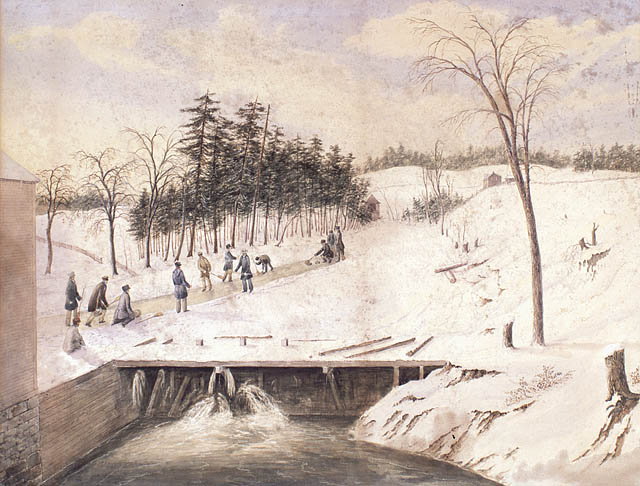
Curling was a popular winter sport brought over to Canada by early Scottish settlers. Many settlements in Upper Canada had their own curling clubs, some of which exist to this day. Below is a wonderfully bucolic scene of a curling match in Toronto, circa 1836.

http://www.collectionscanada.gc.ca/pam_archives/public_mikan/index.php?fuseaction=genitem.displayItem&lang=eng&rec_nbr=2837821
Curling on the Don River, Toronto, Watercolour c. 1836, Artist Unknown
Library and Archives Canada
Sources
Library and Archives Canada 2014, "Curling into Canada"
Galt Curling Club 2014, "History of the Galt Curling Club, 175 years and going strong"
Nancy B. Bouchier's 2003 For the Love of the Game

Further Reading
Canadian Curling Association 2014, "History or Curling"

Thursday, December 11, 2014

Shopping in Shade's Mills

For the early settlers arriving and establishing themselves in Shade's Mills/Galt, there were but a few options when it came to purchasing the goods they needed and/or wanted.

Excerpt from James Young's Reminiscences of Galt, Page 54
The first option was to visit the combined home/general store of Absalom Shade and his second wife, Isabella. This two-storey log home was the first to be built in the new settlement (c.1816), and was located near the corner of Main and Water streets. (Young, 31) By the following year a blacksmith's shop had opened, thus providing the necessary materials and equipment for life on a farm. Mr. Shade was able to secure for himself a bit of a monopoly for his general store, and later increased his trade in 1824 with the opening of a second and larger shop, known as the Red store. (Young, 48) With a promise from William Dickson that no land would be sold to anyone else wishing to construct or operate a shop, Shade was able to comfortably grow his personal fortune.

Nearly a decade later, Mr. Shade added the 'White store' to his holdings (c.1832). Different from the Red store which conducted business in credit or barter, the White store worked in cash. (Young, 109) There was also now a hatter in the village, as well as a tavern, and a hotel. As the population of Dumfries township and surrounding areas grew, so to did competition. In neighbouring Preston, and in Waterloo, shops were able to offer goods at lower prices. The construction of roads, relative ease of transport (as compared to the previous decades), growing industry in other larger towns, and increased demand for "luxury" items encouraged businessmen to open up new enterprises.* By 1838 a former pedlar had opened a shop in the heart of Galt, and Shade's monopoly was effectively broken.

Sources
Black Sheet Iron Money Box, c.1830-1850
Dictionary of Canadian Biography 2014, "Shade, Absalom"James Young's 1880, Reminiscences of the early history of Galt
McCalla, Douglas. “Retailing in the Countryside: Upper Canadian General Stores in the Mid-Nineteenth Century”. In Business and Economic History, Winter 1997; 26, 2. Pages 393-403.

Further Reading
For more information on the credit and barter systems, you can check out a previous blog post here.
W. Hamish Fraser's 1981 The Coming of the Mass Market,1850-1914
Michael Gonder Scherck's 1905 Early Pioneer Life in Upper Canada.

* It has been shown that villages/towns with populations over 500 tend to see the growth of specialised shops. For example, rather than visiting a general store for items you might need, you can visit the shoemaker, the harness shop, the carpenter, or the grocer's separately. Ideally, these specialised shops would be able to offer you more selection, and possibly better prices. (McCalla)

Thursday, December 4, 2014

Huron County Museum

Central School, constructed in 1856
A few weeks ago I happily seized upon an opportunity to visit the Huron County Museum and Historic Gaol in Goderich, Ontario. This was my first visit to the museum, though once inside I felt right at home. The permanent exhibits focus on development - development of the Huron Tract from forests to farms to thriving modern communities; development of agricultural technology and methods over the past two hundred-plus years; and the development of the people from settlers to soldiers, and from farmers to Victorian and Edwardian fashionistas.

1913 Steam Locomotive
The settlement of Goderich is a product of the Canada Company (at that time headed by John Galt), and it's Warden of the Woods and Forests, William "Tiger" Dunlop. Founded in 1827, and linked by a "muddy sleigh track" to Guelph by the following year, it became a popular destination for early British settlers. By its incorporation date in 1850, it had amassed a population of about 800 people. Today, the town of Goderich is home to 7,500.

The Huron County Museum is located near the radial core of Goderich, and is housed within a former schoolhouse (c.1856) and a large, modern addition (c.1989). The layout of the museum is such that it keeps you guessing what might be around the next corner. As I zigzagged through each space, I was constantly surprised and delighted at what I found. Particular exhibits of interest were the replica settlers' cabin (displaying the conditions in which early settlers lived), and of course the Huron County Main Street (for a little 19th century window shopping).
Two-Headed Calf

Finding Goderich and the museum is easy. When I give friends directions I always like to say that if you've driven into Lake Huron, you've gone too far. The museum itself has incredibly friendly staff, and the low admission includes your own audio guide. On your way out you can visit their gift shop and take home some very unique items - like the two-headed calf toy pictured here (they have a taxidermy specimen in the reception area that has become popular with adults and children alike). I would recommend the Huron County Museum to anyone, at any time of year. In the summer you can head out to the beach after your visit, or in the winter you can enjoy a snowy drive and Christmas shopping in the "prettiest town in Canada".

Sources
Huron County Museum and Historic Gaol Online
Hilary Stead 2002, Guelph: A People's Heritage 1827-2002
You can get a head-start by taking a look at the museum's floor plan, here.
Huron County Museum Blog, 2014

Further Reading
Ontario's West Coast 2010, "Huron History"
Immigrants to Canada, "Letters Collected by the Canada Company, to Encourage Emigration 1842" Many of these letters reference the road between Guelph and Goderich; its condition, construction, and uses.

Thursday, November 27, 2014

Ugh, Women Settlers

The following in an excerpt from Anna Brownell Jameson's Winter Studies and Summer Rambles in Canada. First published in 1838, Jameson's travel diary takes readers on a journey through a pre-rebellion Upper Canada. Making stops in Toronto, Niagara, St. Catherine's, London, and up Lake Huron to Manitoulin Island, Jameson writes about her thoughts and interactions with the people and places making up the colony.

"He said he should be quite happy here, were it not for his wife, who fretted and pined continually after her 'home.'

'But,' said I, 'surely wherever you are, is her home, and she ought to be happy where she sees you getting on better, and enjoying more of comfort and independence than you could have hoped to obtain in the old country.'
'Well, yes,' said he, hesitatingly; 'and I can't say but that my wife is a good woman: I've no particular fault to find with her; and it's very natural she should mope, for she has no friend or acquaintance, you see, and she doesn't take to the people, and the ways here; and at home she had her mother and sister to talk to; they lived with us, you see. Then, I'm out all day long, looking after my business, and she feels quite lonely like, and she's crying when I come back - and I'm sure I don't know what to do!'
The case of this poor fellow with his discontented wife is no unfrequent occurrence in Canada; and among the better class of settlers the matter is worse still, the suffering more acute, and of graver consequences.
I have not often in my life met with contented and cheerful-minded women, but I never met with so many repining and discontented women as in Canada. I never met with one woman recently settled here, who considered herself happy in her new home and country: I had heard of one, and doubtless there are others, but they are the exceptions to the general rule. Those born here, or brought here early by their parents and relations, seemed to me very happy, and many of them had adopted a sort of pride in their new country, which I liked very much. There was always a great desire to visit England, and some little airs of self-complacency and superiority in those that had been there, though for a few months only; but all, without a single exception, returned with pleasure, unable to forego the early habitual influences of their native land.
...
Anna Brownell Jameson
calotype 1843-1848 by David Octavius Hill
I have observed that really accomplished women, accustomed to what is called the best society, have more resources here, and manage better, than some women who have no pretensions of any kind, and whose claims to social distnction could not have been great any where, but whom I found lamenting over themselves as if they had been so many exiled princesses"

I found this passage interesting for a couple of reasons. First, Jameson doesn't seem to understand the irony of her opinions. She herself was in an unhappy marriage that only after a few years ended in separation... a separation which allowed her to happily return to England. She critiques any lady who pines for home and family left behind, yet does the same herself in her diaries. She even goes so far as to say that being of the better classes makes the remembrance of home harder, presumably because they have more friends, family members, and luxuries to miss. I also like this passage as it reminds me of countless other (borderline humourous) accounts from this period of women critiquing women. We have always been our own harshest critics, but in the 19th century it really was made into an art form.

Anna had made her journey to the Canadas at the request of her husband, Robert Simpson Jameson, who had recently been appointed chief justice of Upper Canada and who had settled in Toronto. Unhappy in love and life, she travelled the southern portion of the province before returning to England the next year, in 1837.

Sources
Anna Brownell Jameson's 1838, Winter Studies and Summer Rambles in Canada.

Thursday, November 20, 2014

Lands in Upper Canada

Clicking on the image below with enable you to zoom in on this advertisement for settlement, printed in 1835 in London, England.
http://static.torontopubliclibrary.ca/da/pdfs/ohq-ephe-c-w-89.pdf

Some excerpts from the advertisement include:

"The ordinary baggage of Emigrants consists of their wearing apparel, with such bedding, and utensils for cooking, as may be required on the voyage, and any articles of clothing, not intended to be used at sea, ought to be packed in water-tight cases or trunks, not exceeding eighty or ninety pounds in weight."

"The class of persons chiefly required in Upper Canada, and who, of course, will find it best suited to their purposes, are small Capitalists, Farmers, Mechanics, and Labourers."

Sources
Toronto Public Library Digital Archive 2014, "Lands in Upper Canada"